Attenuator Applications
Mechanical Attenuator
Principle: Operates based on traditional opto-mechanical principles. It introduces attenuation by physically blocking or deviating the optical path.
MEMS VOA (Variable Optical Attenuator)
Principle: Based on Micro-Electro-Mechanical Systems (MEMS) technology. It integrates tiny mechanical structures, sensors, actuators, and electronic circuits onto a single silicon chip.
Core Application Area
Protecting Optical Receivers from Overload
This is the most fundamental and critical application of optical attenuators.
Principle: Optical receivers (such as optical transceivers and transponders) have an optimal received power range. Excessively strong input optical power can saturate the receiver, leading to signal distortion, increased bit error rate, and even permanent damage.
Scenarios:
- Short-Distance Transmission: In data centers or local area networks where the transmission distance is very short, signal attenuation is minimal, and the optical power reaching the receiver may still be too strong.
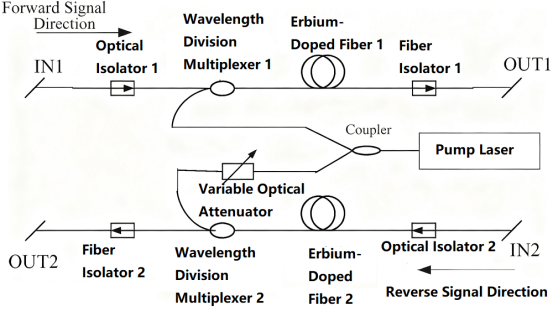
- High-Power Source Systems: When using high-power optical amplifiers like EDFAs (Erbium-Doped Fiber Amplifiers) or lasers.
PON Networks: In Fiber-to-the-Home (FTTH) networks, the OLT (Optical Line Terminal) receives signals from ONUs (Optical Network Units) at varying distances. The signal from the nearest ONU can be excessively strong.