
Optical Circulator Applications
https://www.feiyi-oeo.com/product-category/polarization-maintaining/pm-circulator
An optical circulator is a multi-port, non-reciprocal optical device. Its typical structure consists of N ports (where N ≥ 3), as shown in Figure 1. When light is injected into Port 1, it is directed to Port 2 with minimal loss, while virtually no light exits from the remaining ports. As illustrated in Figure 1, light entering Port 2 is similarly routed to Port 3 with negligible loss, and this pattern continues for subsequent ports, forming a continuous unidirectional channel.
Strictly speaking, a device is termed a circulator if light entering the final port (Port N) can exit from Port 1, completing the cycle. If this is not possible, the device is more accurately called an optical isolator or a quasi-circulator. In common practice, however, the distinction is often relaxed, and both types are generally referred to as circulators.
The non-reciprocal nature of optical circulators makes them critical components in bidirectional communication systems, where they effectively separate forward and backward propagating optical signals. Key applications in optical communications include:
- Single-Fiber Bidirectional Communication
- Optical Add-Drop Multiplexing (OADM)
- Signal Combining/De-multiplexing
- Dispersion Compensation


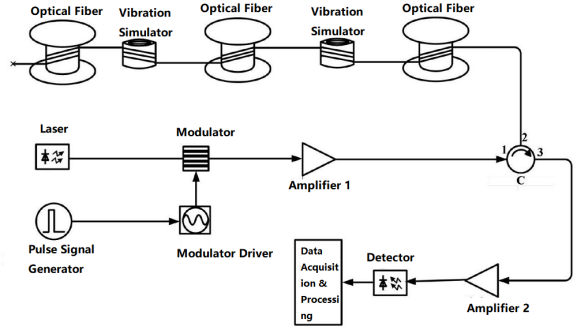
The key technical specifications for an optical circulator include insertion loss, isolation, crosstalk, polarization-dependent loss (PDL), polarization mode dispersion (PMD), and return loss.
The definitions of insertion loss, isolation, PDL, and PMD for an optical circulator are essentially the same as those for an optical isolator. However, for a circulator, these specifications always refer to the performance between two specific adjacent ports. For example, the insertion loss, PDL, and PMD are measured for the path from Port 1 to Port 2, or from Port 2 to Port 3, and so on.
Crosstalk in an optical circulator is defined as the power, expressed in dB, received between two non-adjacent ports where theoretically no signal should be present, but which occurs in practice due to various non-ideal effects. For instance, it is the ratio (in dB) of the power measured at Port 3 to the input power at Port 1 when light is injected into Port 1.