
Maximizing Optical Network Performance with Advanced Arrayed Waveguide Grating (AWG) Solutions
https://www.feiyi-oeo.com/product-category/passive-device/wdm/arrayed-waveguide-grating
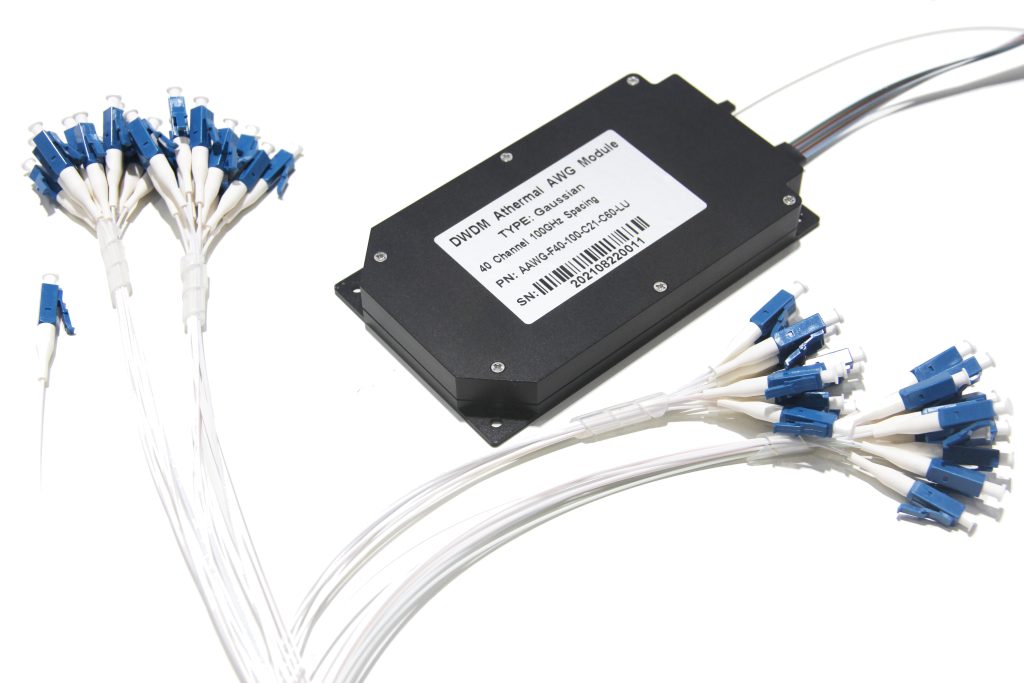
In the demanding landscape of modern optical networks, the efficiency of wavelength management is paramount. As a cornerstone of Dense Wavelength Division Multiplexing (DWDM) technology, the Arrayed Waveguide Grating (AWG) is the critical passive component that enables the multiplexing and demultiplexing of high-density optical channels. The evolution towards more compact, stable, and scalable networks has driven the need for advanced AWG modules that deliver reliability without compromise. Leading manufacturers like Feiyi Optoelectronic are at the forefront of this evolution, offering a comprehensive suite of athermal AWG solutions designed to meet the diverse needs of telecommunications, metro, and access networks.
A Closer Look at a Modern AWG Product Portfolio
Feiyi Optoelectronic’s product line demonstrates a clear commitment to covering the essential requirements of modern WDM systems. Their offerings are characterized by high integration, high reliability, and the crucial advantage of athermal (heatless) operation, which eliminates the need for external power-consuming temperature control. Below is a summary of their featured AWG modules:
| Product Model | Channel Count | Channel Spacing | Key Band | Primary Applications |
|---|---|---|---|---|
| 17-CH Athermal AWG | 17 | 150 GHz | O-band | WDM Networks, Access Networks |
| 40-CH Athermal AWG | 40 | 100 GHz | C-band | DWDM Transmission, Optical Add-Drop |
| 40CH/48CH AWG Module | 40 or 48 | 100 GHz (Implied) | C-band | DWDM Dense Wavelength Division Networks |
| 48-CH Athermal AWG | 48 | 100 GHz | C-band | DWDM Transmission, Wavelength Routing |
| 96-CH Athermal AWG | 96 | 50 GHz | C-band | High-Density WDM, Telecom Backbone |
Core Technical Advantages:
- Athermal Design: All featured modules provide excellent thermal stability, ensuring consistent wavelength accuracy and performance across varying environmental conditions without external control.
- High Performance: They are engineered for low insertion loss and high channel isolation, which are critical metrics for maintaining signal integrity and minimizing crosstalk in dense systems.
- Reliability & Compactness: The robust, integrated planar lightwave circuit (PLC) design ensures long-term, stable operation in demanding network environments while saving valuable space.
Selecting the Right AWG for Your Application
Choosing the correct AWG configuration is key to optimizing both performance and cost-efficiency in a network design.
- For Metro and Access Networks: The 17-CH 150GHz AWG operating in the O-band is an ideal, cost-effective solution for applications requiring a moderate number of channels.
- For Standard DWDM Systems: The 40-CH and 48-CH 100GHz modules represent the industry workhorse for core DWDM applications, balancing high channel count with proven 100GHz spacing technology for metro and regional networks.
- For Maximum Fiber Capacity: When spectral efficiency is the ultimate priority, the 96-CH 50GHz AWG doubles the channel density, allowing the highest possible data throughput on a single fiber strand, making it essential for backbone and long-haul networks.
A significant value proposition offered by Feiyi Optoelectronic is their emphasis on customization. As noted in their product descriptions, parameters such as package type, connector style (e.g., LC/PC, SC/APC), fiber type, spectral profile, and fiber length can often be tailored to meet specific system integration requirements.
Conclusion: Enabling the Future of Connectivity
The advancement of AWG technology from laboratory components to robust, athermal commercial modules has been instrumental in scaling global network capacity. By offering a scalable product range from 17 to 96 channels, manufacturers like Feiyi Optoelectronic provide network architects with the critical building blocks needed for future-proof infrastructure. Whether for expanding current DWDM systems or deploying next-generation high-capacity links, investing in high-performance, reliable AWG solutions is a fundamental step toward ensuring scalable, efficient, and resilient optical connectivity.