
Precision Light Control: The MEMS VOA for Advanced Optical Networks
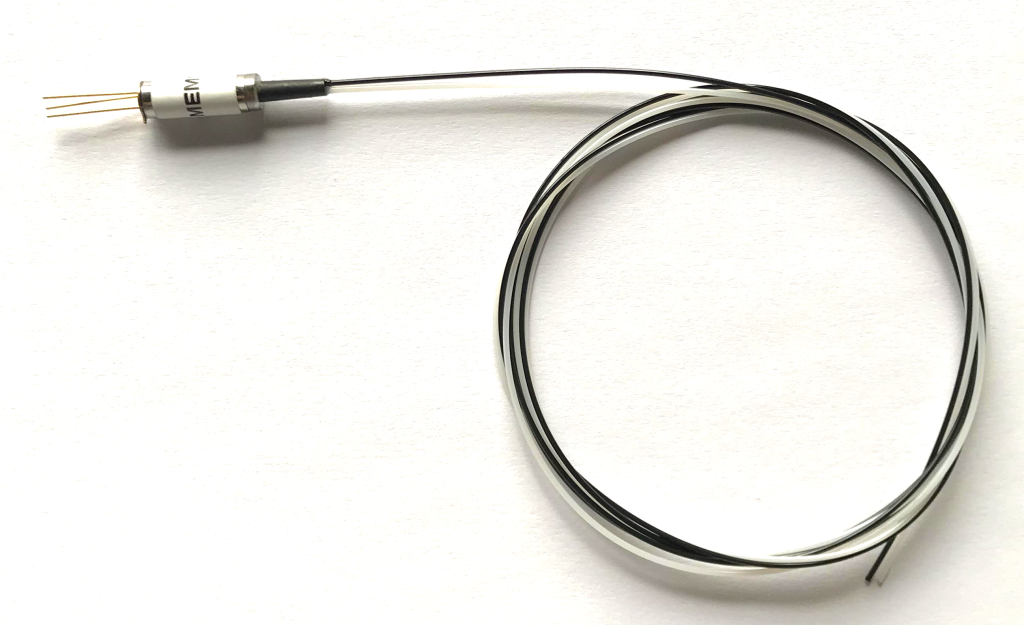
In the dynamic world of optical communication, managing signal power with precision and reliability is paramount. The MEMS-based Variable Optical Attenuator (VOA) stands as a critical component in this endeavor, offering engineers a powerful tool for optimizing network performance. As exemplified by the model from Feiyi OEO, this device leverages cutting-edge Micro-Electro-Mechanical Systems (MEMS) technology to provide unmatched control over light, ensuring signals are perfectly balanced from transmitter to receiver.
Core Principle: The Micro-Mirror at Work
At the heart of this VOA is a tiny, precisely fabricated MEMS mirror. The fundamental principle is elegant: light from an input optical fiber is collimated and directed toward this microscopic mirror. By applying a controlled electrical voltage, the mirror tilts or moves with extreme accuracy. This subtle movement deflects the light beam, controlling how much of it couples into the output fiber. A slight tilt results in minimal attenuation, while a greater tilt scatters more light away, achieving high levels of attenuation. This “free-space” steering mechanism enables continuous, highly precise, and rapid adjustment of optical power, forming the basis for the device’s exceptional performance.
Key Features and Technical Excellence
The featured MEMS VOA is engineered for robustness and high performance in demanding environments:
- Superior Optical Performance: It boasts a very low insertion loss of ≤0.7 dB, ensuring minimal signal strength reduction when attenuation is low. It offers a wide attenuation range of up to ≥30 dB (≥40 dB in Dark/blocking state), capable of handling everything from fine-tuning to complete channel blocking.
- Stability and Speed: Critical for real-time network management, it features a fast response time of ≤2 ms and low polarization-dependent loss (PDL), meaning its performance is consistent regardless of the light’s polarization state. It also maintains stability across a wide operating temperature range of -5 to +65°C.
- Dual-Configuration Flexibility: The device is available in both Bright (default pass-through) and Dark (default blocked) configurations, providing design flexibility for different system fail-safe requirements.
Diverse Applications in Modern Networks
This versatility makes the MEMS VOA indispensable across multiple domains of optical networking:
- Dynamic Channel Management: In OADM/ROADM (Optical Add-Drop Multiplexer) systems, it is crucial for dynamically equalizing power levels between different wavelength channels, preventing some signals from overpowering others.
- Amplifier Control: It plays a key role in EDFA (Erbium-Doped Fiber Amplifier) gain-tilt control, flattening the amplifier’s output across the C-band to ensure uniform channel performance.
- System Protection: It acts as a receiver protector, dynamically attenuating powerful incoming signals to prevent damage to sensitive detection components.
- Power Equalization: Within VMUX and line systems, it ensures optimal signal power for modulation and transmission, maximizing signal integrity and reach.
Customization and Ordering
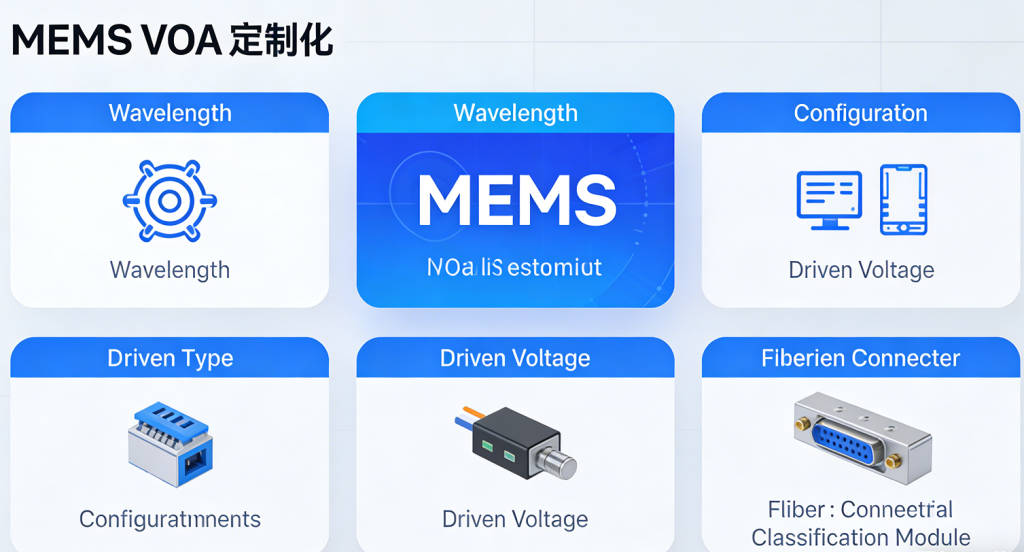
Understanding that no two network designs are identical, this MEMS VOA is offered with extensive customization options. As detailed in the ordering information, engineers can specify:
- Wavelength: 850nm, 1064nm, 1310nm (O-band), or 1550nm (C/L-band).
- Attenuation Type: Bright (B) or Dark (D) configuration.
- Drive Voltage: 5V or 15V options.
- Fiber and Connector: Choices include SMF-28 or G657 fiber, various pigtail lengths, and connector types like FC, SC, or LC with UPC/APC polish.
Conclusion
The MEMS VOA is more than just an attenuator; it is a precision instrument for light. By translating electrical commands into ultra-fine optical adjustments, it provides the essential functionality needed to build stable, efficient, and intelligent optical networks. For system designers aiming to master channel power, protect valuable components, and ensure seamless data flow, integrating a high-performance MEMS VOA like this one is a clear step toward achieving optimal network performance and future-ready scalability.