Demystifying Optical Transceivers: Your Gateway to High-Speed Data Networks
In the digital age, where data flows like water, the infrastructure that carries this information is built on light. At the heart of every modern data center, telecommunications network, and high-speed enterprise link lies a critical, yet often overlooked, component: the optical transceiver. This compact, hot-pluggable module is the essential translator between the electronic world of servers and switches and the optical realm of fiber optic cables. As bandwidth demands skyrocket, choosing the right transceiver becomes paramount for building a network that is not only fast but also reliable, scalable, and cost-effective.
This article explores the key types, technologies, and selection criteria for optical transceivers, providing a clear guide to navigating this complex landscape.
What is an Optical Transceiver?
An optical transceiver is a single, integrated module that performs two core functions: it transmits (Tx) and receives (Rx) optical signals. On the transmit side, it converts incoming electrical data signals into modulated light pulses. On the receive side, it performs the reverse operation, detecting light pulses and converting them back into precise electrical signals for network equipment to process.
By combining these functions into one standardized form factor, transceivers allow network engineers to easily customize and upgrade port capabilities on switches, routers, and servers without replacing entire chassis.
Key Types and Form Factors
Our portfolio showcases the evolution and diversity of transceiver technology, designed to meet specific needs for speed, distance, and density. Below is a comparison of the primary transceiver families:
| Form Factor | Common Data Rates | Key Features | Typical Applications |
|---|---|---|---|
| SFP (Small Form-Factor Pluggable) | 155M to 4.25Gbps (1.25G/2.5G common) | Compact, widely adopted, supports CWDM/DWDM. | Switch-to-switch links, Fiber Channel, router interfaces. |
| SFP+ (Enhanced SFP) | 10Gbps, 25Gbps | Same size as SFP but for higher speeds, low power (<1.5W). | 10GBASE/25GBASE Ethernet, Data Center Interconnects. |
| XFP (10 Gigabit Small Form Factor Pluggable) | 9.95G to 11.3Gbps | Slightly larger legacy form factor for 10G, often with robust optics. | 10G Metro & Long-Haul DWDM/CWDM networks. |
Critical Technology: WDM (Wavelength Division Multiplexing)
Beyond form factors, transceivers are defined by their wavelength technology, which dramatically increases fiber capacity.
https://www.feiyi-oeo.com/product-category/active-device/transceiver
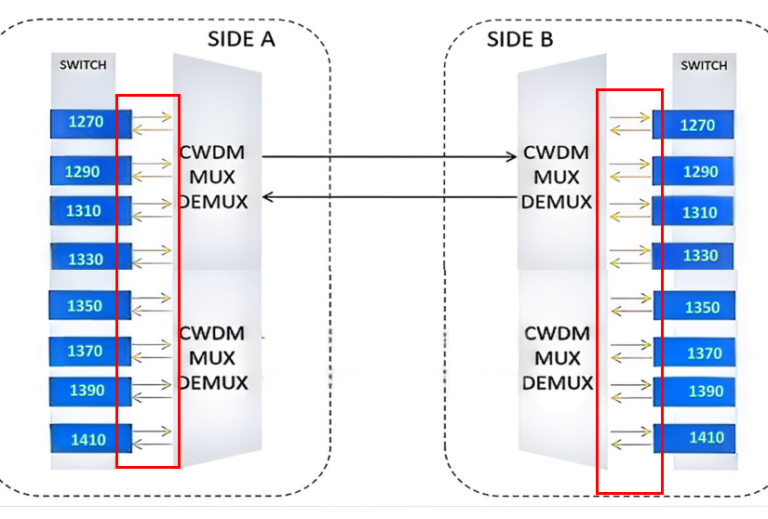
- CWDM (Coarse WDM): Uses widely spaced wavelengths (e.g., 1270nm, 1290nm…1610nm). 10G CWDM SFP+ modules are a cost-effective solution for boosting capacity in metro and access networks up to 80km.
- DWDM (Dense WDM): Uses tightly spaced channels on the ITU grid (e.g., 100GHz spacing). 10G DWDM SFP+ and XFP+ transceivers are designed for high-capacity, long-haul transmission up to 80km, maximizing the utility of every fiber strand.
Essential Specifications and What They Mean
When selecting a transceiver, understanding these key parameters is crucial:
- Data Rate & Protocol Compliance: This must match your switch port and application. For example, our 25G 1310nm SFP+ complies with IEEE 802.3ae for 25G Ethernet, while our 1.25G/2.5G DWDM SFP supports SONET/SDH and Fiber Channel protocols.
- Wavelength & Reach: The operating wavelength (e.g., 1310nm, 1550nm, or a specific DWDM channel) and its maximum transmission distance (10km, 40km, 80km, 120km) define the module’s use case. Longer reaches typically require more sophisticated, cooled lasers.
- Digital Diagnostic Monitoring (DDM / DOM): This is a vital feature for modern network management. DDM provides real-time monitoring of transceiver temperature, optical power (transmit and receive), laser bias current, and supply voltage, enabling proactive maintenance and troubleshooting.
- Temperature Range: Commercial-grade modules (0°C to +70°C) suit controlled data centers. For harsh environments like industrial settings or outdoor cabinets, industrial-grade transceivers (operating from -40°C to +85°C) are essential for reliable performance.
- Power Consumption & Supply: As network density grows, lower power consumption (like the <1.5W of our SFP+ modules) reduces operating costs and thermal load. Compatibility with standard power supplies (+3.3V) is also key.
Core Applications Across Industries
The right transceiver enables a multitude of critical networking functions:
- Data Center Interconnects (DCI): High-density 10G/25G SFP+ modules provide the backbone for server-to-leaf and leaf-to-spine connectivity, forming the fabric of cloud infrastructure.
- Metro & Long-Haul Telecommunications: DWDM SFP+ and XFP+ transceivers are the workhorses of service provider networks, carrying aggregated traffic across cities and countries over a single fiber pair.
- Enterprise Networking: CWDM SFP modules offer a budget-friendly way for campuses and large enterprises to add bandwidth without laying new fiber.
- Specialized Storage & Media Networks: Protocols like Fiber Channel rely on specific 1.25G/2.5G/10G transceivers for reliable, low-latency storage area network (SAN) connectivity.
Making the Right Choice: A Quick Guide
Selecting a transceiver involves more than just matching speed and wavelength. Consider this checklist:
- Compatibility: Ensure MSA (Multi-Source Agreement) compliance with your network equipment vendor.
- Future-Proofing: Consider slightly higher reach or DWDM capability for future network growth.
- Total Cost of Ownership: Factor in power consumption, cooling needs, and management capabilities, not just the upfront price.
- Supplier Reliability: Choose a vendor that provides consistent quality, clear specifications, and robust technical support.
Conclusion: The Strategic Network Component
Optical transceivers are far more than simple commodities; they are strategic components that define the performance, capacity, and agility of your entire network. From enabling cost-effective capacity upgrades with CWDM technology to building resilient, high-capacity DWDM backbones, the right transceiver portfolio is a key investment.
Whether you are designing a new data center fabric, expanding a metropolitan network, or upgrading an enterprise backbone, understanding the nuances of form factor, wavelength technology, and critical specifications is the first step toward a successful deployment. By making informed choices, you build a network that is ready for the demands of today and scalable for the innovations of tomorrow.