
FWDM Explained: How Filter Wavelength Division Multiplexing Enables Modern Fiber Optic Networks
Introduction: Maximizing Fiber Capacity with FWDM Technology
The demand for higher bandwidth continues to accelerate as cloud computing, AI infrastructure, data centers, 5G networks, and fiber-based communication systems expand worldwide.
For network operators and system designers, increasing capacity does not always mean deploying more fiber. A more efficient approach is to maximize the value of existing fiber infrastructure through advanced wavelength management technologies.
Filter Wavelength Division Multiplexing (FWDM) is one of the key passive optical technologies enabling this approach. By combining or separating multiple optical wavelengths within a single fiber, FWDM modules help improve network efficiency while maintaining low cost, high reliability, and long-term stability.
With compact packaging, low insertion loss, and no requirement for electrical power, FWDM has become an essential component in applications such as FTTH networks, optical amplifiers, fiber lasers, sensing systems, and wavelength management solutions.
What Is FWDM and How Does It Work?
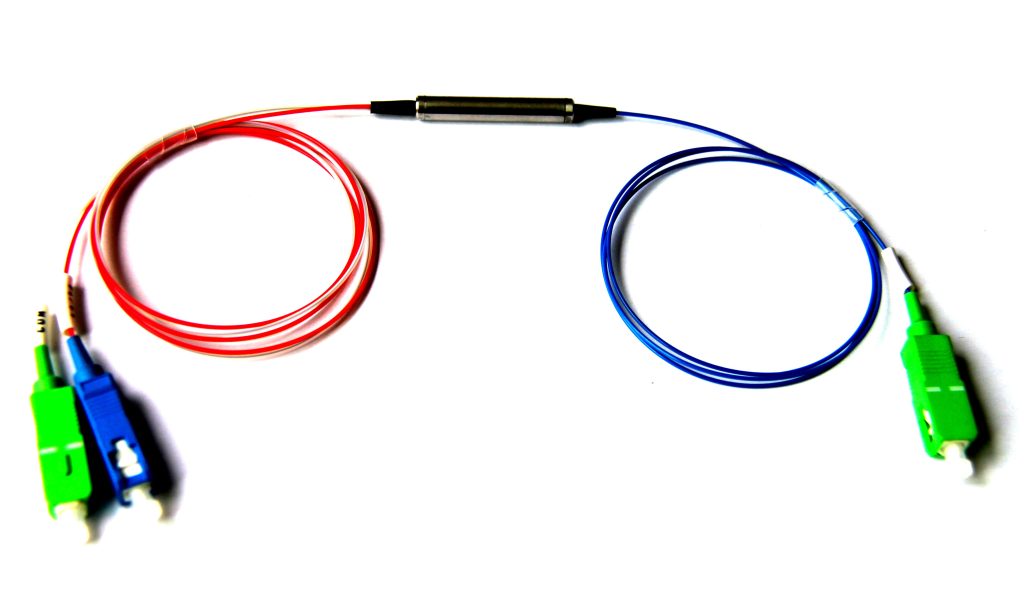
FWDM (Filter Wavelength Division Multiplexing) is a passive optical device that uses thin-film filter technology to separate or combine specific wavelengths.
Unlike active optical components, FWDM operates without external power, making it highly reliable for long-term network deployment.
A typical FWDM module includes three optical ports:
- Common Port
- Pass Port
- Reflect Port
Specific wavelengths pass through the filter, while other wavelengths are reflected to another optical path. This allows multiple optical signals to share the same fiber while maintaining independent transmission channels.
The main advantages of FWDM include:
- Low insertion loss
- High wavelength isolation
- Excellent temperature stability
- Compact and reliable packaging
- Passive operation without power consumption
Modern thin-film filter technology enables FWDM devices to achieve insertion loss levels below 1 dB and channel isolation above 30 dB, making them suitable for demanding optical communication environments.
Key Applications of FWDM
FWDM technology is widely used across different optical systems, including:
1. EDFA Optical Amplifier Systems
In fiber amplifiers, FWDM modules are used to separate pump wavelengths (980 nm or 1480 nm) from signal wavelengths around 1550 nm.
They provide efficient wavelength management with:
- Low optical loss
- High isolation
- Stable performance
This helps improve amplifier efficiency and overall transmission reliability.
2. FTTH and PON Networks
In fiber access networks, FWDM enables multiple services to share the same fiber infrastructure.
Typical applications include:
- 1310 nm upstream signals
- 1490 nm downstream signals
- 1550 nm CATV video signals
By combining different wavelengths, operators can deliver voice, video, and data services through a single fiber connection.
3. Fiber Laser and Sensing Systems
For applications requiring polarization control and high precision, polarization-maintaining FWDM modules provide stable wavelength separation while preserving polarization characteristics.
They are commonly used in:
- Fiber optic gyroscopes
- Coherent detection systems
- Fiber lasers
- Optical sensing equipment
Feiyi FWDM Solutions: Designed for Telecom and Specialty Applications
At Shenzhen Feiyi Optoelectronic Communication Co., Ltd., we provide customized FWDM solutions for telecom operators, system integrators, and optical equipment manufacturers.
Our FWDM portfolio includes:
- Polarization Maintaining FWDM moduleshttps://www.feiyi-oeo.com/product/polarization-maintaining-filter-wdm/
- 980/1550 nm and 1480/1550 nm FWDM moduleshttps://www.feiyi-oeo.com/product/3-ports-fwdm%ef%bc%88980155014801550nm%ef%bc%89/
- 3-port FWDM modules for FTTH and CATV applicationshttps://www.feiyi-oeo.com/product/3-port-fwdm-device/
All products are designed with:
- Low insertion loss
- High channel isolation
- Compact package options
- Flexible wavelength configurations
- OEM customization capability