Beyond Attenuation Range: 3 Critical Parameters Engineers Must Evaluate When Selecting a PM VOA
In the design of polarization-sensitive optical systems—such as high-precision fiber sensing, quantum key distribution (QKDS), or coherent optical communications—the Polarization-Maintaining Variable Optical Attenuator (PM VOA) is not merely a power regulator but a key guardian of signal integrity. While attenuation range and resolution are often the primary specifications considered, focusing solely on them can lead to overlooked system penalties. For engineers aiming to optimize performance, three additional parameters are paramount: Polarization-Dependent Loss (PDL), Wavelength-Dependent Loss (WDL), and Response Time.
This article provides a concise guide to these critical, yet sometimes underestimated, specifications.
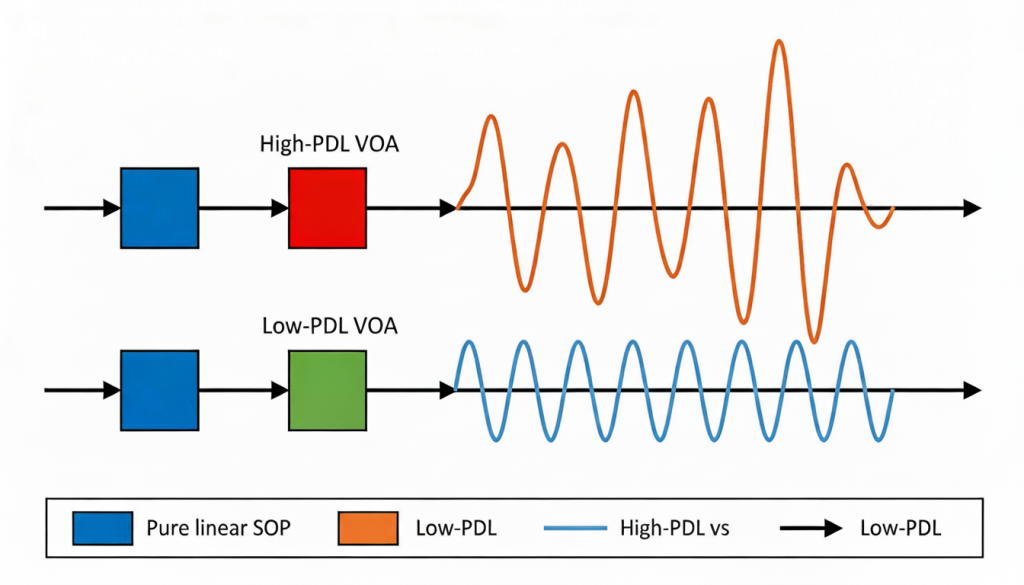
1. Polarization-Dependent Loss (PDL): The Guardian of Polarization Extinction Ratio (PER)
What it is: PDL is the maximum variation in insertion loss that occurs when the state of polarization (SOP) of the input light changes through all possible states. In a PM VOA, low PDL is non-negotiable.
Why it matters: The core function of a PM component is to preserve the linearly polarized light injected into its principal axis. A high PDL in the VOA directly degrades the system’s overall Polarization Extinction Ratio (PER), introducing unwanted polarization noise and crosstalk. This can severely impact the signal-to-noise ratio in sensing systems or increase the bit error rate in communication links.
- System Impact: A PM VOA with poor PDL can become the weakest link, nullifying the benefits of high-PER fibers and other components in the chain.
- Key Question for Suppliers: “What is the guaranteed maximum PDL across the entire attenuation range and operating wavelength?” A quality PM VOA will maintain consistently low PDL (<0.3 dB is typical for high-grade devices) at all attenuation settings.
2. Wavelength-Dependent Loss (WDL): Ensuring Flat Attenuation Across the Band
What it is: WDL is the variation in insertion loss across the specified operating wavelength band (e.g., 1550 nm ± 40 nm) at a fixed attenuation setting.
Why it matters: Real-world optical signals often have a finite spectral width. A VOA with high WDL will attenuate different spectral components unequally, leading to signal distortion. This is especially critical in dense wavelength-division multiplexing (DWDM) systems or when using broadband sources.
- System Impact: Poor WDL can cause spectral tilting, degrading channel uniformity in multi-wavelength systems and impairing the performance of amplitude-sensitive detection schemes.
- Key Question for Suppliers: “What is the WDL specification across my target wavelength window (e.g., C-band) for a typical attenuation setting?” Look for devices engineered for minimal spectral variation.
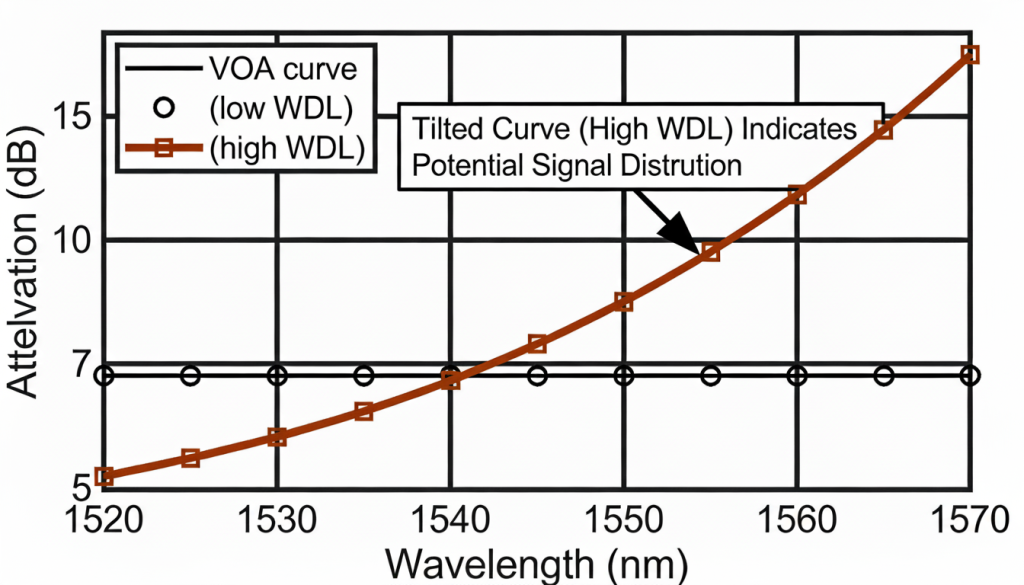
Flat attenuation curve (low WDL) vs. tilted curve (high WDL) across the C-band
3. Response Time: The Dynamics of Control
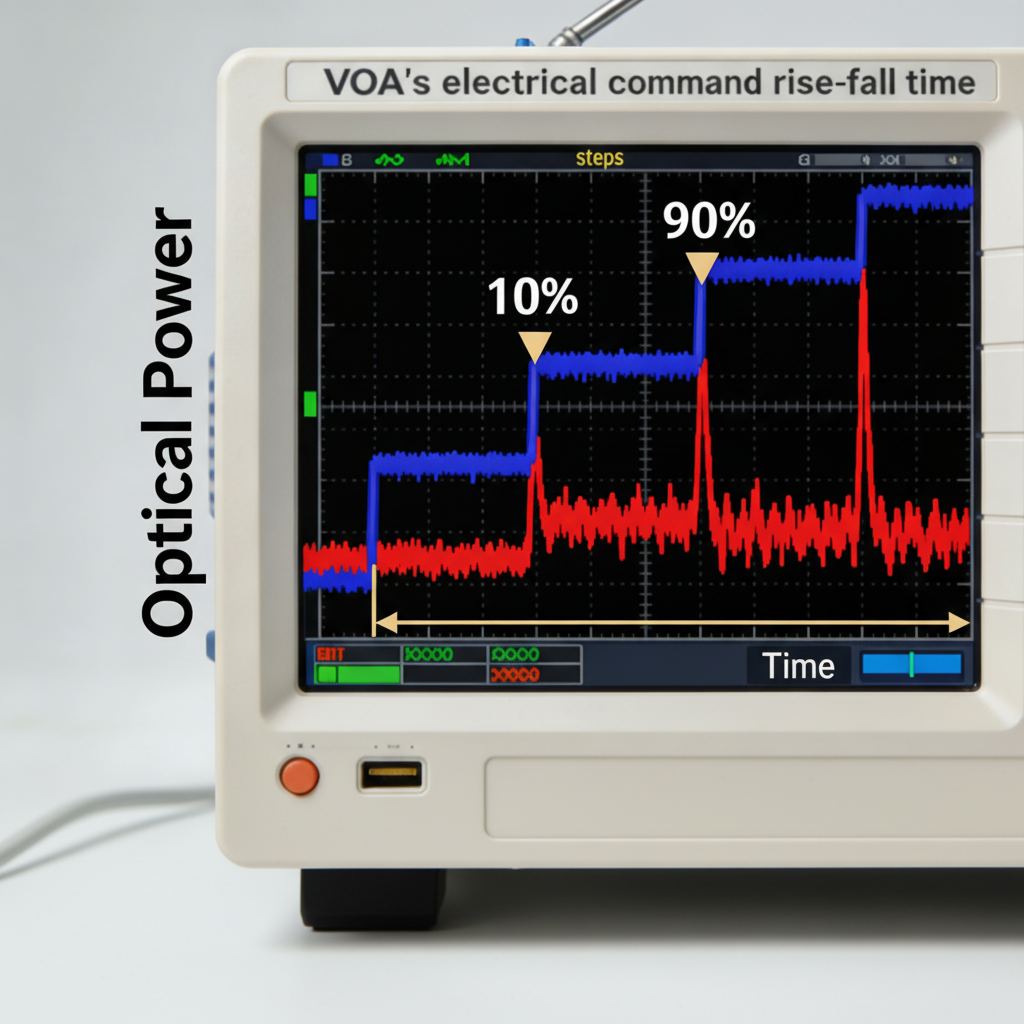
What it is: Response Time defines the speed at which the VOA can transition from one attenuation level to another. It is typically defined as the time to transition from 10% to 90% of the target value (or vice versa).
Why it matters: This parameter dictates how quickly your system can adapt to dynamic changes. It is crucial for applications like automatic power control (APC) loops, optical switching protection, or any scenario where attenuation needs to be modulated.
- System Impact: A response time slower than the system’s required control bandwidth can lead to instability, overshoot, or failure to track changes effectively. For static attenuation settings, this is less critical.
- Key Question for Suppliers: “What is the typical step response time (e.g., for a 10 dB change)? Are there differences between increasing and decreasing attenuation?” Specifications in the millisecond (ms) to sub-millisecond range are common for quality VOAs.
Conclusion: A Holistic Specification Review
Selecting the optimal PM VOA requires a holistic view that balances core performance (attenuation range, accuracy, low insertion loss) with these three critical fidelity and dynamic parameters: Low PDL to preserve polarization integrity, Low WDL to maintain spectral fidelity, and an Appropriate Response Time for your system’s dynamics.
At Shenzhen Feiyi Optoelectronic Communication Co., Ltd., we engineer our PM VOA products with these system-level challenges in mind. Our devices are characterized for consistent, low PDL and WDL across their full operating range, ensuring they integrate seamlessly into your most demanding polarization-sensitive applications.
Ready to specify the right PM VOA for your system?
Visit our product page for detailed datasheets or contact our engineering team for a technical consultation: https://www.feiyi-oeo.com
Disclaimer: The performance parameters discussed are general critical factors. Specific system requirements should always be verified with detailed component specifications and direct communication with the component supplier.