Crafting Precision: The Journey of a Passive Optical Component from Design to Delivery
Every fiber optic network, every laser system, every quantum experiment relies on passive optical components. Yet for most engineers, these components arrive as finished products—small, sealed packages with fiber pigtails, ready for integration. What happens before they reach your workbench? The journey from raw materials to a reliable, high-performance component is a story of precision engineering, rigorous testing, and meticulous craftsmanship.
This article takes you behind the scenes at Feiyi-OEO, tracing the lifecycle of a passive optical component from initial concept through final delivery, and revealing the expertise embedded in every device we ship.
Phase 1: Concept and Design
Understanding the Requirement
Every component begins with a need. A customer designing a fiber optic gyroscope requires a PM circulator with 30 dB extinction ratio and 0.7 dB loss. A data center architect needs a 96-channel athermal AWG for C-band DWDM. A quantum researcher seeks an ultra-high-ER isolator for single-photon experiments.
Our engineering team starts by translating these requirements into technical specifications:
- Optical Performance: Insertion loss, isolation, extinction ratio, PDL, bandwidth
- Environmental Range: Operating temperature, humidity, mechanical stress
- Physical Constraints: Package dimensions, fiber length, connector type
- Reliability Target: Telcordia compliance, lifetime expectation, power handling
Simulation and Modeling
Before any glass is cut, our designers use advanced software to model performance:
- Thin-Film Design: For filter-based components, we simulate layer stacks to achieve target spectral response with minimal ripple and maximum isolation.
- Optical Path Modeling: Ray tracing and beam propagation models verify that micro-optic designs will achieve low loss and high stability.
- Thermal Analysis: Finite element analysis predicts how materials will expand and contract, ensuring alignment across temperature.
- Tolerance Analysis: We model the impact of manufacturing variations, ensuring designs are robust enough for volume production.
Material Selection
Performance begins with materials. Our procurement team sources:
- Optical Substrates: Glass, crystals, and silicon wafers with verified purity and uniformity
- Thin-Film Materials: High-purity Ta₂O₅, SiO₂, and other dielectrics for coating
- PM Fiber: Panda or bow-tie fiber from qualified suppliers, with verified beat length and attenuation
- Packaging Materials: Metals and ceramics with matched CTE for thermal stability
- Magnetic Materials: For isolators and circulators, YIG and permanent magnets with consistent properties
Every material lot is inspected and qualified before entering production.
Phase 2: Manufacturing
Thin-Film Coating
For filter-based components, the journey begins in our coating chambers. Substrates are meticulously cleaned and loaded into vacuum deposition systems. Using ion-assisted deposition, we apply dozens of alternating high and low refractive index layers:
- Layer Thickness Control: Each layer is monitored optically during deposition, with thickness controlled to within a few nanometers
- Uniformity: Rotating fixtures ensure coating thickness variation below 0.1% across the substrate
- Adhesion: Ion bombardment creates dense, stable films that resist environmental degradation
After coating, filters are tested for spectral performance. Only those meeting strict criteria proceed.
Chip Fabrication (for AWGs)
AWG manufacturing follows semiconductor-like processes:
- Deposition: Silica layers are deposited on silicon wafers using flame hydrolysis or CVD
- Photolithography: Waveguide patterns are transferred using precision masks and UV exposure
- Etching: Reactive ion etching creates waveguides with smooth, vertical sidewalls
- Cladding: A top cladding layer completes the waveguide structure
- Dicing: Individual chips are separated from the wafer
Our AWG chips undergo extensive optical testing before assembly.
Micro-Optics Assembly
With filters and crystals ready, assembly begins. This is where precision mechanics meets optical expertise:
Active Alignment:
Components are mounted on multi-axis stages with nanometer resolution. While monitoring optical power in real-time, operators or automated systems position each element for maximum transmission. For PM components, polarization alignment adds another dimension—the fiber’s slow axis must be rotated to match the component’s internal polarization.
Epoxy-Free Bonding:
Traditional assembly uses epoxy to secure components, but epoxy introduces failure risks. Our proprietary non-flux metal bonding replaces adhesives with metallic joints created by laser welding or soldering. Benefits include:
- No outgassing or aging
- Matched CTE for thermal stability
- Higher power handling capability
- Telcordia-qualified reliability
Pigtailing:
Fibers are stripped, cleaved, and aligned to the optical path. For PM fibers, rotational alignment is verified using polarization analysis. The fiber is then secured—again, epoxy-free where the optical path is concerned.
Packaging
The assembled optical engine is housed in a protective package:
- Glass Tube Packages: For miniature components, hermetic glass tubes protect the optics while maintaining a small footprint
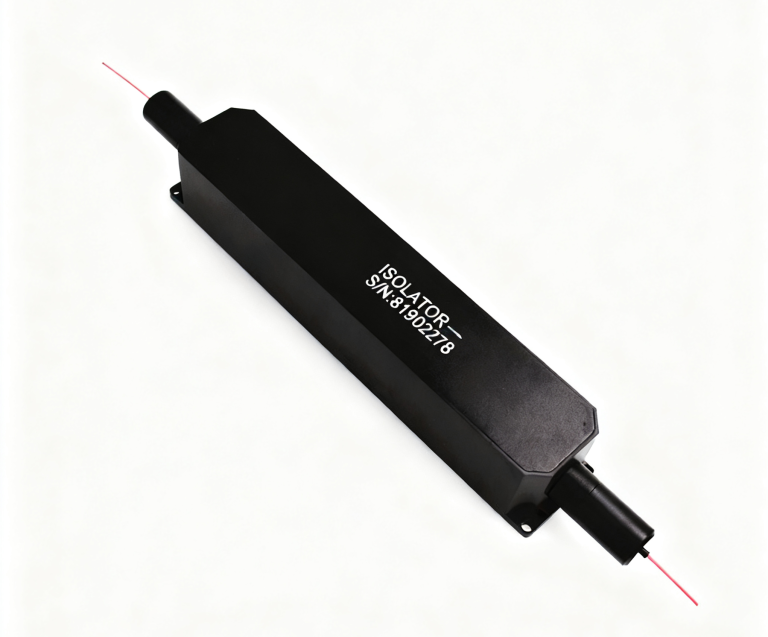
- Metal Box Packages: Rugged metal housings with strain-relieved fiber exits for demanding environments
- Rackmount Modules: Integrated assemblies for central office and data center deployment
Packages are sealed to protect against humidity and contamination, then labeled with serial numbers for traceability.
Phase 3: Testing and Qualification
100% Optical Testing
Every Feiyi-OEO component undergoes comprehensive optical testing before shipment:
| Parameter | Test Method | Acceptance Criteria |
|---|---|---|
| Insertion Loss | Cutback method or direct measurement | Per spec (e.g., ≤0.7 dB) |
| Return Loss | Optical backscatter reflectometer | ≥45 dB typical |
| Isolation | Spectral scanning with source/detector | Per spec (e.g., ≥50 dB) |
| PDL | Polarization controller + power meter | ≤0.1 dB typical |
| Extinction Ratio (PM) | Rotating polarizer method | Per spec (20–35 dB) |
| Spectral Response | OSA scan | Center wavelength, bandwidth, ripple |
Test data is recorded and stored, providing traceability for every component.
Environmental Qualification
Beyond production testing, sample components from each design undergo qualification per Telcordia GR-1221:
- Temperature Cycling: -40°C to +85°C, 100–500 cycles
- Damp Heat: 85°C/85% RH, 500–2000 hours
- Mechanical Shock: 500–1500 G, multiple axes
- Vibration: 10–2000 Hz sweep, 4 hours/axis
- Fiber Pull/Twist: Simulating installation stress
Components must maintain performance within specification throughout these tests. Passing qualification confirms that the design is ready for long-term deployment.
Power Handling Verification
For high-power applications, additional testing verifies capability:
- Burn-In: Components operate at rated power for extended periods
- Thermal Imaging: Identifying hot spots under load
- Transient Testing: Simulating power surges and interruptions
Our epoxy-free designs consistently demonstrate superior high-power performance.
Phase 4: Customization and Integration
Tailoring to Your Needs
No two systems are identical. Feiyi-OEO’s strength lies in our ability to customize:
- Wavelength: Any ITU grid channel or custom wavelength
- Fiber Type: SMF-28, PM980, PM1550, LMA, specialty
- Connector: FC, SC, LC, ST, MU, MTRJ, MPO/MTP, in UPC or APC polish
- Package: Glass tube, metal box, 1U rackmount, custom
- Length: 0.5m, 1.0m, 1.5m, or custom
- Environmental Rating: Commercial, industrial, extended
Our engineering team works directly with customers to develop application-specific solutions, from simple modifications to entirely new designs.
Integration Support
We don’t just ship components—we support your integration:
- Documentation: Detailed datasheets, mechanical drawings, and handling instructions
- Application Support: Technical guidance on splicing, connector care, and system integration
- Custom Testing: Additional tests for specific application requirements
- Qualification Assistance: Supporting your system-level qualification efforts
Phase 5: Delivery and Lifecycle Support
Packaging and Shipment
Components are packaged to survive transit:
- Individual Protection: Anti-static bags, foam-lined boxes
- Environmental Control: Desiccant for moisture-sensitive components
- Traceability: Serial numbers and test data included
Long-Term Availability
Optical systems operate for decades. Feiyi-OEO commits to:
- Product Longevity: Maintaining availability of standard products
- Obsolescence Management: Advance notice of any changes
- Repair and Replacement: Supporting fielded systems throughout their life
The Human Element: Expertise Behind Every Component
Behind the processes and equipment are people—250+ employees whose skills and dedication make Feiyi-OEO’s quality possible:
- Optical Engineers: Designing components that push performance limits
- Process Engineers: Developing and refining manufacturing techniques
- Technicians: Operating precision equipment with steady hands
- Quality Specialists: Inspecting and testing every component
- Application Engineers: Supporting customers with technical expertise
Many have been with the company for over a decade, accumulating knowledge that cannot be captured in any manual.
Conclusion: The Journey Matters
When you receive a Feiyi-OEO component, you are receiving the culmination of a journey—one that began with a design concept, passed through precision manufacturing, survived rigorous testing, and was customized to your needs. Every splice, every alignment, every test contributes to the reliability you depend on.
Understanding this journey matters because it reveals why quality cannot be assumed—it must be engineered, manufactured, and verified at every step. At Feiyi-OEO, we take pride in every stage of this journey, knowing that our components will enable your success.
The next time you specify a passive optical component, consider the journey behind it. And know that Feiyi-OEO’s journey delivers reliability you can count on.