
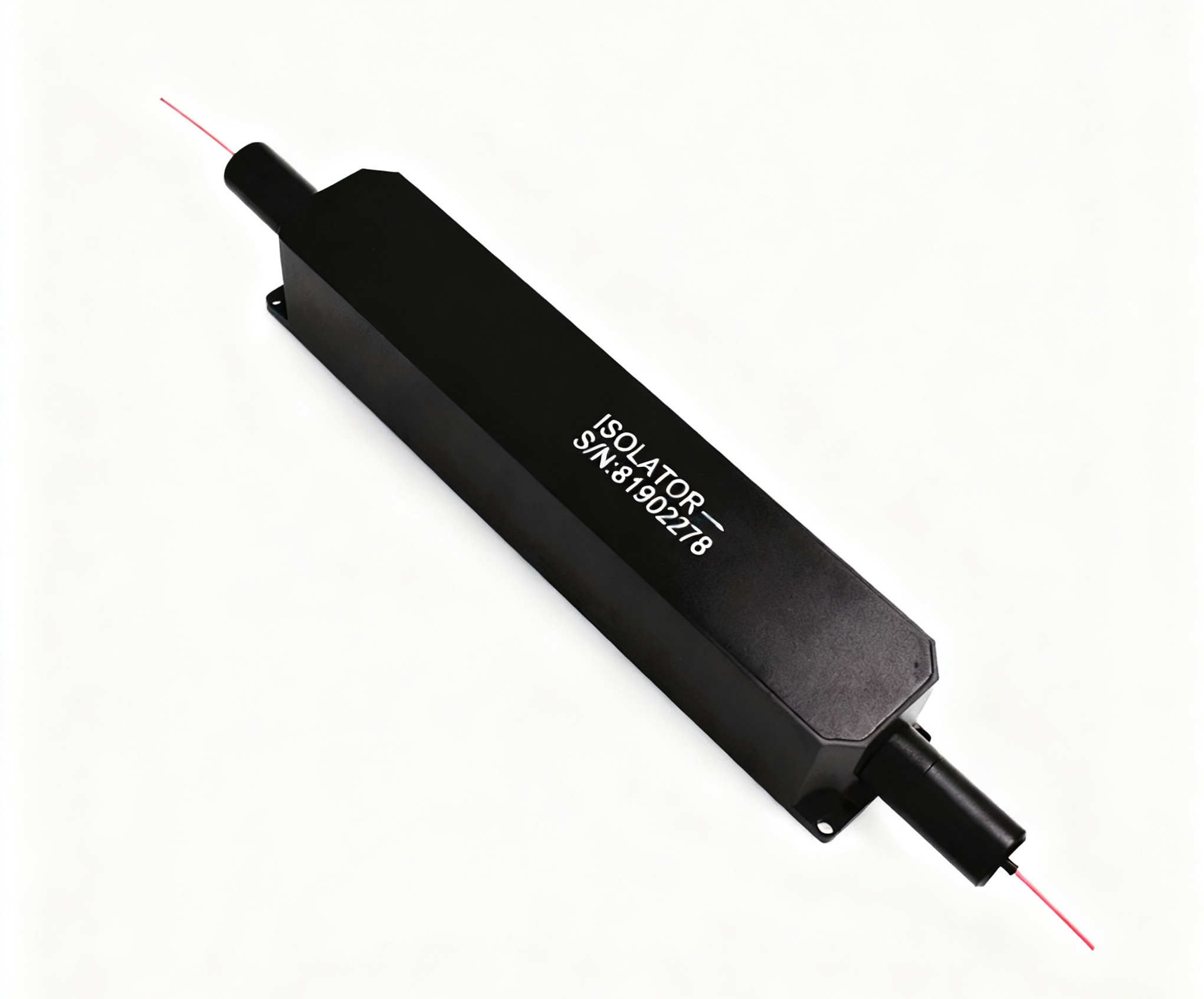
High-Performance Optical Isolation at 980 nm: A Critical Component for Advanced Photonic Systems
Abstract
The PM 980nm High-Power Optical Isolator, engineered with Terbium Gallium Garnet (TGG) crystal technology, represents a pivotal advancement in optical component design for high-power, precision photonic systems. Operating at a wavelength of 980±5 nm, this device delivers exceptional isolation (>50 dB), minimal insertion loss (<1.2 dB), and robust power handling up to 100W. This article details its operational principles, key performance parameters, and its indispensable role in applications ranging from industrial fiber lasers to sensitive test and measurement setups.
1. Introduction: The Critical Role of Optical Isolation
Optical isolators are non-reciprocal devices that function as “one-way streets” for light, allowing forward transmission while suppressing back-reflected light. This function is crucial in high-gain optical systems, where even minuscule back-reflections can cause instability, noise, spectral degradation, and catastrophic damage to sensitive components like pump laser diodes. The PM 980nm isolator is specifically optimized for systems operating in the 980 nm band, a key wavelength for pumping erbium-doped and ytterbium-doped fiber amplifiers and lasers. Its polarization-maintaining (PM) design and TGG-based Faraday rotator ensure reliable performance under demanding high-power conditions.
2. Core Technology and Performance Specifications
The device’s performance is anchored in its TGG crystal core and precision PM fiber alignment.
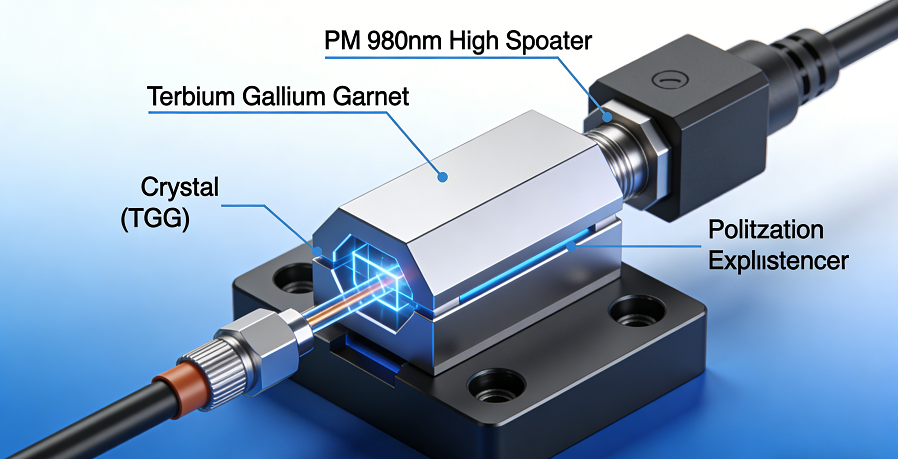
- TGG Crystal Core: TGG is the material of choice for high-power Faraday rotators due to its excellent Verdet constant, high thermal conductivity, and low absorption coefficient at near-infrared wavelengths. This enables efficient optical rotation and minimal thermal lensing effects at power levels up to 100W.
- Polarization Maintenance: The isolator is designed for “slow-axis operation with fast-axis cutoff” using PM1060 fiber. This ensures that only the desired polarization state is transmitted with high fidelity, characterized by a minimum extinction ratio of 20 dB. This is essential for systems where polarization state integrity is critical.
- Key Specifications: As detailed in the product data, the isolator achieves a typical isolation of 65 dB (minimum 50 dB) and a typical insertion loss of 0.8 dB. Other critical metrics include a high return loss of 45 dB and a low polarization-dependent loss (PDL) of 0.2 dB, ensuring signal integrity and minimal system impact.
3. Primary Applications in Photonic Systems
This isolator is engineered for stability and reliability in several critical high-performance applications.
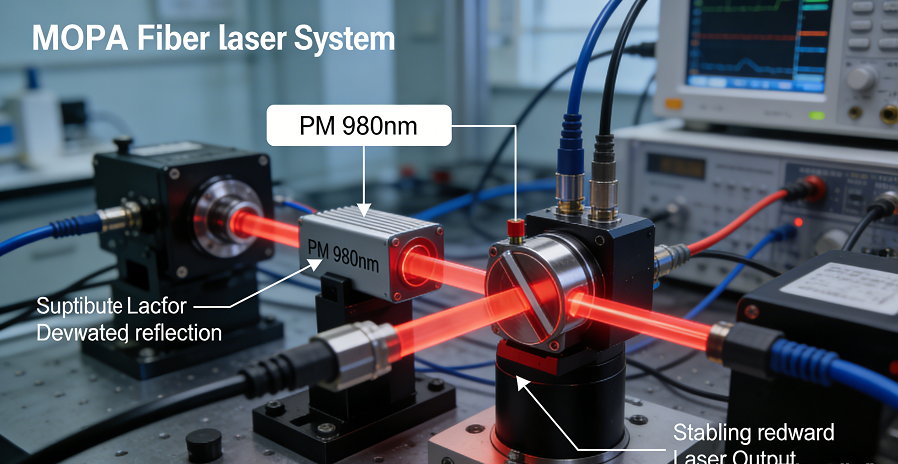
3.1 Master Oscillator Power Amplifier (MOPA) Fiber Lasers
In MOPA architectures, a low-power, high-quality seed laser is amplified through one or more stages. The 980nm isolator is strategically placed between amplification stages and at the system output. This prevents amplified spontaneous emission (ASE) and back-reflections from traveling backward, which would destabilize the seed oscillator, create feedback noise, and potentially damage the amplifier’s pump diodes. Its high isolation and power handling are essential for achieving clean, stable, high-power laser output.
3.2 Polarization-Maintaining (PM) Fiber Amplifiers
980 nm laser diodes are the primary pump source for erbium-doped fiber amplifiers (EDFAs) and ytterbium-doped fiber amplifiers (YDFAs). When integrated into the pump injection path of a PM amplifier, this isolator protects the pump diode from back-reflected light originating from splices, connectors, or the active fiber itself. This protection is vital for maximizing pump diode lifetime and ensuring consistent amplifier gain.
3.3 High-Power Fiber Laser Systems for Material Processing
Industrial fiber lasers for cutting, welding, and marking operate at kilowatt power levels, often using 980 nm pumps in their oscillator or amplifier stages. The PM 980nm isolator is used to stabilize the pump cavities and protect pump combiners. Its ability to handle high power (1-100W) and maintain performance over an operating temperature range of 10-50°C makes it suitable for the challenging thermal environments of industrial laser systems.

4. Secondary Applications in Precision and Test Environments
Beyond laser systems, the device’s precision is leveraged in other fields.
- CATV Fiberoptic Links: In analog broadcast systems, system noise figure and signal linearity are paramount. Isolators at optical amplifiers prevent back-reflections that degrade the Carrier-to-Noise Ratio (CNR) and create interfering interference patterns. The high return loss (45 dB) of this component is particularly beneficial here.
- Optical Test and Measurement Systems: In laboratory setups for characterizing components or fibers, optical isolators are used to stabilize source lasers. By eliminating feedback into the tunable laser source (TLS) or laser diode under test, the isolator ensures accurate, repeatable measurements of insertion loss, return loss, and spectral characteristics.
5. Integration and Customization
A significant practical advantage of this component is its configurable design, which facilitates seamless integration into diverse system architectures. As indicated in the ordering information, engineers can specify:
- Fiber Type: PM1060 (standard). Other PM fiber types (e.g., PM980) are available upon request.
- Connector Style: Options include FC/PC, FC/APC, SC/PC, and SC/APC to match existing patch panels.
- Fiber Length: Available from 0.5 meters and longer, allowing for flexible routing within laser cabinets or test benches.
6. Conclusion
The PM 980nm High-Power Optical Isolator (TGG Based) is more than a simple protective component; it is an enabler of system reliability, performance, and power scaling. By offering superior isolation, low loss, and high-power resilience in a polarization-maintaining format, it addresses the core challenges in modern photonics system design. Its applicability spans from foundational R&D in optics laboratories to the heart of industrial material processing lasers, making it a versatile and critical building block for advancing optical technology. System designers should prioritize its integration in any high-gain or high-power 980 nm photonic chain to ensure operational stability and component longevity.
For detailed specifications, pricing, or to inquire about custom configurations, please visit the official product page:https://www.feiyi-oeo.com/