
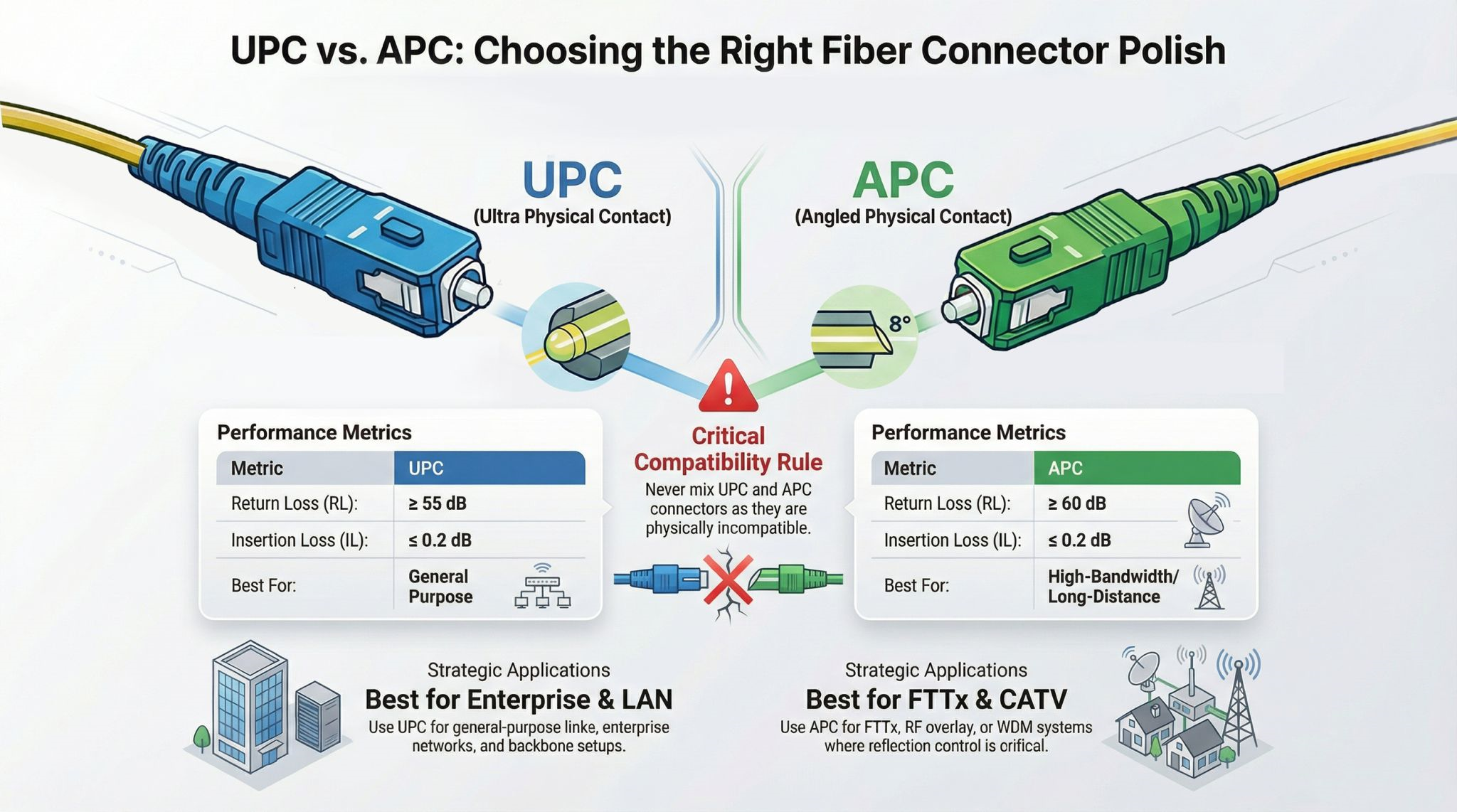
UPC vs. APC: Choosing the Right Fiber Connector Polish for Optimal Network Performance
In fiber optic networks, the seemingly small choice of connector polish—UPC (Ultra Physical Contact) or APC (Angled Physical Contact)—has a significant impact on signal quality, especially in high-speed or high-power applications. Both are modern polishing styles designed to minimize signal loss, but they achieve this through different physical geometries, leading to distinct performance characteristics and application suitability.
The Evolution of Connector Polish
To understand UPC and APC, it helps to know their predecessor: PC (Physical Contact) . PC connectors, developed in the 1980s, feature a slightly domed end-face. This curvature forces the fiber cores into direct physical contact when mated, drastically reducing the air gap compared to older flat connectors and improving return loss to around -40dB.
UPC is a refinement of the PC polish. By using extended polishing techniques, the domed end-face is given a superior surface finish, resulting in even better physical contact and a lower back reflection. A well-polished UPC connector typically achieves a return loss of -50dB or higher.
APC takes a fundamentally different approach. Instead of a domed surface, the ferrule end-face is polished at a precise 8-degree angle. This angled surface causes any light reflected back from the interface to be directed into the fiber cladding, where it dissipates, rather than traveling straight back down the core towards the source. This design yields an industry-standard return loss of -60dB to -65dB or higher.
Key Differences: APC vs. UPC
The following table summarizes the critical distinctions between the two connector types.
| Feature | UPC (Ultra Physical Contact) | APC (Angled Physical Contact) |
|---|---|---|
| End-Face Geometry | Domed end-face with a superior finish; 0° angle. | Domed end-face polished at a precise 8° angle. |
| Return Loss (Reflection) | Excellent; typically ≥ 50 dB. Can reach ≥ 55 dB in new, high-quality connectors. | Superior; typically ≥ 60 dB, with high-performance connectors achieving 65-75 dB. |
| Insertion Loss | Very low; typically 0.08 dB – 0.15 dB for new connectors. | Slightly higher initially (0.12 dB – 0.20 dB) but often more stable over many mating cycles. In practice, the difference is minimal and well within standards. |
| Connector Color (Common) | Typically Blue. | Typically Green. This is a key visual identifier. |
| Typical Applications | Digital TV, telephony, data systems, patch panels in data centers (especially for short links). | FTTx (Fiber-to-the-x), Passive Optical Networks (PON), WDM systems, CATV / RFoG (analog video), long-haul and high-speed coherent optics (e.g., 100G+, 400G-ZR). |
Critical Rule: Never Mix UPC and APC
It is essential to understand that UPC and APC connectors are not compatible and must never be mated. Because their end-faces have different geometries (0° vs. 8°), connecting them will not only result in extremely high insertion loss but can also permanently damage the delicate fiber end-faces. Equipment transceivers are equally sensitive and must be matched with the correct connector type.
Making the Right Choice for Your Network
The choice between UPC and APC depends on your application’s sensitivity to back reflection.
- Choose APC if your network involves:
- High-bandwidth applications like FTTx and PONs (GPON, EPON, 50G-PON) , where high split ratios amplify reflection issues.
- Wavelength Division Multiplexing (WDM) systems, which use multiple wavelengths and are sensitive to interference.
- Analog video overlay (CATV/RFoG) , as reflections directly degrade signal quality.
- High-speed coherent optics (400G-ZR and beyond) , which have extremely tight optical signal-to-noise ratio (OSNR) budgets.
- Any application using high-power lasers that could be damaged by reflected light.
- Choose UPC for:
- General-purpose digital systems, telephony, and data center connections, particularly over shorter distances where return loss is less critical.
- Applications where cost sensitivity is high and the ultimate performance of APC is not required.
As data rates and power budgets become increasingly stringent, the trend, especially in new access and long-haul deployments, is clearly toward APC connectors for their superior reflection performance and long-term reliability. By carefully considering your network’s demands, you can select the connector polish that ensures optimal performance and future-proofs your infrastructure.
For more information, visit www.feiyi-oeo.com