
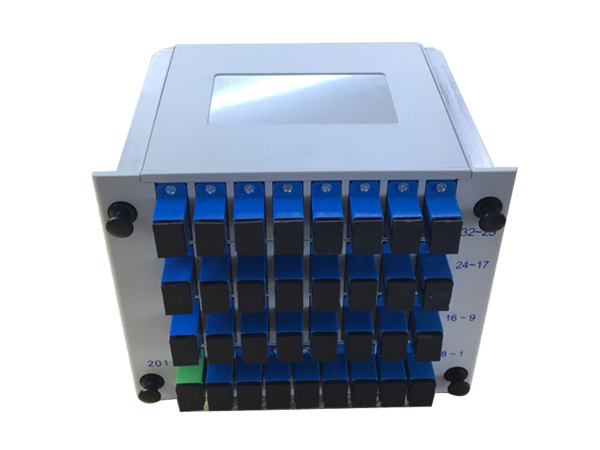
PLC Splitter – Insert Type: Precision Optical Signal Distribution for Modern Fiber Networks
In passive optical networks, the splitter is where network capacity meets physical reality. A single feeder fiber carries multiple wavelengths and services to a distribution point. At that point, the PLC splitter divides the optical signal across multiple output ports — each serving a different home, a different business, a different end user. If the split is uneven, if insertion loss varies too widely between ports, the entire distribution leg suffers. Service quality degrades. Troubleshooting becomes unpredictable.
Our Insert-Type PLC Splitter is designed to eliminate that variability. Built on planar lightwave circuit technology, it delivers uniform signal distribution with industry-leading insertion loss, high return loss, and stable performance across the full operating wavelength range — from 1260 nm to 1650 nm. Whether deployed in a GPON access network, a CATV distribution hub, or an XGS-PON upgrade, it ensures that every subscriber on the split receives the signal quality they were promised.
How It Works: Planar Lightwave Circuit Technology
A PLC splitter is fundamentally different from its older counterpart, the FBT (Fused Biconical Taper) splitter. Instead of physically fusing and tapering fibers together — a process that introduces mechanical variability — a PLC splitter uses a silica-based planar waveguide chip fabricated through photolithographic processes. Light entering the input port is guided through a precisely engineered waveguide structure that divides the optical power equally across all output ports.
This planar approach delivers several inherent advantages over FBT technology:
Wavelength uniformity. Because the splitting ratio is determined by the waveguide geometry rather than mechanical tapering, PLC splitters maintain consistent performance across the entire 1260–1650 nm band. This is critical in modern PON networks, where 1490 nm downstream data, 1310 nm upstream data, and 1550 nm CATV overlay signals share the same distribution fiber.
Channel-to-channel consistency. In an FBT splitter, achieving a precise 1×8 split requires cascading multiple 1×2 stages, each introducing its own tolerance stack-up. A PLC splitter achieves the same split in a single planar chip, with loss uniformity as low as 0.4 dB across all output ports.
Scalability. FBT splitters become increasingly complex and lossy as the port count grows. PLC technology scales naturally — our Insert-Type PLC Splitter supports configurations from 1×2 to 2×128, with insertion loss increasing predictably and modestly with each additional split level.
Temperature stability. The silica-on-silicon waveguide platform exhibits minimal thermal expansion mismatch, enabling stable operation from -40°C to +85°C — a temperature range that covers everything from climate-controlled central offices to unshielded outdoor cabinets in desert or arctic environments.
Performance Specifications
| Parameter | 1×2 | 1×4 | 1×8 | 1×16 | 1×32 | 1×64 | 1×128 | 2×2 | 2×4 | 2×8 | 2×16 | 2×32 | 2×64 |
|---|---|---|---|---|---|---|---|---|---|---|---|---|---|
| Insertion Loss, Max (P-Grade) | 3.8 dB | 7.1 dB | 10.2 dB | 13.5 dB | 16.5 dB | 19.5 dB | 23.8 dB | 3.8 dB | 7.3 dB | 10.5 dB | 13.8 dB | 17.1 dB | 20.4 dB |
| Loss Uniformity, Max | 0.4 dB | 0.6 dB | 0.8 dB | 1.0 dB | 1.3 dB | 1.8 dB | 2.5 dB | 0.6 dB | 1.0 dB | 1.2 dB | 1.5 dB | 1.8 dB | 2.2 dB |
| PDL, Max | 0.2 dB | 0.2 dB | 0.2 dB | 0.3 dB | 0.3 dB | 0.3 dB | 0.4 dB | 0.2 dB | 0.2 dB | 0.3 dB | 0.3 dB | 0.3 dB | 0.4 dB |
| Return Loss, Min | 55 dB | 55 dB | 55 dB | 55 dB | 55 dB | 55 dB | 55 dB | 55 dB | 55 dB | 55 dB | 55 dB | 55 dB | 55 dB |
| Directivity, Min | 55 dB | 55 dB | 55 dB | 55 dB | 55 dB | 55 dB | 55 dB | 55 dB | 55 dB | 55 dB | 55 dB | 55 dB | 55 dB |
Common Specifications Across All Configurations
- Operating Wavelength: 1260–1650 nm
- Operating Temperature: -40°C to +85°C
- Storage Temperature: -40°C to +85°C
- Fiber Type: SMF-28e or customer-specified
- Pigtail Length: 1.0 m standard (custom lengths available)
- Connector: LC/UPC, LC/APC, SC/UPC, SC/APC
Insert-Type Design: Why Form Factor Matters
The Insert-Type package is designed for seamless integration into fiber distribution hubs, street cabinets, and ODF splice trays. Unlike bulky ABS box splitters that consume valuable rack space, the Insert-Type form factor fits directly into standard splitter slots — enabling higher port density in the same physical footprint.
Three packaging variants are available to match different deployment environments:
Bare Fiber. The most compact option. The PLC chip and pigtails are protected within a compact stainless steel tube, with 900 μm loose-tube fibers exiting directly. Designed for integration into splice trays, cassette modules, or custom enclosures where space is at a premium.
Mini Module. The PLC chip is housed in a compact plastic or metal enclosure with a 900 μm or 2.0 mm or 3.0 mm fan-out, offering additional mechanical protection while maintaining a small form factor. Ideal for distribution boxes and wall-mount enclosures.
ABS Box. The splitter is enclosed in a robust ABS plastic housing with an integrated adapter panel. Available in multiple port configurations, the ABS Box option is designed for direct field deployment — plug-and-play, no additional housing required.
Applications
FTTX and PON Networks. PLC splitters are the backbone of passive optical distribution. In a GPON deployment, a 1×32 splitter serves up to 32 subscribers from a single feeder fiber. In an XGS-PON upgrade, the same splitter infrastructure supports 10 Gbps symmetrical service without modification — a direct benefit of the PLC splitter’s wavelength-independent performance.
CATV Distribution. In HFC and RFoG networks, PLC splitters distribute the broadcast optical signal across multiple nodes while maintaining the carrier-to-noise ratio (CNR) required for high-quality video delivery.
Optical Sensing. Distributed and quasi-distributed fiber optic sensing systems rely on PLC splitters to divide the interrogation signal across multiple sensing fibers. The high return loss and low PDL of our Insert-Type splitter ensure that the sensing signal is not contaminated by reflections or polarization-dependent power fluctuations.
Data Center Interconnects. In high-density data center environments, PLC splitters enable efficient optical signal distribution within fiber management systems, reducing the number of active components required for connectivity.
Test and Measurement. PLC splitters are essential in optical test setups where a reference signal must be distributed across multiple channels with known, repeatable loss characteristics.
Manufacturing Quality and Reliability
Every Insert-Type PLC Splitter that leaves the Feiyi Optoelectronic factory undergoes individual optical performance testing. Insertion loss, return loss, PDL, and uniformity are measured and documented for each unit. Test reports are shipped alongside every order, providing verifiable evidence of performance and full traceability.
Our splitters are designed and manufactured to meet the requirements of Telcordia GR-1209-CORE and GR-1221-CORE, the industry-standard reliability assurance specifications for passive optical components. These standards define a comprehensive battery of environmental and mechanical stress tests — including high- and low-temperature storage, temperature cycling, damp heat exposure, mechanical shock, and vibration — that collectively verify the component’s ability to survive the rigors of carrier-grade deployment.
With 14 years of manufacturing experience and an ISO 9001:2015 certified facility, Feiyi Optoelectronic delivers consistent quality across every production batch. We offer full OEM/ODM support — neutral packaging or your own brand — with custom fiber types, connector configurations, and packaging options available on request.
Why Feiyi Optoelectronic
14 years of specialized manufacturing. We have focused exclusively on passive optical components since our founding. This depth of experience translates into consistent product quality, predictable lead times, and the ability to support custom requirements that generic contract manufacturers cannot accommodate.
Factory-direct pricing. By manufacturing in our own facility and selling directly, we eliminate intermediary markups. Our customers receive carrier-grade performance at competitive price points — without sacrificing quality or traceability.
Complete test documentation. Every splitter ships with a full test report. This documentation supports our customers’ own quality assurance processes and provides auditable evidence of performance for end-customer acceptance.
Flexible OEM/ODM support. Whether you require neutral packaging, your own brand labeling, or custom fiber types and connector configurations, we adapt our production to your requirements. No minimum order quantity — we support both prototype evaluation and volume production.
Short lead times. Standard configurations ship within 7–10 days. Custom configurations are quoted on a per-project basis with realistic, reliable delivery commitments.
Contact Us
For complete technical specifications, custom configuration requests, or to arrange evaluation samples, contact Feiyi Optoelectronic at the details below.
*Feiyi Optoelectronic — Passive Optical Components, Factory-Direct, 14 Years of Manufacturing Excellence.*