Single‑Fiber Bidirectional 8‑Channel 10G CWDM Transmission System Solution
1. Solution Overview
This solution is based on Coarse Wavelength Division Multiplexing (CWDM) technology, enabling full‑duplex 8‑channel 10 Gbps transmission over a single optical fiber. By separating upstream and downstream traffic into distinct wavelength windows, it increases the total capacity of one fiber to 80 Gbps without deploying additional fiber infrastructure.
With low cost, fast deployment, and broad compatibility, this solution is ideal for:
- Campus interconnectivity
- Metro access networks
- Data center interconnection
- Security surveillance transmission
2. System Architecture & Working Principle
2.1 Overall Topology
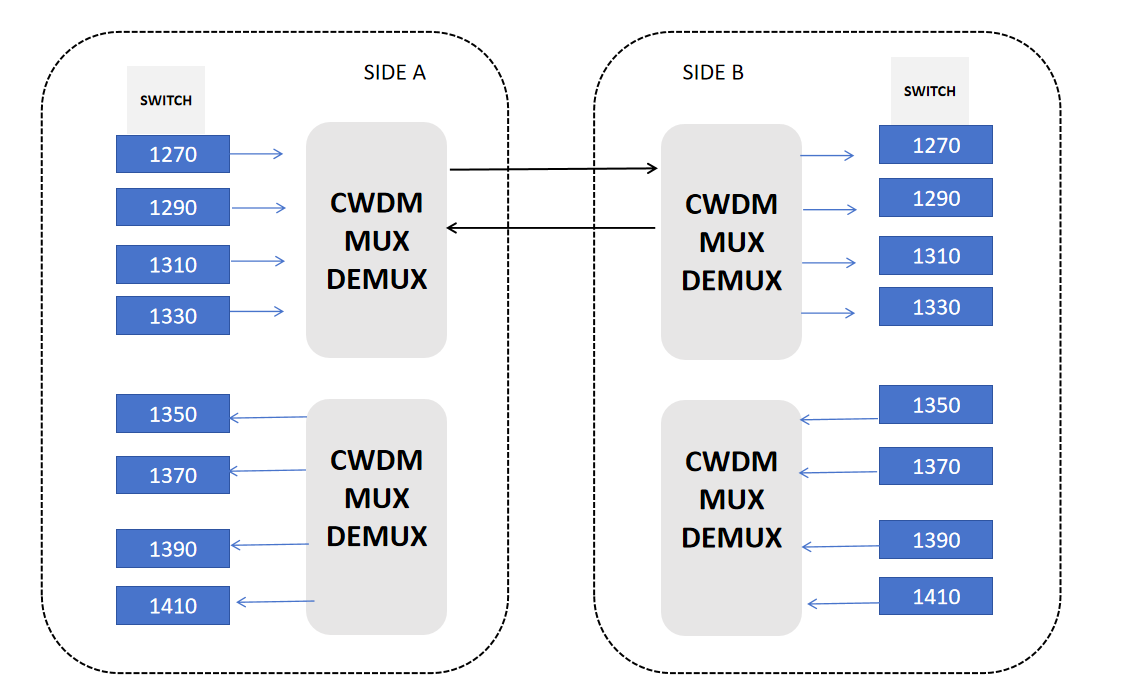
The system uses a symmetric dual‑end architecture (Side A / Side B), with identical configurations at both ends. Each end is equipped with two independent 4‑channel CWDM MUX/DEMUX units, connected end‑to‑end via a single standard single‑mode fiber (G.652).
- Upstream (Side A → Side B): The first MUX/DEMUX multiplexes 4 × 10 Gbps signals and transmits them over the single fiber to the remote end.
- Downstream (Side B → Side A): The second MUX/DEMUX demultiplexes the 4 × 10 Gbps signals returning from the remote end and connects them to the local switch.
2.2 Wavelength Allocation Strategy
The solution operates in the O‑band (1260 nm – 1460 nm) , which offers low transmission loss (≤0.4 dB/km), minimal chromatic dispersion, and no dispersion compensation requirement – making it particularly suitable for medium‑ to long‑distance 10 Gbps transmission.
| Transmission Direction | Wavelengths (nm) | Per‑Channel Rate | Total Bandwidth |
|---|---|---|---|
| Upstream (A → B) | 1270, 1290, 1310, 1330 | 10 Gbps | 40 Gbps |
| Downstream (B → A) | 1350, 1370, 1390, 1410 | 10 Gbps | 40 Gbps |
2.3 Single‑Fiber Bidirectional Transmission Principle
Bidirectional transmission over the same fiber is achieved through wavelength isolation:
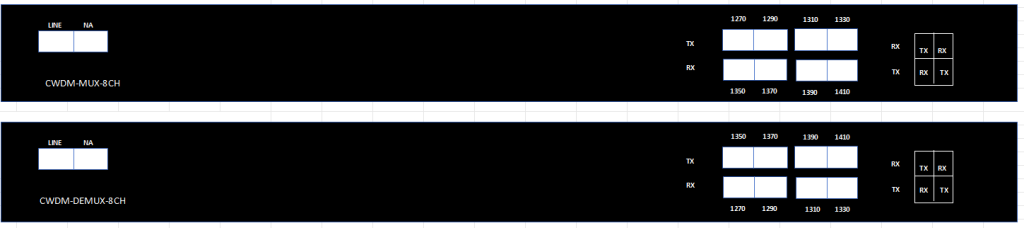
- Transmitter side – The MUX converts electrical signals of different wavelengths into optical signals and couples them into the same fiber.
- Transmission line – The single fiber carries both upstream and downstream optical signals at different wavelengths simultaneously, without interference.
- Receiver side – The DEMUX separates the incoming optical signals by wavelength and routes them to the corresponding switch ports.
3. Core Technical Advantages
3.1 Maximum Fiber Resource Saving
Compared to traditional dual‑fiber bidirectional solutions, this system saves 50% of fiber cores, significantly reducing infrastructure investment in scenarios where fiber is scarce or installation costs are high (e.g., river crossing, road crossing, or old campus renovation projects).
3.2 High Cost‑Effectiveness & Low O&M Cost
- Uses uncooled lasers – power consumption is only 1/3 of typical DWDM solutions.
- Modular, plug‑and‑play design – no complex network configuration required.
- Industrial‑grade components – Mean Time Between Failures (MTBF) ≥ 1,000,000 hours.
3.3 Flexible Scalability
Supports smooth capacity expansion. Channels can be added gradually as business needs grow, without replacing existing MUX/DEMUX equipment. To upgrade to 25 Gbps or 100 Gbps, only the corresponding optical modules need to be replaced.
3.4 Broad Device Compatibility
Fully compatible with all standard SFP+ optical modules and Ethernet switches. No need to replace existing network equipment – the solution can be seamlessly integrated into current network architectures.
4. Key Technical Specifications
| Parameter | Value |
|---|---|
| Number of Channels | 8 (4 upstream + 4 downstream) |
| Per‑Channel Rate | 10 Gbps full‑duplex |
| Total System Bandwidth | 80 Gbps |
| Transmission Distance | 20 km (standard single‑mode fiber G.652) |
| Insertion Loss | ≤1.5 dB per channel |
| Channel Isolation | ≥30 dB |
| Return Loss | ≥45 dB |
| Operating Temperature | –40 °C to +85 °C (industrial grade) |
| Power Supply | 3.3 V single supply |
| Interface Type | LC duplex |
5. Typical Application Scenarios
5.1 Enterprise Campus / Headquarters‑Branch Interconnection
Enables high‑speed data transmission between geographically separated enterprise sites, supporting voice, video, and data service convergence – meeting the needs of daily office operations and business system continuity.
5.2 Metro Access Network Transmission
Used by carriers for metro access network deployment, providing high‑speed broadband access to residential communities, office buildings, and commercial complexes – solving the “last‑mile” bandwidth bottleneck.
5.3 Data Center Disaster Recovery Link
Serves as an off‑site disaster recovery link between data centers, enabling real‑time data synchronization and backup to ensure business continuity and data security.
5.4 High‑Definition Security Surveillance Transmission
Supports long‑distance transmission of multiple 4K/8K HD camera signals – ideal for safe city, traffic monitoring, and campus security applications.
6. Conclusion
The single‑fiber bidirectional 8‑channel 10G CWDM transmission system is an efficient, economical, and reliable optical fiber transmission solution. Through innovative wavelength multiplexing technology, it achieves bidirectional high‑speed transmission over a single fiber, drastically reducing fiber‑laying and equipment costs. With flexible deployment, easy scalability, and strong compatibility, it is a mainstream choice for medium‑ to long‑distance transmission in today’s optical communications field.
For more technical details or customized solutions, please feel free to contact us.
Let me know if you’d like a shorter marketing version or a datasheet layout for this solution.