
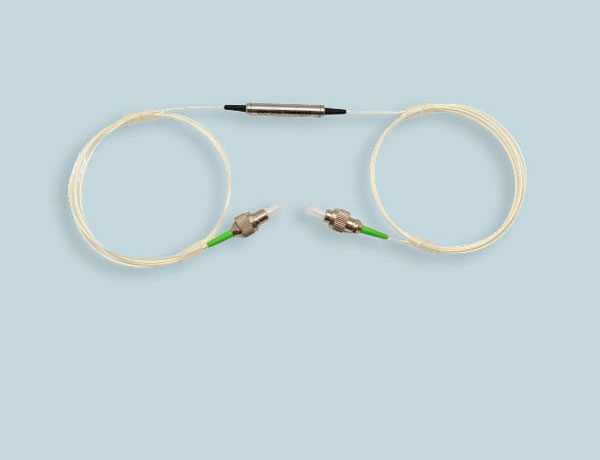
PM Fiber Isolator — Precision Polarization Control for High-Performance Optical Systems
When Polarization Is the Signal, Every Decibel of Extinction Matters
In a fiber optic gyroscope, a 1 dB degradation in extinction ratio can translate directly into bias drift. In a coherent optical receiver, polarization cross-talk limits the achievable signal-to-noise ratio. In a fiber laser cavity, an uncontrolled polarization state leads to mode hopping and power instability. In these systems, polarization is not an afterthought — it is the signal itself. And the component that protects it is the PM fiber isolator.
A PM (Polarization-Maintaining) fiber isolator serves a dual purpose that no other single component can fulfill simultaneously. First, it blocks backward-propagating light — protecting laser sources, pump diodes, and upstream components from the destabilizing effects of back-reflections. Second, and critically, it preserves the polarization state of the forward-propagating signal. Ordinary polarization-insensitive isolators achieve the first objective but scramble the second. For the applications listed above, that trade-off is unacceptable.
At Feiyi Optoelectronic, we have been manufacturing PM fiber isolators for 14 years. Our product line spans single-stage and dual-stage configurations, covering center wavelengths from 1064 nm through the L-band, with custom wavelengths available from 780 nm to 2000 nm and beyond. Every unit is individually tested, temperature-cycled, and shipped with a complete test report that documents its measured extinction ratio, isolation, insertion loss, and return loss.
How a PM Fiber Isolator Works
The core of any PM isolator is the Faraday rotator — a magneto-optic crystal, typically terbium gallium garnet (TGG) or yttrium iron garnet (YIG), placed in a permanent magnetic field. When linearly polarized light passes through this crystal, its plane of polarization rotates by a fixed angle (typically 45 degrees) in a direction determined solely by the magnetic field orientation, not by the direction of light propagation. This non-reciprocal behavior is the physical basis for optical isolation.
In a PM isolator, the incoming light is already linearly polarized — it arrives through a polarization-maintaining fiber aligned to the slow axis. A birefringent beam displacer or polarizer at the input ensures that only the desired polarization mode enters the Faraday rotator. The rotator then rotates the polarization by 45 degrees, and a second polarizer at the output, oriented at 45 degrees, transmits the forward-propagating light with minimal loss.
When light attempts to travel in the reverse direction, the Faraday rotator rotates it by another 45 degrees in the same rotational sense — producing a total rotation of 90 degrees relative to the input polarizer. The input polarizer, oriented at 0 degrees, blocks this cross-polarized light. This is how isolation is achieved.
In a dual-stage isolator, two Faraday rotators and two sets of polarizers are cascaded within a single package. The result is dramatically higher isolation — typically ≥55 dB compared to ≥30 dB for a single-stage design — at the cost of a small increase in insertion loss (typically 0.2-0.3 dB additional).
Performance Specifications
The following table summarizes the key optical performance parameters of Feiyi Optoelectronic’s PM fiber isolators at 1550 nm center wavelength. Custom specifications are available on request.
| Parameter | Single-Stage | Dual-Stage |
|---|---|---|
| Center Wavelength | 1310, 1480, 1550 nm (custom: 780–2000 nm) | 1310, 1480, 1550 nm (custom: 780–2000 nm) |
| Extinction Ratio | ≥23 dB | ≥28 dB |
| Insertion Loss | ≤0.5 dB | ≤0.7 dB |
| Isolation | ≥30 dB | ≥55 dB |
| Return Loss | ≥55 dB (APC) / ≥50 dB (PC) | ≥55 dB (APC) / ≥50 dB (PC) |
| Optical Power Handling | 300 mW (standard) | 300 mW (standard) |
| Fiber Type | PM Panda fiber, slow axis aligned | PM Panda fiber, slow axis aligned |
| Package Dimensions | 5.5 mm OD × 30 mm L | 5.5 mm OD × 58 mm L |
| Operating Temperature | -5°C to +70°C | -5°C to +70°C |
| Storage Temperature | -40°C to +85°C | -40°C to +85°C |
Note on Extinction Ratio: The extinction ratio of a PM isolator measures its ability to maintain the linear polarization of the forward-propagating signal. It is defined as the ratio of optical power in the slow axis to optical power in the fast axis at the output, expressed in decibels. A higher value indicates better polarization maintenance. For navigation-grade FOGs requiring bias stability below 0.01 °/h, an extinction ratio of ≥28 dB in the isolator is a defining performance parameter.
Custom Wavelengths
Many of the applications that demand PM isolators — fiber lasers, quantum optics, sensing — operate at wavelengths outside the standard telecom bands. We manufacture PM isolators at customer-specified center wavelengths across the visible, near-infrared, and short-wave infrared regions.
Our standard wavelength coverage includes: 780 nm, 850 nm, 980 nm, 1020 nm, 1064 nm, 1310 nm, 1480 nm, 1550 nm, 1650 nm, and 2000 nm. Wavelengths between these values and beyond are available on request. For dual-wavelength applications — such as 980/1064 nm or 1064/1550 nm — we can design isolators with broadband performance or dual-wavelength coating.
All custom wavelength isolators undergo the same rigorous testing as our standard products, with complete test reports documenting the measured performance at the specified center wavelength.
The Epoxy-Free Advantage
A defining characteristic of our manufacturing process is the epoxy-free optical path design. In conventional isolator designs, epoxy is used to bond optical elements within the beam path. Under sustained optical loading, particularly at elevated temperatures or high power levels, epoxy can outgas, thermally degrade, or delaminate — leading to contamination of optical surfaces, insertion loss drift, and ultimately component failure.
By eliminating epoxy from the optical path entirely, our design removes this failure mechanism. The result is isolators with superior long-term stability, higher power handling capability, and extended operational lifetimes. For applications in space-qualified systems, undersea equipment, or high-power fiber lasers — where component failure is not an option — the epoxy-free optical path is not a luxury; it is a requirement.
Applications
Fiber Optic Gyroscopes (FOG)
FOGs measure rotation by detecting the phase difference between two counter-propagating beams of light within a fiber coil. A PM isolator is positioned between the broadband light source and the PM coupler that splits light into the coil. Any polarization cross-talk introduced by the isolator directly translates into bias drift in the gyroscope output. For high-precision FOGs, the PM isolator must deliver high extinction ratio, low insertion loss, and stable performance across the full operating temperature range. Our dual-stage PM isolators, with extinction ratios ≥28 dB, are purpose-built for these demanding applications.
Coherent Optical Communication
In coherent receivers, the polarization state of the incoming signal carries information — in DP-QPSK and higher-order modulation formats, polarization is an independent data channel. A PM isolator at the local oscillator output ensures that the reference signal maintains a known, stable polarization state throughout the optical path. Any extinction ratio degradation in the isolator introduces polarization-dependent loss and degrades the receiver’s bit error rate. Our isolators deliver the extinction ratio and insertion loss stability that coherent systems demand.
Fiber Lasers
Fiber laser cavities are exquisitely sensitive to back-reflections. A reflection from a dirty connector, a splice point, or the workpiece itself can destabilize the cavity, causing mode hopping, power fluctuations, or Q-switching instabilities. A PM isolator placed at the laser output blocks these reflections while preserving the polarization state of the output beam — a critical requirement for frequency doubling, pumping nonlinear crystals, and other polarization-sensitive downstream processes. For high-power fiber laser applications, our epoxy-free optical path provides the power handling headroom and long-term reliability that production environments demand.
Quantum Optics
In quantum key distribution (QKD) and entangled photon experiments, the polarization state of individual photons encodes quantum information. A PM isolator in the optical path must maintain extinction ratios that are orders of magnitude higher than what is acceptable in telecom systems. Our dual-stage PM isolators, with extinction ratios ≥28 dB and return loss ≥55 dB, are designed to meet the stringent polarization requirements of quantum optics research.
Interferometric Fiber Sensors
Fiber optic hydrophones, strain sensors, and temperature sensors based on Mach-Zehnder or Michelson interferometry require stable polarization throughout the sensing and reference arms. A PM isolator at the laser source ensures that the polarization entering the interferometer is well-defined and stable, maximizing fringe visibility and minimizing measurement uncertainty.
Why Feiyi Optoelectronic
14 years of specialized manufacturing. We have focused exclusively on passive optical components since our founding. This depth of experience translates into consistent product quality, predictable lead times, and the ability to support custom requirements that generic contract manufacturers cannot accommodate.
Epoxy-free optical path. Our proprietary manufacturing process eliminates epoxy from the optical beam path, removing the primary failure mechanism in high-power and high-reliability applications. The result is superior long-term stability and extended operational lifetimes.
Complete test documentation. Every PM isolator ships with a full test report documenting its measured extinction ratio, isolation, insertion loss, and return loss. This documentation supports our customers’ own quality assurance processes and provides auditable evidence of performance for end-customer acceptance.
Custom wavelengths and configurations. We manufacture PM isolators at customer-specified center wavelengths from 780 nm to 2000 nm and beyond. Custom fiber types, connector configurations, and package dimensions are available on request.
Factory-direct pricing. By manufacturing in our own facility and selling directly, we eliminate intermediary markups. Our customers receive high-performance PM isolators at competitive price points — without sacrificing quality, traceability, or customization flexibility.
OEM/ODM ready. Neutral packaging or your own brand labeling. No minimum order quantity — we support both prototype evaluation and volume production.
Contact Us
For complete technical specifications, custom wavelength requests, or to arrange evaluation samples for your engineering team, contact Feiyi Optoelectronic at the details below.