
PM 1064nm Fiber Patch Cord Supplier: Preserve the Laser Chain From Connector Key to Fiber Type
PM 1064nm Fiber Patch Cord Supplier: Preserve the Laser Chain From Connector Key to Fiber Type
A PM 1064nm fiber patch cord supplier should be given more than a wavelength and cable length. In a 1064 nm laser, sensing, amplifier or test setup, the patch cord carries a polarization reference between two pieces of equipment. Feiyi’s PM 1064nm Optical Patch Cord lists 1064 nm operation, PM1060 fiber, insertion loss of no more than 0.2 dB, return loss of at least 50 dB for the listed UPC interface and at least 60 dB for the listed APC interface, a minimum extinction ratio of at least 22 dB, and fast-axis, slow-axis or customized orientation.
For a buyer, the first question is therefore not “FC or LC?” It is: which polarization axis leaves the upstream source, how is that axis referenced mechanically, and what does the downstream module expect? Once that chain is clear, connector polish, fiber length, jacket and service life can be chosen without turning the patch cord into an uncontrolled variable.
A PM 1064nm fiber patch cord supplier should receive the source-to-load axis map
A 1064 nm fiber laser can have several polarization-sensitive interfaces between the source and the final detector or process head. A patch cord may connect a source to an isolator, an isolator to a circulator, a test instrument to a device under test, or a collimator to another module. If the buyer only specifies “slow axis” without saying how the mating equipment is keyed, the optical requirement is incomplete.
Feiyi lists fast-axis, slow-axis and customized orientation. Put that choice on the cable drawing for both ends. If the connector key is the reference, show the relation between key and polarization axis. If one end is connectorized and the other is spliced, define the splice-side orientation separately.
The connector key is useful only when both mating devices use the same convention
External 1064 nm PM patch-cord documentation commonly treats key-to-axis alignment as a controlled property. For example, Idealphotonics describes a 1064 nm PM cable with the narrow key aligned to the slow axis, while other suppliers also distinguish slow- and fast-axis options. Those values belong to their products, but the industry practice is useful: the buyer should not assume that “PM” alone tells an assembler how to orient the cable.
PM1060 fiber should stay visible in the 1064 nm bill of materials
The Feiyi 1064 nm page identifies PM1060 as the fiber specification. That detail belongs in the approved part description because wavelength labels do not uniquely define fiber construction. A replacement cable built from a different PM fiber can still fit the same connectors and look identical on the bench.
When a project uses nearby wavelength families, such as Feiyi’s PM 980nm Optical Patch Cord and the 1064 nm version, separate the inventory by wavelength and fiber identity rather than by jacket color. This is particularly important in laser laboratories where several red or yellow patch leads can be routed through the same rack.
A distributor should not merge 980 nm and 1064 nm stock because the connector looks the same
Connector compatibility is a mechanical condition. Optical suitability depends on the approved fiber, wavelength and polarization behavior. If a customer qualified a PM1060 build at 1064 nm, substituting a mechanically similar 980 nm item should trigger engineering review instead of a warehouse decision.
Insertion loss and extinction ratio answer different questions in a laser chain
Feiyi lists insertion loss at no more than 0.2 dB and minimum extinction ratio at at least 22 dB on the 1064 nm page. Low insertion loss confirms that the wanted optical power is transferred efficiently. Extinction ratio is the more direct check on polarization preservation. A cable can meet a power budget while still creating a polarization problem if its axis is misaligned.
For incoming inspection, measure the cable in the orientation that will be used in the equipment. Record which end was the launch end, the connector polish and the axis reference. If the cable is later reversed in a mixed-connector build, do not assume the result is directly comparable without documenting the new test direction.
Power measurements should be paired with an axis-controlled test
A technician can see a small power loss and conclude that the cable is acceptable. That is not enough for a polarization-sensitive laser path. The acceptance record should preserve the same axis convention that the product design uses. This is especially valuable when the patch cord sits before a polarization-sensitive component such as Feiyi’s PM 1064nm Circulator or PM 1064nm Fiber Optic Isolator.
UPC and APC choices should follow the reflection sensitivity of the actual 1064 nm source
The Feiyi table lists return loss of at least 50 dB for the shown UPC configuration and at least 60 dB for the shown APC configuration. Those numbers should remain attached to the connector and polish being quoted. A laser source that is sensitive to optical feedback may justify APC mating where the equipment is designed for it. A test fixture built around UPC ports should not be forced into APC simply because the headline return-loss number is higher.
Do not mix UPC and APC mating interfaces. The difference is not cosmetic; the end-face geometry is part of the optical connection. A purchasing description should say “FC/APC” or “FC/UPC”, not simply “FC”. The same principle applies to SC and other connector families where more than one polish may be available.
A 1064 nm replacement cable should preserve the approved end-to-end geometry
Service teams often replace a patch cord after contamination, connector damage or a layout change. If the replacement request only repeats wavelength and length, the new cable can introduce a different connector orientation or polish. Preserve the original end-A/end-B drawing and the axis convention when ordering the replacement.
If the upstream source uses one connector family and the downstream instrument another, label both ends in the controlled drawing. The cable should arrive with an identity that makes its installed direction obvious to the technician.
Mixed-connector assemblies need a launch-end label for repeatable acceptance tests
A mixed FC/APC-to-LC/UPC assembly, for example, has a natural installed direction. If acceptance testing is done from the FC side on the first batch, record that condition. A later batch measured from the opposite side may not produce directly comparable return-loss behavior because the two terminations are different.
Repeated mating is a real requirement for 1064 nm test leads
Feiyi lists repeatability no more than 0.1 dB, interchangeability no more than 0.2 dB, at least 1000 plug cycles, tensile strength of at least 100 N and durability change no more than 0.2 dB. These values matter more for a service cable or test lead than for a patch cord that is installed once inside an enclosure.
For a laboratory test station, the cable specification should include how frequently it will be disconnected, who cleans the connectors and how the axis orientation is identified after reconnection. When optical loss changes after months of use, inspect the end faces and mating adapters before assuming the PM fiber itself has degraded.
Fiber length should be decided from the laser enclosure and service route
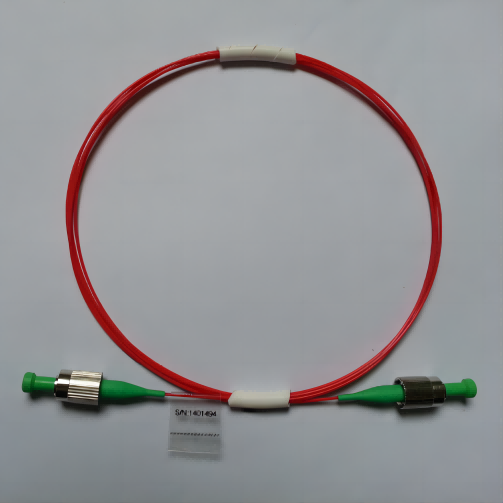
Long spare loops are convenient during prototyping but can become a routing problem inside a production enclosure. Excess cable can create bends, contact moving hardware or make connector cleaning harder. A cable that is too short can load the ferrule or adapter. Measure the installed path, include the service loop that is actually needed, and then freeze the finished length.
For a distributor, stocking a few standard lengths can be practical, but a customer-specific axis and connector configuration should remain a separate item. Length alone should not drive substitution between two PM cables.
The 1064 nm patch cord should be reviewed together with the surrounding PM components
A 1064 nm optical chain may include the patch cord, a PM isolator to protect the source from return light, a PM circulator to route forward and returning signals, a PM coupler to divide power, and a collimator where the fiber path transitions to free space. These components can share a wavelength but solve different optical jobs.
Feiyi’s PM 980/1030/1064nm Coupler is a power-routing component, not a cable substitute. The PM 1064nm Circulator is directional routing. The PM 1064nm Isolator is source protection. The patch cord is the controlled connection between those devices. Writing the optical function beside each BOM line helps purchasing avoid matching parts by wavelength alone.
When a 1064 nm system migrates to another wavelength, review the whole interface chain
Feiyi also lists PM patch cords at 1310 nm and 1550 nm. A redesign that changes source wavelength should not copy the 1064 nm cable description and change only the number. Reconfirm fiber type, connector polish, axis convention and the related isolator, circulator or coupler requirements for the new optical band.
The current operating-temperature row should be confirmed before it is written into a controlled specification
The Feiyi 1064 nm patch-cord page contains an operating-temperature row that appears anomalous rather than a valid temperature range, while the storage row lists -45 to +85 掳C. The safe procurement approach is to use the page for the clearly stated wavelength, fiber, insertion loss, return loss, extinction ratio, connector and mechanical endurance data, then request current confirmation of operating temperature for the exact cable build if the project has an environmental requirement.
This distinction matters in an industrial or outdoor instrument. A room-temperature laboratory lead and a cable routed through a wide-temperature enclosure do not need the same environmental qualification. Do not invent a limit from a corrupted table cell.
Incoming inspection should compare the cable with the approved optical chain, not a generic jumper
A useful receiving check for a 1064 nm PM patch cord starts with identity: wavelength, PM1060 fiber, connector types, polish, length and axis reference. Then inspect end faces, verify the required insertion-loss and polarization condition, and confirm that the physical labels match the drawing. If the cable will be used repeatedly, include a mating and strain check appropriate to the service role.
The inspection does not need to reproduce every laboratory experiment. It does need to protect the design choices that made the first approved cable work. If a later lot differs in connector keying or fiber identity, stop the substitution before it enters the laser chain.
Shipping protection should preserve the 1064 nm connector faces and axis identity
Connector contamination can change loss or reflection before the cable ever reaches the laser bench. As a general fiber-handling practice, keep ferrules capped during transport and receiving, and do not remove the identification that distinguishes end A from end B. If a buyer requires special packaging, write that requirement into the order rather than assuming a standard pack. The receiving team should inspect the caps, strain-relief area and cable label before opening the optical acceptance test.
A repeat 1064 nm order should be reproducible without the original engineer present
The strongest purchase file is one that another engineer can use months later without reopening the prototype notebook. Keep the 1064 nm wavelength, PM1060 fiber, axis convention at both ends, connector family and polish, finished length, jacket or loose-tube construction, insertion-loss limit, extinction-ratio requirement, return-loss requirement and the installed direction if the two ends differ.
Feiyi’s PM fiber patch cord supplier article gives broader context for axis alignment, while the exact 1064 nm product page should remain the reference for current Feiyi options. The practical goal is simple: when a 1064 nm cable is replaced, the laser system should see the same optical interface rather than merely a cable with the same connectors.