Lensed Fiber Manufacturer: Choose the Tip Geometry From the Beam You Need
A buyer searching for a lensed fiber manufacturer should not begin with the question “which lens shape is best?” The useful first question is what output field or coupling geometry the assembly actually needs. A tapered tip, wedge, two-faceted tip, four-faceted or pyramidal tip, and an angled end can create very different beam behavior even when they are made from the same base fiber.
Feiyi’s current lensed-fiber family includes Tapered Lensed Fiber, Wedge Lensed Fiber, Two-Faceted Lensed Fiber, Four-Faceted/Pyramidal Lensed Fiber and Angled Lensed Fiber. Across those pages, the company publishes customization around single-mode, multimode and polarization-maintaining fiber, fiber length and stripped-coating length. The pages also state that the bare fiber can be directly processed without auxiliary adhesives and that coating can be applied directly to the bare-fiber endface.
A lensed fiber manufacturer should receive a target beam or coupling condition before geometry is chosen
Lensed fibers are not cosmetic end-face variations. The processed tip changes how light leaves or enters the fiber. For a buyer, that means the desired far-field pattern, divergence, coupling target and available mechanical space should be described before the tip shape is frozen. Choosing from a product photograph first can lead to a geometry that looks appropriate but produces the wrong beam.
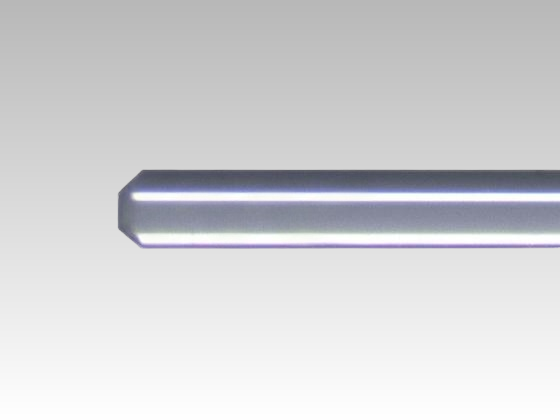
Wedge lensed fiber fits coupling jobs that need a controlled wedge and divergence range
Feiyi’s Wedge Lensed Fiber page lists single-mode, multimode, PM and customized fiber options. Published customizable values include a tip radius of curvature from 8 to 12 micrometers, a wedge angle from 60 to 120 degrees and an applicable coupling far-field divergence from 15 to 40 degrees. The page identifies DFB-laser fiber coupling as an application.
Those parameters give an engineer three different levers. The radius describes the processed curvature at the tip. The wedge angle changes the end geometry. The far-field divergence describes the coupling behavior the design is trying to reach. An RFQ should therefore provide the target optical condition rather than simply asking for a “wedge fiber.”
Two-faceted lensed fiber is published for a flat-top far-field spot
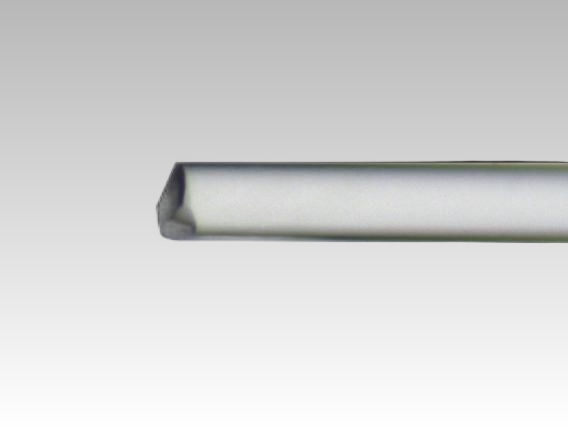
Feiyi’s Two-Faceted Lensed Fiber page lists a flat-top far-field pattern and a wedge angle range of 60 to 120 degrees. It supports SM, MM, PM and customized fiber choices and identifies endoscope illumination and DFB-laser coupling among the applications.
A flat-top target is a different optical request from the ring-shaped field published for Feiyi’s tapered lensed fiber. If an illumination system needs a more uniform field, a two-faceted geometry may enter the design discussion. If the objective is beam expansion or a ring-shaped output, another geometry may be more appropriate. The manufacturer needs the target field description to make that distinction.
Lensed fiber manufacturer selection changes when the spot must be rectangular
Feiyi’s Four-Faceted/Pyramidal Lensed Fiber page publishes a rectangular far-field pattern and a 60-120 degree wedge-angle range. The page identifies coupling of high-power laser-diode emission into optical fiber as an application. That makes the four-faceted family an example of geometry being selected around a specific spatial field rather than only fiber type.
Four-faceted fiber gives a different design starting point from a round or ring-shaped field
A rectangular spot can be useful when the emitter or receiving region is not rotationally symmetric. The engineering team should provide the target spot dimensions or coupling condition it is trying to achieve, then work with the manufacturer on the geometry. A simple request for “pyramidal tip, 80 degrees” describes manufacturing geometry but not whether the resulting field is suitable for the application.
The published Feiyi page supports SM, MM, PM and customized fiber and offers optional FC, LC, SC and SMA connectors with PC/APC choices. Connectorization can simplify handling, but the processed lensed end still defines the optical interface at the active side of the assembly.
Angled lensed fiber is useful when beam deflection or back-reflection control drives the design
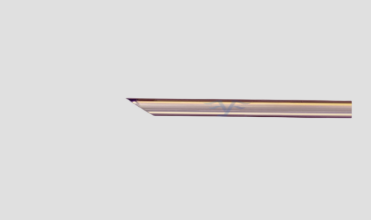
Feiyi’s Angled Lensed Fiber page lists selectable angles of 8, 30, 45 and 60 degrees. Its published applications include reducing back reflection, coupling laser diodes, coupling output for passive devices such as PLC and WDM, changing the optical path, generating large-angle deflection, endoscope illumination and 90-degree optical-path turning.
The angle should follow the required optical path, not a familiar connector convention
An 8-degree end is often familiar to fiber engineers because angled interfaces are associated with reflection control, but Feiyi’s lensed-fiber page goes beyond that and publishes much larger processing angles. A 45- or 60-degree geometry can be relevant where the optical path itself must be redirected. The buyer should therefore distinguish an angled connector polish from a deliberately shaped lensed-fiber tip.
Passive-device coupling creates a different acceptance test from laser-diode coupling
If an angled fiber is used to couple into a PLC or WDM assembly, the acceptance metric should reflect the passive device interface. If it couples a laser diode, the engineer may care more about launch efficiency and position tolerance relative to the emitter. The tip geometry can be similar while the system-level test is different.
That is why a lensed-fiber manufacturer needs to know what sits on the other side of the gap. A drawing that defines only fiber type and angle does not describe the complete optical job.
Tapered lensed fiber is published for a ring-shaped far field and broad fiber customization
Feiyi’s Tapered Lensed Fiber page lists SM, MM, PM and customized fiber options. It publishes a ring-shaped far-field spot and an apex-angle range from 60 to 120 degrees. Connector options include FC, LC, SC and SMA with PC/APC choices. The page identifies beam expansion, endoscope illumination and DFB-laser coupling among its applications.
Taper angle is only one input to the final coupling result
An engineer may start with a 60-120 degree apex-angle window, but the final output depends on the fiber, wavelength and geometry as a system. The manufacturer should receive the desired spot or coupling target so the tip can be reviewed in context. A later article on tapered lensed fiber selection can focus more narrowly on that geometry.
For repeat orders, preserve the approved fiber raw material, fiber length, stripped length and processed tip definition. Those details are exactly the kinds of customization Feiyi identifies on its lensed-fiber pages and should not be reduced to a generic family name after sample approval.
SM, MM and PM raw fiber should be chosen before connector packaging
All of the Feiyi lensed-fiber pages reviewed here publish SM, MM, PM and customized raw-fiber options. That decision affects mode behavior before the connector is considered. A single-mode laser coupling job, multimode illumination path and polarization-sensitive PM assembly have different optical requirements even if all three eventually use an FC housing.
PM lensed fiber adds an axis requirement to an already sensitive tip geometry
If polarization must be preserved, the PM fiber orientation becomes part of the assembly. The buyer should state which axis is used and how that axis relates to any connector or mechanical reference. The lensed tip then has to satisfy both spatial coupling and polarization requirements.
A standard single-mode lensed fiber does not have the same rotational requirement. This is another reason to choose raw fiber before finalizing packaging: the mechanical drawing should reflect the optical property that needs to survive installation.
Direct bare-fiber processing and endface coating affect cleanliness and handling
Feiyi states that its lensed-fiber products can be processed directly on bare fiber without auxiliary adhesives, with no organic residue from an added bonding material at the processed tip. The pages also state that coating can be applied directly on the bare-fiber endface to improve coating performance and durability.
Coating requirements should be tied to wavelength and interface conditions
A coating is not simply a catalog decoration. The buyer should define the wavelength and optical interface so the manufacturer can confirm the appropriate coated configuration. If the design requires an uncoated tip for a specific experiment, that should be stated as deliberately as a request for coating.
Packaging should also protect the processed end. A lensed or faceted fiber is more geometrically specific than an ordinary cleaved fiber. The public pages do not define one universal packing method, so OEM buyers should agree protection, labeling and handling instructions for the actual order.
Sample approval should include the measured field, not only a microscope image of the tip
A lensed-fiber sample can look geometrically correct under inspection and still miss the coupling target. For that reason, an engineering sample should be reviewed both mechanically and optically. Record the processed angle, radius or facet definition that was ordered, then compare the resulting far-field pattern or coupling result with the application’s acceptance condition.
For repeat orders, preserve the setup used to evaluate the approved geometry
If a wedge sample was accepted because it produced the required divergence into a DFB-laser interface, keep the wavelength, launch condition and measurement distance with the sample record. If a two-faceted sample was approved for a flat-top illumination field, preserve the field-measurement condition rather than only the fiber drawing. That information helps the buyer distinguish a real process shift from a change in the test setup.
Dimensional inspection and optical inspection answer different questions. The former checks whether the tip was made as specified; the latter checks whether the manufactured geometry works in the intended optical system. A lensed fiber manufacturer is most useful when both sets of information can be tied to the same approved configuration.
Environmental limits provide a common baseline across the lensed-fiber family
The reviewed Feiyi wedge, two-faceted, four-faceted, angled and tapered product pages publish an operating-temperature range of -40 to +85 deg C and relative humidity from 0 to 85 percent. The pages also state compliance with Telcordia GR-1221 and GR-63 Core environmental or reliability testing for those products.
Those published limits can support a supplier review, but the application still defines the final qualification. A medical illumination assembly, laser module and industrial sensor may need different vibration, cleanliness or handling requirements that are not captured by temperature and humidity alone.
Choose lensed-fiber geometry from the field you need to create
Start with the Wedge Lensed Fiber when a wedge geometry and defined divergence are central to coupling. Review the Two-Faceted Lensed Fiber for a flat-top far-field requirement. Compare the Four-Faceted/Pyramidal Lensed Fiber when a rectangular field is relevant, and the Angled Lensed Fiber when beam deflection or reflection control drives the tip.
Feiyi’s earlier lensed-fiber spot-shape article approaches the same family from a coupling decision. For manufacturer qualification, the key is to preserve the full approved geometry: raw fiber, processed tip, angle or radius, desired field, coating, connector and lead length. That is what allows the second production lot to reproduce the first.