Pyramidal Lensed Fiber Manufacturer: Use Four Facets When the Target Needs a Rectangular Far Field
[Reading 65 lines from start (total: 65 lines, 0 remaining)]
[Reading 58 lines from start (total: 58 lines, 0 remaining)]
Pyramidal Lensed Fiber Manufacturer: Use Four Facets When the Target Needs a Rectangular Far Field
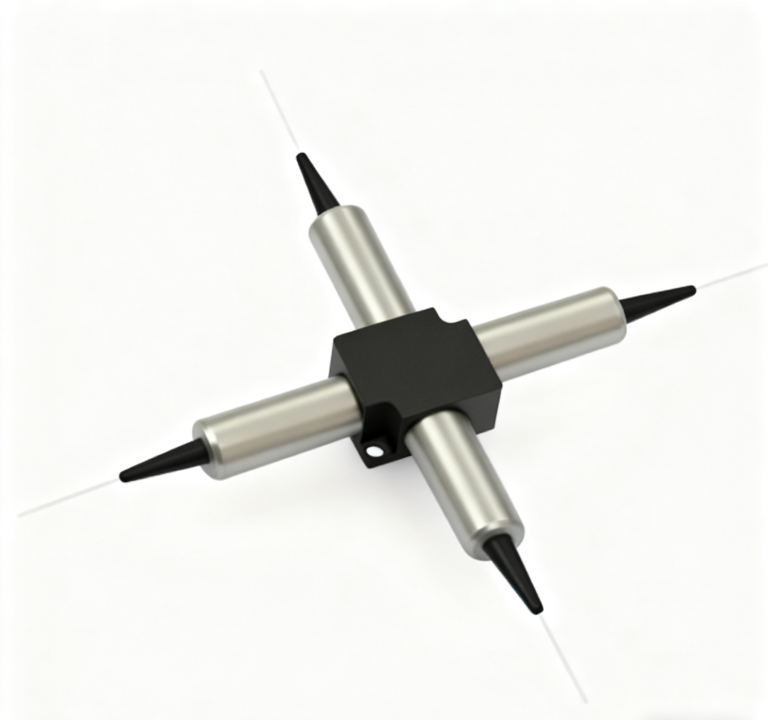
A pyramidal lensed fiber manufacturer should be selected from the required output pattern, not simply from the fact that the source is a high-power laser diode. Feiyi’s Four-Faceted Lensed Fiber / Pyramidal Lensed Fiber is built by precision-processing multiple facets at the fiber tip and lists a rectangular far-field pattern with a configurable wedge angle of 60°–120°. The product can be made from SM, MM, PM or customized fiber, with optional FC, LC, SC and SMA connectors and PC/APC choices.
That makes this product most relevant when the optical system benefits from a deliberately rectangular or multi-axis-shaped beam rather than a simple round focus. Feiyi lists high-power laser-diode emission coupling into optical fiber as the primary application. The buyer should therefore provide the source far field, the desired rectangular output orientation, wavelength and target fiber before choosing the facet geometry.
A pyramidal lensed fiber manufacturer needs the desired rectangular spot orientation
A rectangular far field has a long direction and a short direction. The supplier and buyer need to agree how those directions relate to the laser package and fiber holder. If the four-faceted tip is rotated after assembly, the optical pattern can rotate with it even though the fiber type and wedge angle remain correct.
Put the required rectangle orientation on the drawing relative to a mechanical datum. This is especially important in high-power diode modules where the fiber may be permanently fixed after alignment and cannot be rotated during service.
Long-axis and short-axis labels should be carried into the production fixture
A prototype engineer can visually optimize a beam on a camera, but production needs a repeatable reference. Mark which facet orientation corresponds to the required long and short axes so the assembly fixture does not rely on operator judgment.
The 60°–120° facet angle range should be tuned to the actual diode output
Feiyi lists a configurable wedge angle from 60° to 120°. The correct value depends on the laser-diode far field and the required transformation at the fiber tip. A high-power diode with a very asymmetric beam may need a different facet geometry from a lower-divergence source at the same wavelength.
For a sample program, keep the diode package and alignment method constant while comparing facet angles. Otherwise a change in laser position can be mistaken for an improvement in the fiber geometry.
A four-facet geometry should not be reduced to one angle number in the purchase description
The drawing should preserve the overall facet orientation, not only the nominal angle. If different facets are meant to act on different source axes, their relation to the laser must remain controlled through assembly.
Rectangular far field is the reason to compare pyramidal and wedge lensed fibers before ordering
Feiyi’s Wedge Lensed Fiber uses a two-facet wedge and lists a tip radius of 8–12 µm, wedge angle of 60°–120° and applicable far-field divergence of 15°–40°. The pyramidal product instead highlights a rectangular far-field pattern. Those are different design intents.
If the source needs mainly elliptical-beam correction into a fiber mode, the wedge route may be appropriate. If the target requires rectangular output shaping or four-facet symmetry, the pyramidal geometry deserves separate evaluation. Do not substitute them because both product names include “lensed fiber.”
SM, MM and PM options should be matched to what happens after the rectangular beam is formed
Feiyi offers single-mode, multimode, polarization-maintaining and customized fibers for the four-faceted product. The correct fiber is determined by the downstream optical system. A multimode high-power delivery path may value acceptance area and power transfer differently from a PM sensing path that needs a controlled polarization axis.
For a PM version, the polarization-axis convention should be included on the same drawing as the rectangular far-field orientation. The system may need the PM slow axis aligned with either the long or short dimension of the desired beam. Leaving those as separate documents creates an avoidable assembly ambiguity.
Polarization axis and rectangular spot axis should not share one unlabeled arrow
If both are important, draw both. A technician should be able to tell whether an arrow refers to PM fiber orientation, the long dimension of the far field, or a mechanical flat on the holder.
High-power diode coupling should include the source package and thermal operating point
Feiyi describes the pyramidal lensed fiber for coupling high-power laser-diode emission into optical fiber. A buyer should state the source wavelength, expected operating power, package type and relevant far-field behavior at the real operating condition. Diode beam characteristics can change with drive and temperature, so a geometry optimized only at a low-power alignment point may not represent production use.
The product page does not publish a specific optical power rating for the pyramidal tip, so the article should not invent one. If the project has a defined high-power requirement, ask Feiyi to confirm the configuration for that power, fiber and coating combination.

Direct processing without auxiliary adhesive keeps the micro-optic at the fiber itself
Feiyi states that the bare-fiber tip is processed directly without auxiliary adhesive and that optical coatings can be applied directly to the endface. For a compact diode package, this keeps the shaped optical surface at the fiber tip rather than adding a separate bonded lens element.
The buyer should still define how the tip is held. A production clamp designed for ordinary stripped fiber can damage a four-faceted microstructure if it is positioned too close to the processed region. Preserve the stripped length and protected-tip clearance in the mechanical drawing.
Coating requirements should follow the diode wavelength and reflection sensitivity
Feiyi can deposit optical thin films on the processed fiber endface. If the high-power source is sensitive to reflected light, specify the wavelength band and the purpose of the coating. Do not assume that the same coating used on a different diode or wedge-fiber project belongs on the pyramidal build.
Coating and facet geometry should be qualified together because both participate in the optical interface. A sample that meets the desired rectangular far field without the final coating is not automatically equivalent to the production part after coating is added.
A coating revision should trigger a short requalification of coupling and far-field shape
If coating design changes, repeat the measurements that matter to the application. The point is not to retest every property from zero, but to confirm that the revised optical surface still produces the approved coupling and beam pattern.
The connector should be chosen after the custom tip and mounting geometry are stable
Feiyi lists FC, LC, SC and SMA connector options with PC/APC variants. In many OEM diode modules, the processed tip will be the critical end while the remote connector simply interfaces with test equipment or another subsystem. Keep the custom tip geometry, fiber type and finished fiber length visible in the purchase description even when a familiar connector is used.
For a bare-fiber design, specify enough stripped length for the alignment holder without exposing unnecessary unsupported fiber. Feiyi states that fiber length and stripped coating length can be customized.
The -40 to 85 °C operating range should be reviewed with the final package
The product page lists -40 to 85 °C operating temperature, 0–85% relative humidity and a statement of compliance with Telcordia GR-1221 and GR-63 Core environmental or reliability testing. Those are Feiyi site claims for the product family. If the lensed fiber is bonded into a high-power diode package, the customer should still confirm that the complete assembly process is compatible with its own environmental requirement.
A laboratory coupling experiment may never approach those limits, while an industrial module can experience thermal cycling and vibration from neighboring hardware. Use the system environment to decide the acceptance plan.
Far-field inspection should be part of first-article approval, not inferred from total coupled power
A four-faceted tip can deliver useful total power while the rectangular pattern is rotated, distorted or sized differently from what the next optical element expects. During first-article evaluation, capture the far-field pattern or another application-relevant beam measurement together with the coupled-power result.
For production, the inspection method can be simplified if the relationship between geometry and performance is stable, but the approved reference should preserve the beam shape that justified the pyramidal design.
A reference image should include scale and orientation if it is used for comparison
A camera image without scale can make two different spot sizes look equivalent. If a beam image is kept in the acceptance file, note the observation distance, orientation and scale or measurement method so a later lot can be compared meaningfully.
Shipping protection must keep all four processed facets away from hard contact
The four-facet region is the functional micro-optic. If the project needs a protective sleeve, cap, ferrule clearance or tray, specify that handling requirement. The fiber tip should not be free to strike the package or another fiber during transit.
At receiving, inspect the tip and orientation before installing it in the high-power diode fixture. Contamination or a chipped facet can alter the far field and look like an incorrect design angle.
A pyramidal lensed fiber should not replace an angled tip in a side-illumination design without optical review
Feiyi’s Angled Lensed Fiber is aimed at reflection control and deliberate beam-path deflection, including side illumination and 90° path concepts. The pyramidal product is presented around rectangular far-field shaping and high-power diode coupling. These roles can overlap, but they are not the same.
If the customer changes from one geometry to another, treat the move as a source-to-target optical redesign. Connector compatibility and fiber type alone are not enough to declare the parts interchangeable.
A repeat order should preserve the rectangular-beam requirement together with the facet geometry
After the first build is approved, keep the source wavelength and package, desired rectangular far-field orientation, selected 60°–120° facet angle, fiber type, PM-axis convention where applicable, coating requirement, connector or bare-fiber termination, fiber length, stripped length and protected-tip handling requirement. If the source operating power is important, include the value Feiyi confirmed for that exact configuration.
Feiyi’s wedge and angled lensed-fiber pages provide nearby alternatives, but the four-faceted part should remain a distinct controlled item when the rectangular beam is the reason it was selected. A useful repeat-order file lets the next engineer understand the beam-shaping objective without reverse-engineering the original prototype.
Prototype comparison should separate beam-shape success from assembly sensitivity
When two four-facet samples produce a similar rectangular far field, the better production choice may be the one that is less sensitive to small axial, lateral or rotational placement errors. During prototype evaluation, record how much adjustment is required to recover the approved spot after the fiber is removed and reinstalled. This gives the buyer an assembly-tolerance view rather than only a best-case optical image.
That distinction matters in a high-power module where the fiber may be bonded after one alignment operation. A geometry that needs continual fine rotation on a laboratory stage can be difficult to transfer to a fixed holder. If the production fixture has a defined positioning tolerance, evaluate the pyramidal sample within that window before freezing the facet angle.
For repeat manufacturing, keep the approved holder reference and fiber-tip orientation together so optical performance is not separated from the mechanical condition that produced it.
[executed on device: SK-20260121JOTG (a251fff9-956e-47b5-9307-14fb53329ed2)]
[executed on device: SK-20260121JOTG (a251fff9-956e-47b5-9307-14fb53329ed2)]