Fiber Optic Splitter Supplier: Choose Between Couplers and PLC Distribution by the Optical Job
A buyer searching for a fiber optic splitter supplier should not begin by asking for “a 1 x 2 splitter.” That phrase can describe different optical jobs. One project may need equal 50/50 power division for monitoring, another may need a 10/90 tap that leaves most power on the main path, and a third may need a PLC device distributing one feeder to 16, 32 or 64 branches. The split ratio, wavelength range, port count and package must be defined together.
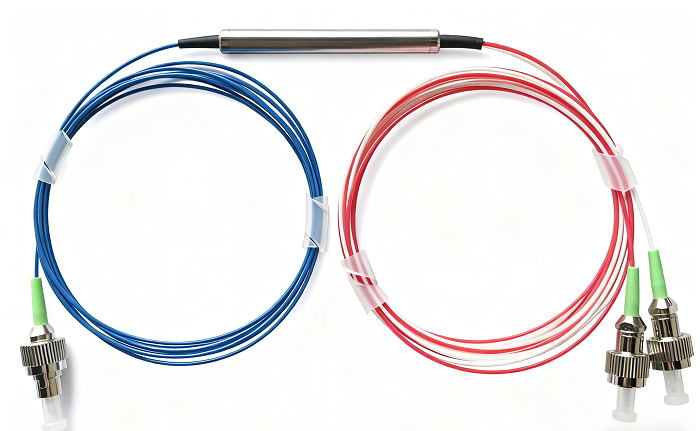
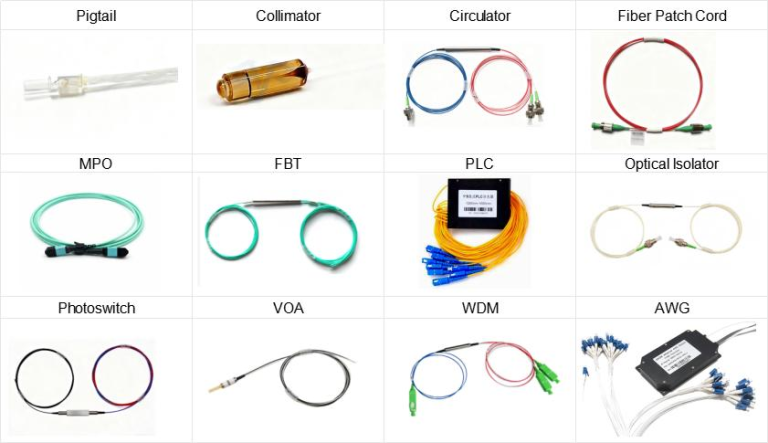
Feiyi’s passive splitter range includes single-mode fused couplers, single-mode double-window couplers, multi-film couplers and PLC splitters in mini, insert and ABS-box formats. These products overlap in the broad idea of dividing light, but they should not be treated as interchangeable. A supplier discussion becomes much clearer when the buyer first decides whether the system needs a low-port-count coupling ratio or a high-port-count distribution tree.
A fiber optic splitter supplier should separate coupling ratio from port count
Port count answers how many physical paths exist. Coupling ratio answers how optical power is divided between them. For an equal two-way split, those ideas happen to align. For monitoring taps and asymmetric branches, they do not.
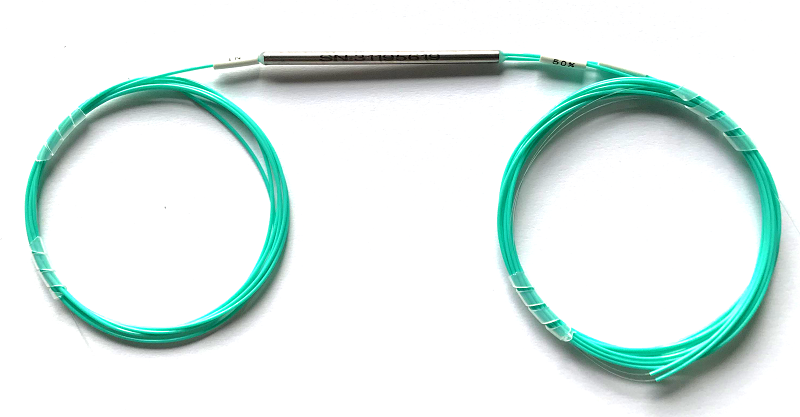
A 50/50 fused coupler fits a balanced two-branch optical path
Feiyi’s Single mode coupler page publishes 1 x 2 or 2 x 2 port configurations and a 50/50 standard coupling ratio. The listed typical excess loss is 0.07 dB for P Grade and 0.1 dB for A Grade, while maximum insertion loss is 3.4 dB and 3.5 dB respectively for the 50/50 standard coupler. Published operating wavelengths include 1310, 1480 and 1550 nm or a custom wavelength.
A laboratory instrument that intentionally sends similar power to two detectors can use this type of architecture. A network monitor that only needs a small tap should not automatically use 50/50, because half of the nominal optical power would be diverted from the primary path before excess loss is considered.
An unequal coupler can protect the main path while feeding a monitor
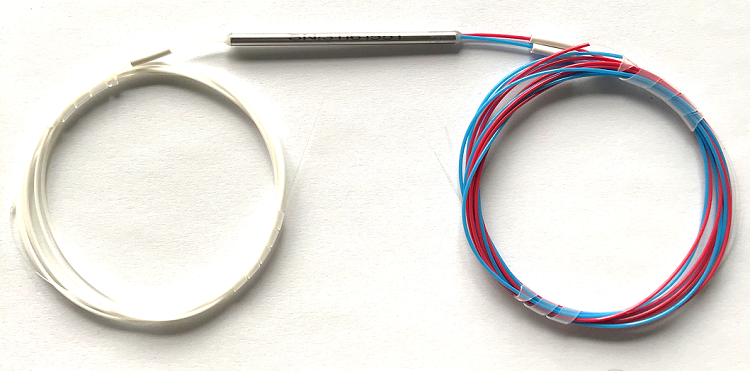
Feiyi’s wideband single-mode coupler specification lists coupling-ratio options from 1% to 50%. The page provides example ratio/loss pairs such as 10/90, 20/80, 30/70 and 40/60. This type of device can be useful when one output exists mainly for monitoring or feedback while the other carries the working signal.
An OEM should specify which physical lead is the high-power branch and which is the tap branch. Writing “10/90” without a port definition leaves room for an assembly error even if the optical component itself meets the requested ratio.
High branch counts point a fiber optic splitter supplier toward PLC technology
When one feeder must be distributed to many outputs, the purchasing problem changes. Instead of choosing a two-port coupling ratio, the buyer needs a controlled multi-branch distribution device with acceptable insertion loss and uniformity across all outputs.
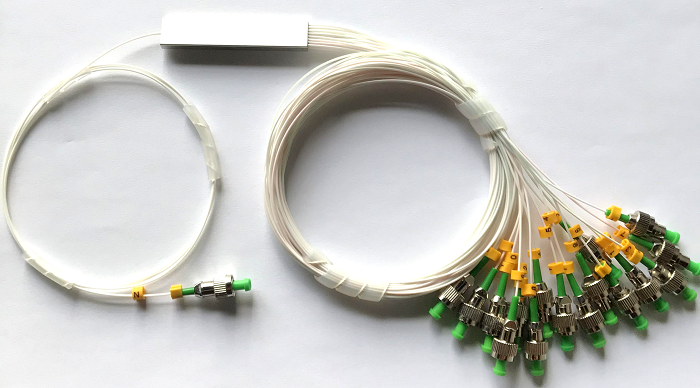
Feiyi PLC splitters cover 1 x N and 2 x N configurations up to 128 outputs
Feiyi publishes PLC Splitter – Mini, Insert Type and ABS Box versions. The 1 x N table includes 1 x 2, 1 x 4, 1 x 8, 1 x 16, 1 x 32, 1 x 64 and 1 x 128. A separate 2 x N table extends the same idea to two inputs.
The published operating wavelength is 1260-1650 nm with G657A1 or customer-specified fiber. This broad operating range suits passive optical distribution, but the network designer still needs to check the actual service wavelengths and complete power budget.
The split ratio determines insertion loss before packaging is even discussed
For Feiyi’s 1 x N PLC specification, the P/S insertion-loss figures progress from 3.8/4.0 dB at 1 x 2 to 10.2/10.5 dB at 1 x 8, 13.5/13.7 dB at 1 x 16, 16.5/16.9 dB at 1 x 32 and 20.5/21.0 dB at 1 x 64. The 1 x 128 values are 23.8/24.2 dB.
A contractor should therefore calculate the optical budget before deciding that a larger splitter creates “more flexibility.” More branches mean less power at each output. If the longest drop is already close to receiver sensitivity, moving from 1 x 16 to 1 x 32 can require changes elsewhere in the network.
Wavelength behavior helps decide which fiber optic splitter family fits the system
A splitter is not automatically wavelength-neutral. The intended operating band and the device’s published wavelength behavior need to match the optical source and receiver.
Single-mode couplers support defined telecom wavelengths and custom options
Feiyi’s Single mode coupler lists 1310, 1480 and 1550 nm or custom wavelength for the standard version. The wideband version supports the same general telecom use while offering a range of coupling ratios. The Single mode double window coupler publishes 1310/1550 plus or minus 40 nm or custom wavelength.
A dual-window system carrying both 1310 and 1550 nm should therefore be evaluated with a product intended for those windows rather than assuming a narrow single-wavelength coupler will behave identically across both bands.
PLC covers a broad 1260-1650 nm passive distribution window
Feiyi’s PLC splitter specification spans 1260 to 1650 nm. Wavelength-dependent loss is listed at 0.3 dB for lower split counts and up to 0.5 dB for higher counts in the published table. PDL is listed from 0.2 dB at lower ratios up to 0.4 dB for 1 x 128.
For a PON or broadband distribution network, those parameters belong in the system budget. A commissioning team should test at wavelengths relevant to the service rather than qualify the splitter at one wavelength and assume identical results everywhere in the band.
A fiber optic splitter supplier should help prevent the wrong technology from becoming a field replacement
Fused couplers and PLC splitters can both divide light, so replacement requests based on photographs or port count can be misleading. The accepted part should be identified by optical function as well as connector and package.
A 1 x 2 PLC and a 1 x 2 fused coupler are not automatically substitutes
A 1 x 2 PLC can provide broad-band equal splitting in a platform designed around PLC technology. A fused coupler can offer equal or deliberately unequal ratios and may be selected for a different wavelength or monitoring role. The right replacement depends on the original design intent.
A maintenance team should therefore retrieve the old specification or measure the installed function before changing technologies. If the original branch was a 10% monitor tap, installing a 50/50 equal splitter would change the system power distribution even though both devices have one input and two outputs.
A double-window coupler can be important where two telecom bands share the same split
Feiyi’s Single mode double window coupler lists 1 x 2 or 2 x 2 configurations, 50/50 standard splitting and a published 1310/1550 plus or minus 40 nm operating window. The page lists maximum insertion loss of 3.5 dB for the standard 50/50 case and typical excess loss of 0.1 dB.
A fiber sensor or telecom assembly using both windows can therefore treat the dual-band behavior as part of the approved requirement. Replacing it with a component qualified only around one wavelength may change the second wavelength path even if room-temperature loss at the first wavelength looks correct.
Packaging should be selected after the splitter function is settled
Feiyi’s splitter products range from compact fused devices to mini PLC modules, insert units and ABS boxes. The mechanical form controls how fibers are protected, routed and serviced but should not be used to infer the optical split.
A mini PLC device works where the surrounding enclosure provides fiber management
Mini splitters can fit into compact distribution hardware where the enclosure already controls strain relief and connector organization. The buyer should verify module dimensions for the selected split count and reserve enough space for the pigtails.
Higher split counts create more fibers. A compact body does not remove the need for bend-radius control and clear port identification. The installer should be able to trace each output without pulling on adjacent fibers.
Insert and ABS-box PLC versions serve different maintenance environments
An insert-type splitter can suit modular field hardware designed around replaceable units. An ABS-box splitter gives the optical element a protected housing with external leads. The project should choose based on the enclosure and servicing method rather than assuming one package is universally more robust.
For distributors, package style should have its own stock code. “1 x 8 PLC” is not enough when one customer needs an insert module and another needs a pigtail-style ABS box.
Receiving inspection should verify the power distribution the fiber optic splitter supplier was asked to provide
For a low-port-count unequal coupler, measure both branches and confirm that the high- and low-power outputs match the port definition. For an equal coupler, record the loss on both outputs. For a PLC splitter, check enough outputs to reveal channel-to-channel uniformity and any unusually weak branch.
Use clean interfaces before judging loss or return performance
Feiyi’s single-mode coupler pages list minimum directivity of 55 dB for the wideband configurations, while the PLC table publishes directivity of 55 dB and return-loss values of 55/50 dB for the listed P/S grades. Contaminated connectors or unstable launch conditions can corrupt these measurements.
Inspect and clean connector end faces before testing. If bare fibers are used, document the splice or launch arrangement. The acceptance record should be repeatable enough that a later replacement can be compared under similar conditions.
Choose a supplier by whether the product map matches the optical job
Feiyi’s relevant starting points include the Single mode coupler, Single mode double window coupler, Multi film coupler, PLC Splitter – Mini, PLC Splitter – Insert Type and the broader optical splitter range.
A distributor stocking replacement parts should classify them first by optical function: equal two-way, unequal monitoring tap, dual-window coupler or high-port-count PLC distribution. An engineer designing a new system should add wavelength, split ratio, loss budget and package. Once those fields are clear, the supplier can select a real component instead of trying to interpret the word “splitter” after the order has already been placed.
A sample approval should lock the branch identity as well as the measured ratio
When a buyer approves an unequal 1 x 2 coupler, keep a simple drawing that marks which physical output is the tap and which remains on the main optical path. Record the wavelength, coupling ratio, connector or pigtail format and the acceptance readings from that sample. If a later replacement arrives with the same nominal ratio but the high-power branch is assigned to the opposite lead, the component can pass its own optical test and still be wired incorrectly in the instrument.
The same discipline helps distributors. A 10/90 coupler, a 50/50 dual-window coupler and a 1 x 16 PLC module should never be grouped under one vague \u201cfiber splitter\u201d stock description. Keeping the optical function in the item name makes it much easier for sales, receiving and field technicians to select the intended replacement without reopening the engineering decision every time.