
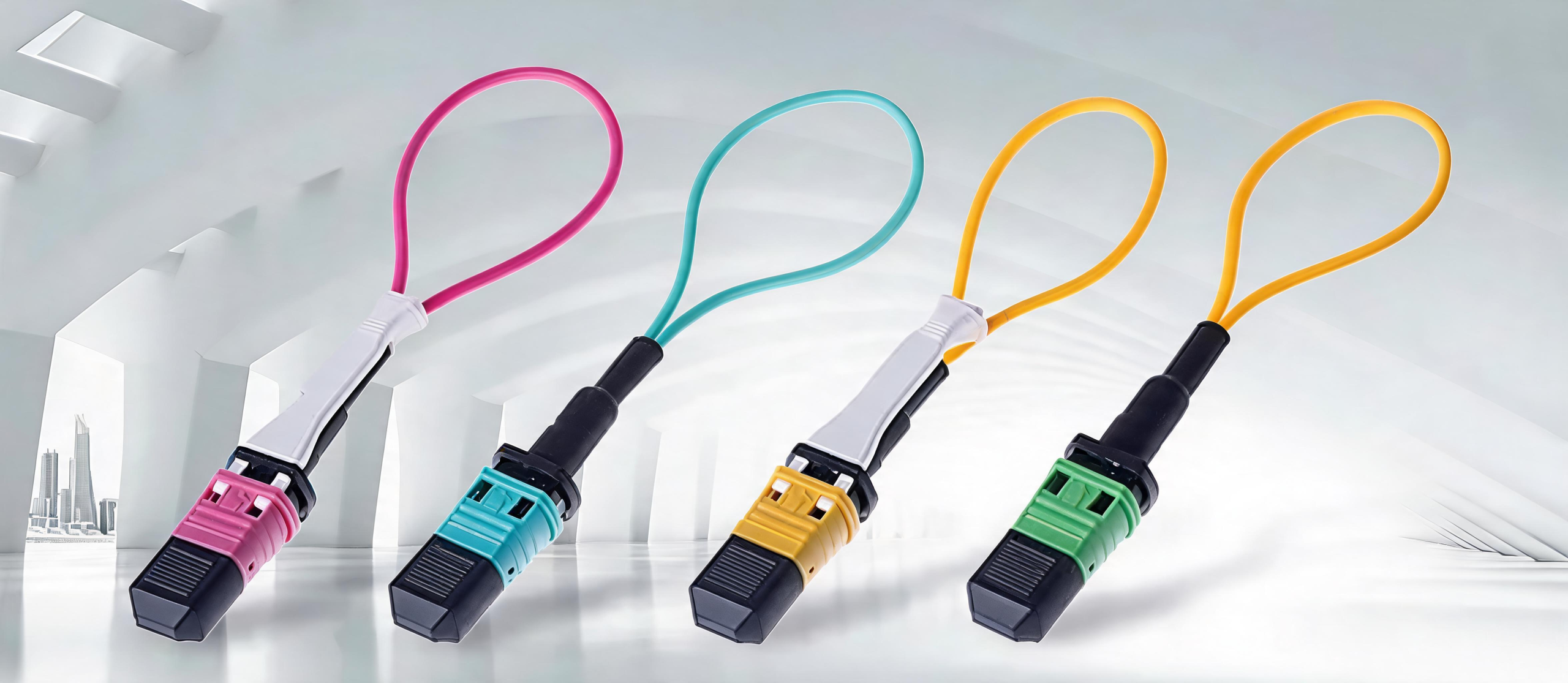
MPO/MTP High-Density Fiber Connectivity: Types, Gender, Polarity, and Applications
Introduction
With the rapid development of cloud computing, artificial intelligence (AI), hyperscale data centers, and high-speed optical networks, traditional fiber cabling solutions are facing increasing challenges in terms of space utilization, installation efficiency, and scalability.
MPO/MTP high-density fiber assemblies have become a critical solution for modern optical connectivity, enabling fast deployment and reliable transmission for 40G, 100G, 400G, and 800G networks.
This article explains the structure, fiber counts, connector gender, polarity types, and major applications of MPO/MTP fiber systems.
1. What is an MPO/MTP Fiber Assembly?
MPO (Multi-fiber Push-On) is a multi-fiber optical connector designed for high-density fiber connections.
Compared with traditional LC or SC connectors, MPO connectors integrate multiple fibers into a compact ferrule, significantly increasing port density and reducing cable management complexity.
An MPO/MTP assembly typically consists of:
- MPO/MTP connectors
- Multi-fiber optical cable
- Fiber ribbon
- Protective jacket
- Precision alignment components
MPO/MTP pre-terminated cabling systems are factory assembled and 100% tested before shipment, ensuring stable optical performance and reducing installation time in the field.
2. Advantages of MPO/MTP Pre-Terminated Fiber Systems
A. Improved Quality and Reliability
Factory-terminated MPO/MTP assemblies are manufactured under controlled conditions and tested before delivery.
Benefits include:
- Consistent optical performance
- Reduced installation errors
- Faster deployment
- Reliable long-term operation
Compared with field termination, pre-terminated solutions provide better quality control and easier project management.
B. High-Density Cabling and Space Saving
Data centers require more connections within limited rack space.
MPO/MTP solutions provide:
- Higher port density
- Reduced cable volume
- Better airflow management
- Easier cable organization
This makes them ideal for high-density environments such as:
- Data centers
- AI computing clusters
- Cloud infrastructure
- Telecom backbone networks
C. Faster Installation and Lower Labor Cost
Traditional fiber deployment requires extensive field termination, splicing, and testing.
MPO/MTP pre-terminated assemblies provide:
- Plug-and-play installation
- Reduced deployment time
- Lower labor requirements
- Simplified maintenance
They are especially suitable for large-scale data center projects requiring rapid deployment.
3. MPO Fiber Counts and Configurations
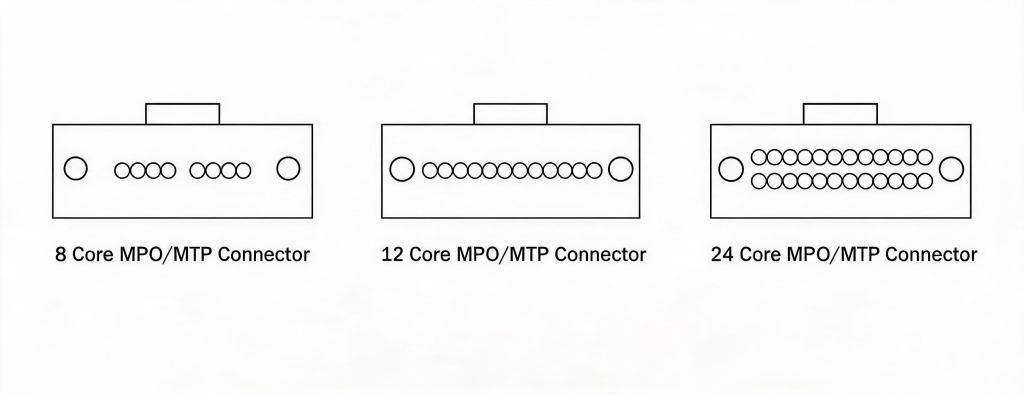
MPO connectors are available in various fiber counts, including:
- 8 fibers
- 12 fibers
- 16 fibers
- 24 fibers
- 32 fibers
- 48 fibers
- 72 fibers
- 144 fibers
Among these, the most commonly used configurations are:
MPO-12
Widely used in:
- 40G optical links
- 100G SR4 applications
- Data center backbone connections
MPO-24
Used for higher-density applications requiring more fiber channels.
MPO-16 / MPO-32
Designed for next-generation high-speed networks, including:
- 400G optical transmission
- 800G optical interconnects
- AI and HPC environments
As network speeds continue increasing, higher-density MPO solutions are becoming increasingly important.
4. MPO Connector Male and Female Types
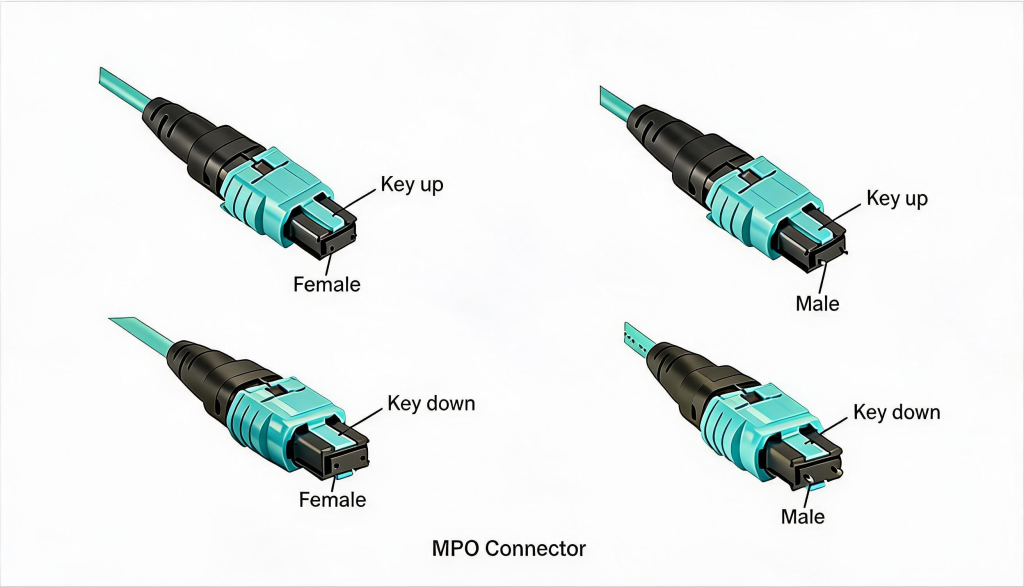
An MPO connector includes:
- MT ferrule
- Guide pins (PIN)
- Key structure
- Spring mechanism
- Housing
- Dust cap
MPO connectors are divided into two types:
Male MPO Connector
Features:
- Two guide pins (PINs)
- Provides precise fiber alignment
Female MPO Connector
Features:
- No guide pins
- Designed to mate with male connectors
For proper connection, two MPO connectors must be paired as:
Male + Female
The guide pins ensure accurate alignment between the fiber cores.
5. Understanding MPO Polarity
MPO polarity defines how optical signals are transmitted from one end of the link to the other.
A complete optical connection requires:
Transmitter (Tx) → Fiber Link → Receiver (Rx)
Incorrect polarity can result in:
- Signal transmission failure
- Tx/Rx mismatch
- Network troubleshooting difficulties
Therefore, selecting the correct MPO polarity is essential for reliable optical networks.
6. Three Common MPO Polarity Types
Type A — Straight Polarity
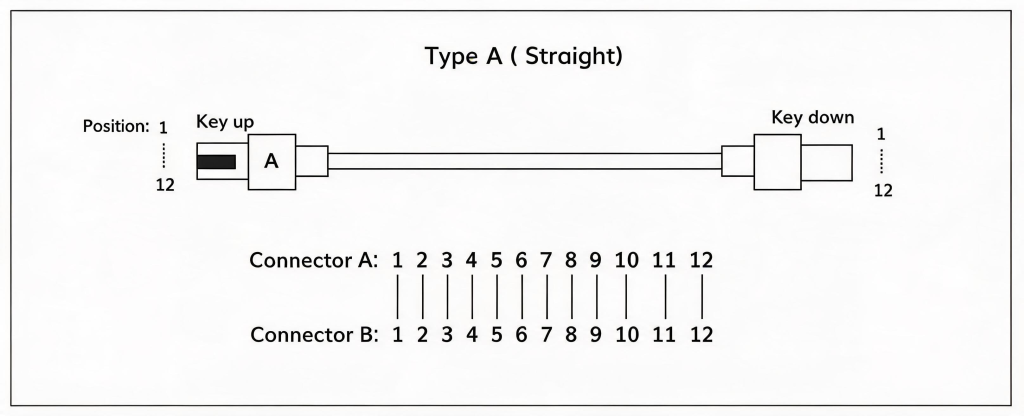
Type A provides a straight-through fiber arrangement.
Example:
Fiber 1 → Fiber 1
Fiber 12 → Fiber 12
Characteristics:
- Fiber positions remain unchanged
- Connector keys are opposite:
Key Up ↔ Key Down
Applications:
- Backbone cabling
- Structured fiber networks
Type B — Reversed Polarity
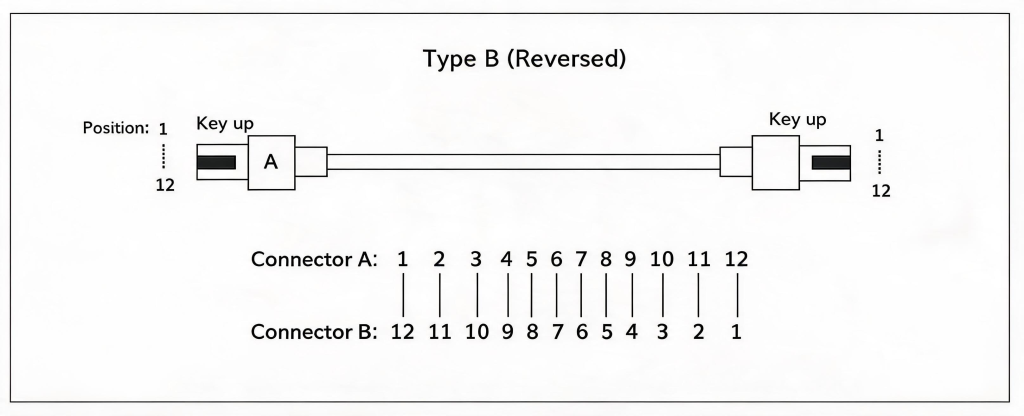
Type B reverses the fiber positions.
Example:
Fiber 1 → Fiber 12
Fiber 12 → Fiber 1
Characteristics:
- Connector keys have the same orientation:
Key Up → Key Up
Applications:
Commonly used in:
- Parallel optics
- 40G SR4
- 100G SR4
- High-speed data center links
Type C — Pair-Reversed Polarity
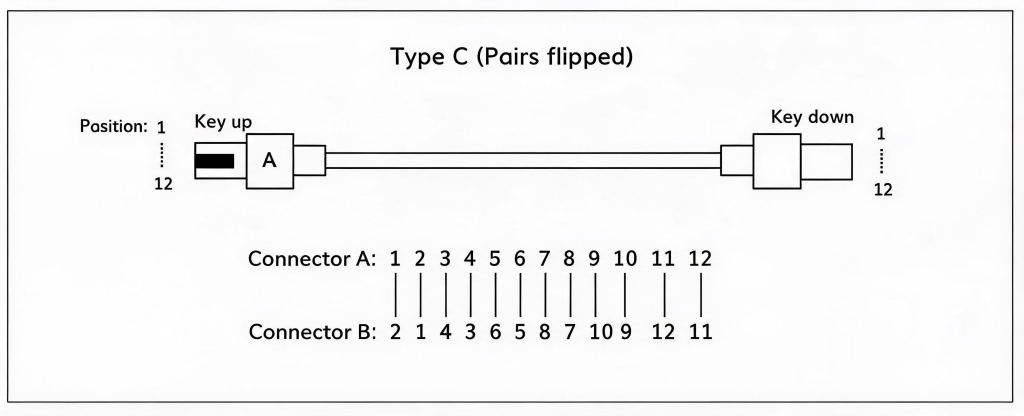
Type C reverses fiber pairs.
Example:
Fiber 1 → Fiber 2
Fiber 2 → Fiber 1
Fiber pairs are swapped while maintaining duplex channel alignment.
Applications:
- Duplex transmission systems
- Structured cabling environments
7. What is MTP?
MTP (Multi-fiber Termination Push-On) is an enhanced version of the MPO connector developed by US Conec.
Compared with standard MPO connectors, MTP provides improvements in:
- Optical performance
- Mechanical reliability
- Connector precision
- Insertion loss consistency
MTP connectors comply with MPO standards and are fully compatible with MPO systems.
8. Applications of MPO/MTP Fiber Assemblies
MPO/MTP technology is widely used in:
Data Centers
Applications:
- Server-to-switch connections
- Switch-to-switch links
- High-density backbone cabling
High-Speed Optical Networks
Supporting:
- 40G
- 100G
- 400G
- 800G optical systems
AI and High-Performance Computing
AI clusters require massive bandwidth and low-latency optical connections.
MPO/MTP assemblies enable:
- High-density GPU networking
- Scalable optical interconnects
- Efficient fiber management
Telecom Networks
Used in:
- FTTH networks
- Central offices
- Optical distribution systems
Feiyi MPO/MTP Fiber Assembly Solutions
Shenzhen Feiyi Optoelectronics Communication Co., Ltd. provides customized MPO/MTP fiber connectivity solutions for data center and telecom applications.
Our capabilities include:
✔ MPO assemblies — from 8 fibers up to 24 fibers, and any custom fiber count in between
✔ Type A, Type B, and Type C polarity options
✔ Male and female MPO configurations
✔ Single-mode and multimode solutions
✔ Customized cable length and fiber configuration
✔ Low insertion loss and high reliability testing
✔ OEM and custom manufacturing support
With factory-direct manufacturing and strict quality control, Feiyi helps customers build reliable, scalable optical networks for next-generation connectivity.
Contact Feiyi for customized MPO/MTP fiber solutions.