
Why Optical Switches, Raman Filters, and Circulators Are the Unsung Heroes of Distributed Fiber Optic Sensing
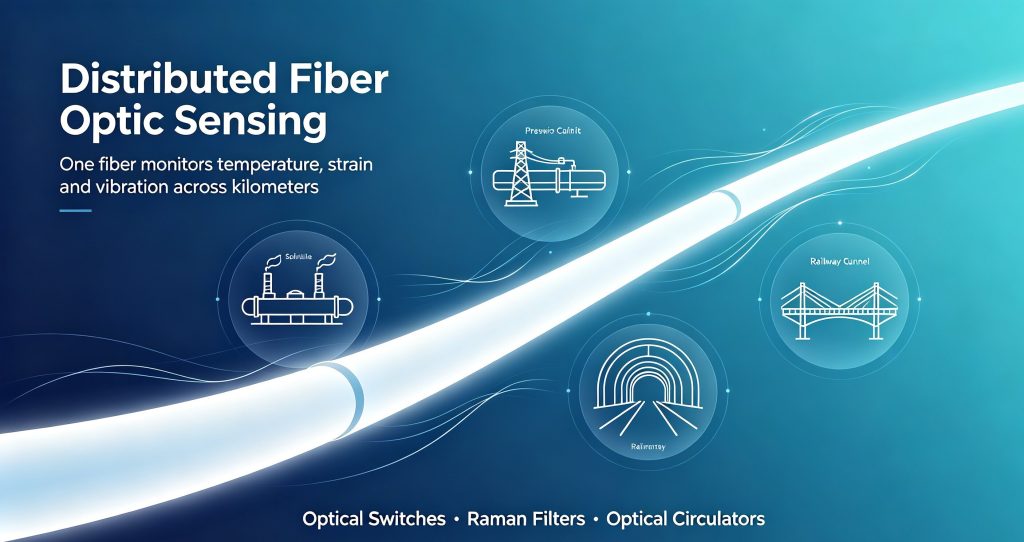
Discover how optical switches, Raman filters, and optical circulators improve signal integrity, channel scalability, and measurement accuracy in Distributed Fiber Optic Sensing (DFOS) systems.
The Invisible Technology Behind Smarter Infrastructure
A single fiber optic cable, stretching tens of kilometers, can now function as thousands of temperature or strain sensors—without a single electronic sensor installed along its path. That is the power of Distributed Fiber Optic Sensing (DFOS).
Behind this remarkable capability, however, lies a carefully engineered optical architecture. Among its most critical yet often overlooked components are optical switches, Raman filters, and optical circulators. Together, they ensure that optical signals are routed, separated, and filtered with the precision required for reliable distributed sensing.
As industries increasingly rely on real-time infrastructure monitoring, these passive optical components have become indispensable building blocks for high-performance sensing systems.
How Distributed Fiber Optic Sensing Works
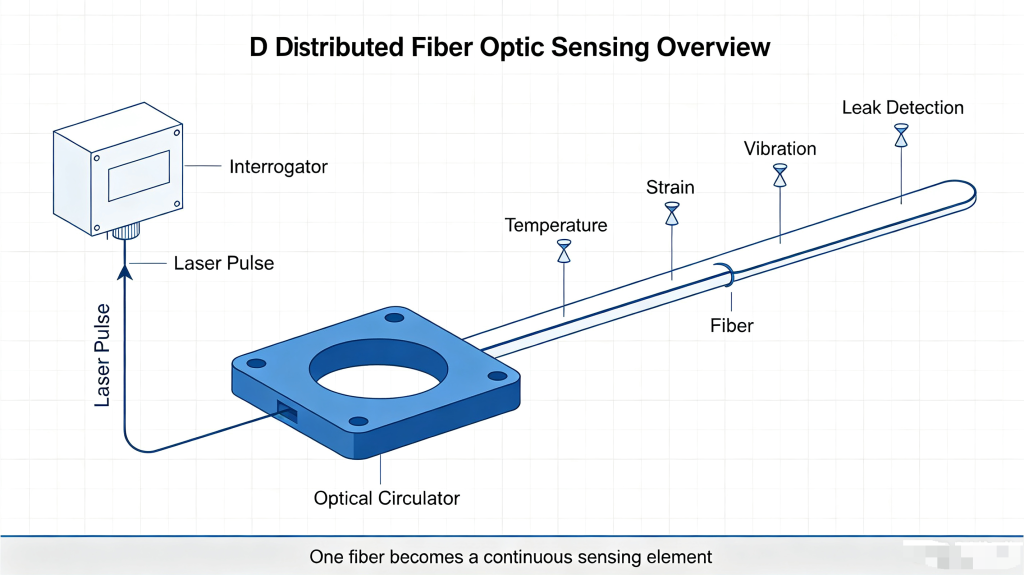
Distributed Fiber Optic Sensing transforms a standard optical fiber into a continuous sensing element capable of monitoring conditions along its entire length.
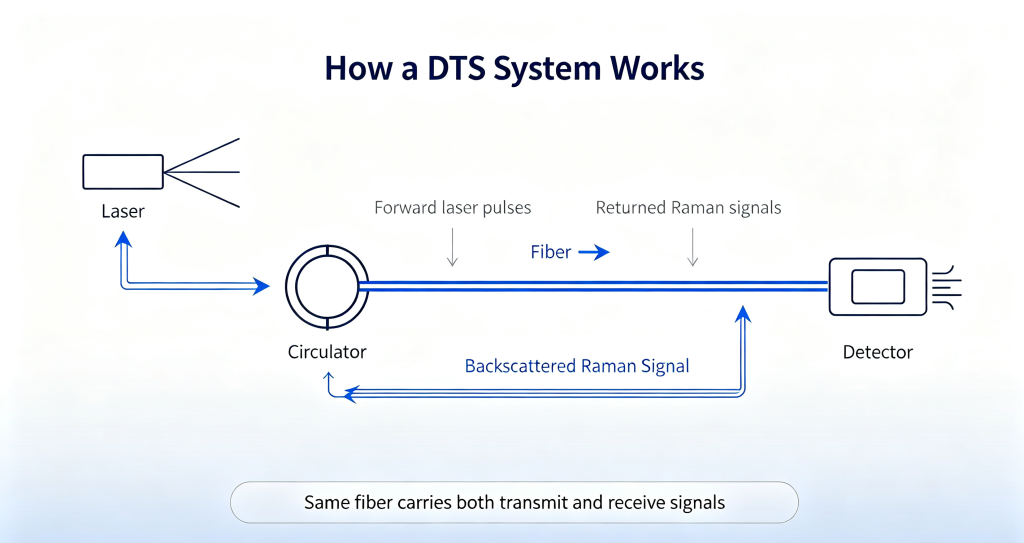
In a typical Distributed Temperature Sensing (DTS) system, a pulsed laser injects light into the sensing fiber. As the light travels, a tiny portion is naturally scattered back toward the interrogator. By analyzing the characteristics of this backscattered light, the system can determine temperature at every point along the fiber.
Because these returned signals are extremely weak, maintaining signal integrity throughout the optical path is essential. This is where optical switches, Raman filters, and circulators play a critical role.
Optical Switch: Expanding Monitoring Capacity
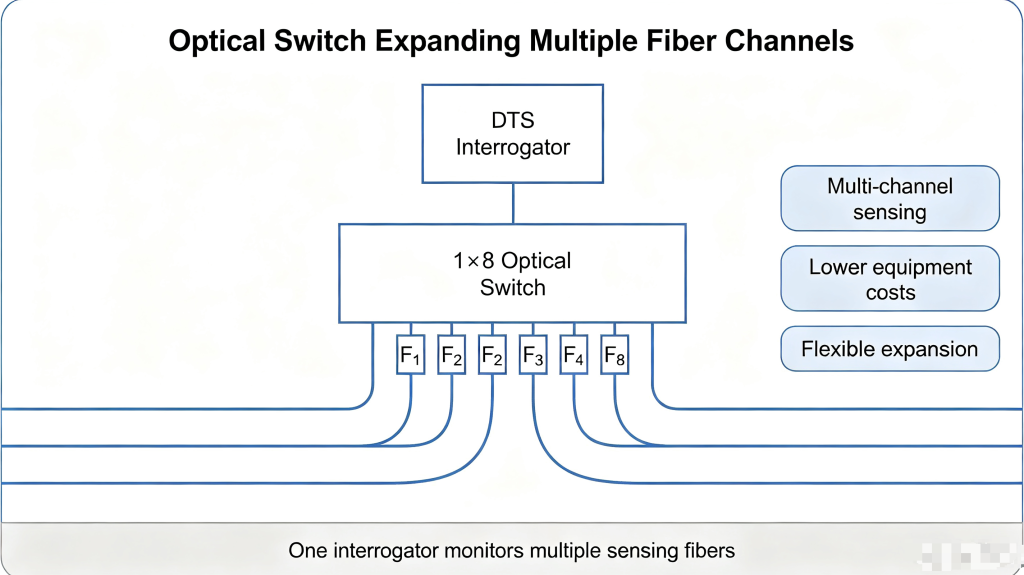
An optical switch enables a single interrogator to monitor multiple sensing fibers.
Instead of deploying dedicated equipment for every sensing line, the switch sequentially connects different fiber channels to the same measurement system. This significantly improves equipment utilization while reducing system complexity and overall deployment costs.
Typical applications include:
- Pipeline monitoring
- Power cable networks
- Tunnel fire detection
- Multi-zone industrial facilities
- Redundant sensing paths
For remote and unattended installations, latching optical switches are often preferred because they maintain their switching position even when power is removed, helping reduce power consumption while improving operational reliability.
Why It Matters
- Enables multi-channel sensing with one interrogator
- Expands monitoring coverage without additional hardware
- Supports redundant fiber routing for improved system availability
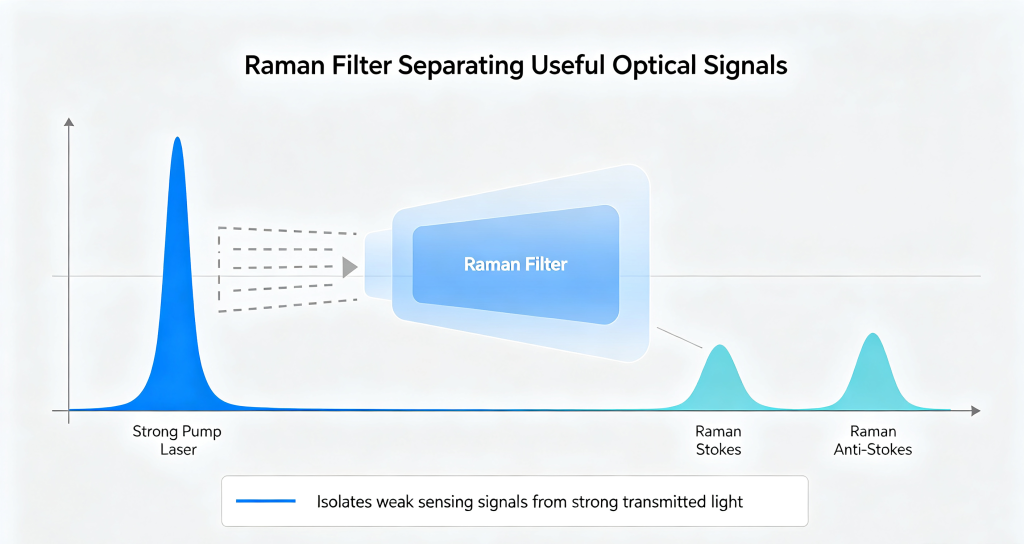
Raman Filter: Extracting the Useful Signal
The Raman backscattered signal contains the temperature information required for DTS measurement, but it is much weaker than the launched laser pulse.
A Raman filter selectively passes the desired sensing wavelengths while suppressing unwanted optical signals before they reach the photodetector. By improving the signal-to-noise ratio, the filter helps ensure more accurate and stable measurements.
Key benefits include:
- Improved signal quality
- Better measurement accuracy
- Enhanced long-distance sensing performance
- Reduced interference from unwanted wavelengths
The performance of the Raman filter directly influences the sensitivity and reliability of the overall sensing system.
Optical Circulator: Separating Forward and Return Signals
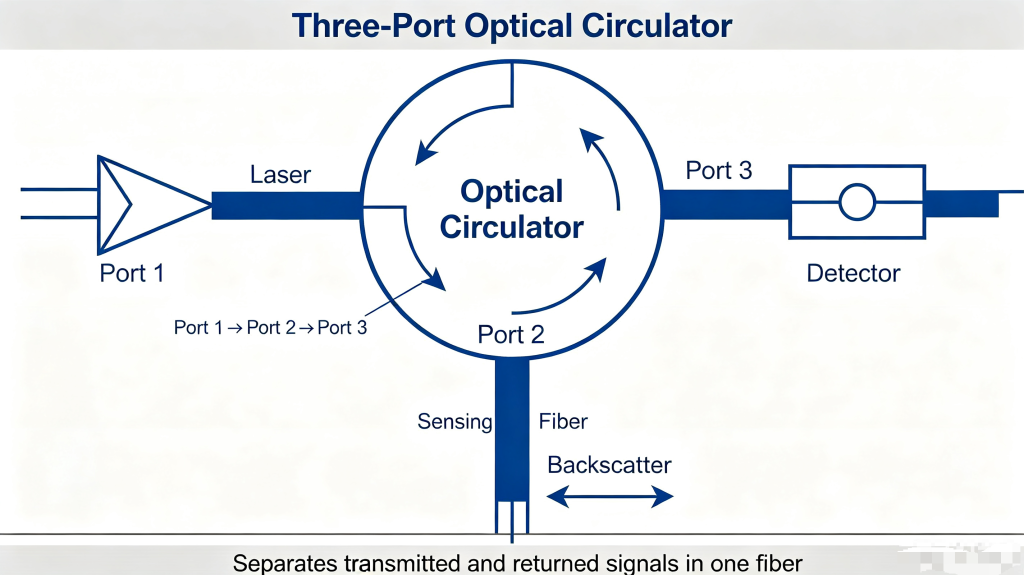
An optical circulator functions as a one-way traffic controller for light.
It directs the outgoing laser pulse into the sensing fiber while simultaneously routing the returning backscattered signal toward the receiver. This allows both transmission and reception to occur over a single fiber without interference.
Without a circulator, the much stronger transmitted light could overwhelm the extremely weak returned signal, making accurate detection difficult.
Optical circulators are widely used in:
- Raman Distributed Temperature Sensing (DTS)
- Brillouin Distributed Strain Sensing (BOTDR/BOTDA)
- Optical Time Domain Reflectometers (OTDR)
- Fiber optic test and measurement systems
Why It Matters
- Enables single-ended sensing architectures
- Provides excellent isolation between transmitted and received signals
- Improves overall measurement stability
How These Components Work Together
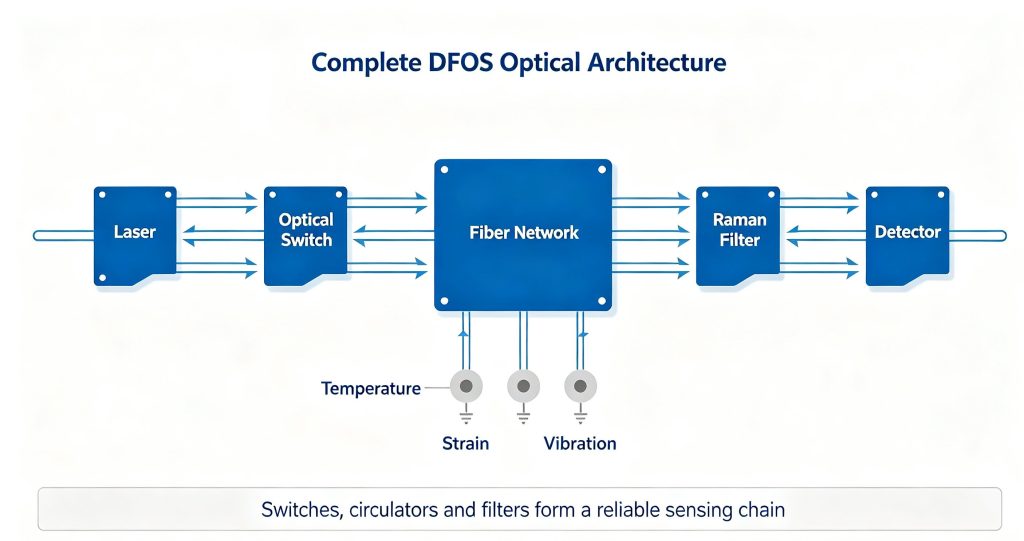
Although each component performs a different function, they operate as a coordinated optical chain within a distributed sensing system.
A typical signal path follows these steps:
- The laser pulse enters the sensing fiber through the optical circulator.
- Backscattered light returns through the circulator.
- Raman filters isolate the sensing wavelengths while suppressing unwanted optical signals.
- Optical switches connect different sensing fibers or monitoring channels as required.
- The interrogator analyzes the processed optical signals to generate continuous temperature or strain profiles.
Together, these components ensure efficient signal routing, separation, and filtering, enabling accurate measurements over long distances.
Applications Across Industries
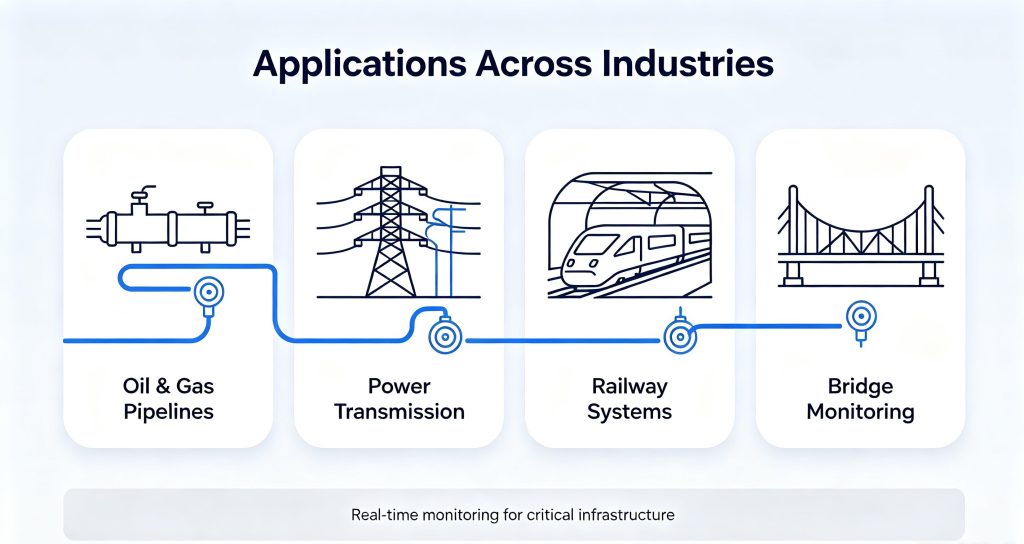
Distributed Fiber Optic Sensing has become an essential technology for monitoring critical infrastructure across a wide range of industries.
Oil & Gas
Continuous pipeline temperature monitoring, leak detection, and asset protection over long distances.
Power Utilities
Real-time monitoring of underground and submarine power cables to prevent overheating and improve network reliability.
Transportation
Fire detection and structural monitoring in tunnels, rail systems, and metro infrastructure.
Civil Engineering
Structural health monitoring of bridges, dams, buildings, and other critical assets.
Industrial Facilities
Process monitoring in harsh environments where conventional electronic sensors may be unsuitable.
Why Optical Component Quality Matters
Distributed sensing systems depend on detecting extremely weak optical signals. Even small amounts of optical loss or unwanted reflections can affect measurement performance.
High-quality passive optical components help deliver:
- Low insertion loss
- High return loss
- Excellent channel isolation
- Stable long-term performance
- Reliable operation across demanding environments
Selecting well-designed optical components contributes to greater measurement consistency, improved system stability, and lower maintenance over the lifetime of the installation.
Optical Components from Feiyi Optoelectronic
Feiyi Optoelectronic supplies a comprehensive range of passive optical components for telecommunications, industrial sensing, and fiber optic networking applications, including:
- Optical Switches
- Raman Filters
- Optical Circulators
- WDM Components
- PLC Splitters
- AWG Modules
- Fiber Optic Passive Components
Manufactured under an ISO 9001-certified quality management system, our products are designed to support OEMs, system integrators, and equipment manufacturers with reliable performance and flexible customization options.
Whether you are developing a new distributed sensing platform or optimizing an existing design, our engineering team can help identify the right optical components for your application.
Looking Ahead
As industries continue investing in smarter infrastructure and predictive maintenance, Distributed Fiber Optic Sensing will play an increasingly important role in ensuring safety, efficiency, and operational reliability.
Behind every successful DFOS system is a carefully designed optical architecture. While optical switches, Raman filters, and circulators often remain hidden from view, they are fundamental to delivering accurate, stable, and long-term sensing performance.
Every component in the optical path contributes to the overall accuracy, stability, and reliability of a distributed sensing system. Choosing the right optical components today can make a significant difference in long-term system performance.
At Feiyi Optoelectronic, we provide high-quality optical switches, Raman filters, circulators, and other passive optical components trusted by customers in telecommunications and industrial sensing applications.
Looking to optimize your next DFOS project? Contact our engineering team to request product datasheets, discuss your application, or arrange sample evaluation and customized optical solutions.