

How AWG Modules Enable Next-Generation DWDM Optical Networks
Introduction
With the rapid growth of cloud computing, artificial intelligence, 5G networks, and data center interconnect (DCI) applications, optical communication networks are facing increasing demands for higher capacity, better scalability, and improved spectral efficiency.
To support massive data transmission over existing fiber infrastructure, Dense Wavelength Division Multiplexing (DWDM) technology has become a critical solution for modern optical transport networks.
At the heart of many advanced DWDM systems, Arrayed Waveguide Grating (AWG) modules play an essential role as high-performance passive optical components, enabling precise wavelength multiplexing and demultiplexing with excellent stability and scalability.
As a professional passive optical component manufacturer, Feiyi Optoelectronic provides customized AWG solutions designed to meet the requirements of optical networking equipment manufacturers, telecom system integrators, and advanced photonics applications.
What is an AWG Module?
An Arrayed Waveguide Grating (AWG) is a planar lightwave circuit (PLC)-based passive optical device that uses an array of precisely designed waveguides to separate or combine multiple optical wavelengths.
Unlike traditional optical filters, AWG technology utilizes the principle of optical interference to achieve accurate wavelength routing.
A typical AWG module consists of:
- Input/output fiber arrays
- Optical waveguide array
- Free propagation regions (FPR)
- PLC substrate
- Fiber packaging structure
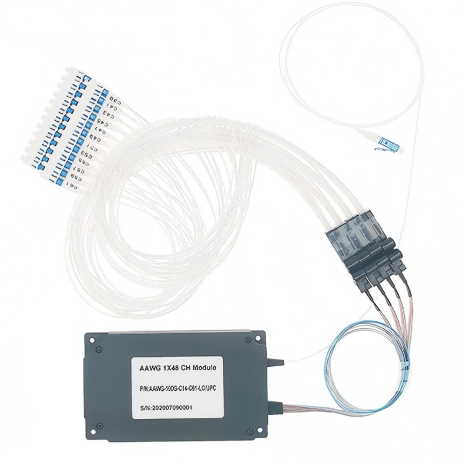
By precisely controlling wavelength spacing and optical path differences, AWG modules can efficiently manage multiple optical channels within a single fiber.
Common configurations include:
- 40-channel AWG
- 48-channel AWG
- 96-channel AWG
with applications across C-band and L-band DWDM networks.
The Role of AWG Modules in DWDM Systems
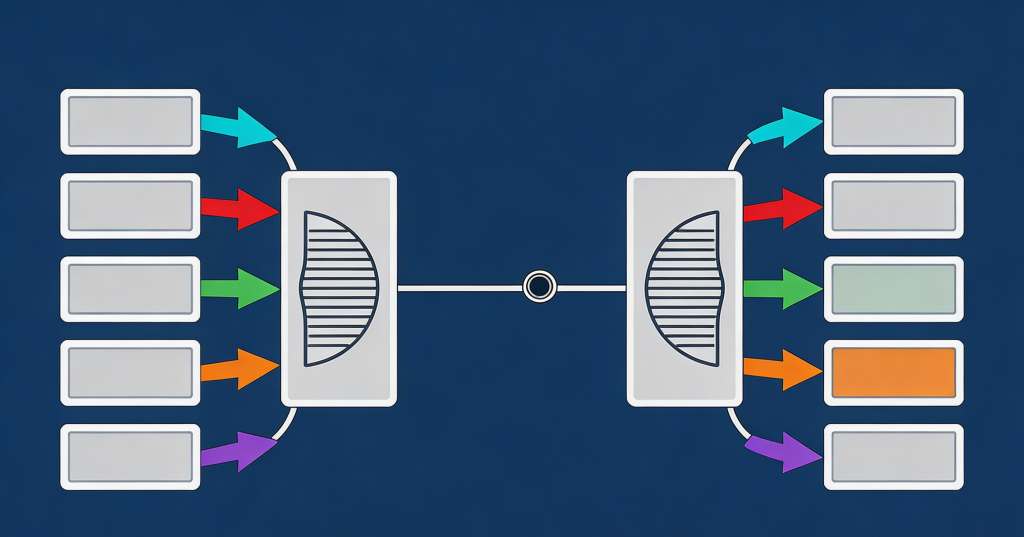
In modern DWDM networks, AWG modules are mainly used for high-density wavelength multiplexing and demultiplexing.
A DWDM system transmits multiple independent optical signals at different wavelengths through a single fiber. At the transmission side, multiple wavelengths need to be combined into one optical path; at the receiving side, each wavelength must be separated accurately.
AWG modules perform this critical function:
Multiple optical channels → AWG Multiplexer → Single fiber transmission
and:
Single fiber transmission → AWG Demultiplexer → Individual optical channels
By providing precise wavelength separation, AWG modules enable:
1. Higher Network Capacity
AWG allows multiple wavelength channels to operate simultaneously, significantly increasing the bandwidth capacity of existing fiber infrastructure.
2. Improved Network Scalability
With multi-channel AWG solutions, network operators and equipment manufacturers can easily expand transmission capacity without deploying additional fiber cables.
3. Low Insertion Loss and High Reliability
As passive optical devices without electrical components, AWG modules offer:
- Low power consumption
- Long-term stability
- High reliability
- Maintenance-free operation
making them ideal for carrier-grade optical networks.
Why Optical Equipment Manufacturers Choose AWG Modules
For DWDM and OTN equipment manufacturers, selecting the right AWG supplier is critical to achieving system performance and reliability.
The key advantages include:
1. Compact and High-Density Design
AWG modules provide multi-channel wavelength management in a compact package, making them suitable for:
- DWDM transmission equipment
- OTN platforms
- Muxponder systems
- ROADM networks
- Data center interconnect solutions
2. Excellent Wavelength Accuracy
Modern optical networks require precise wavelength control.
High-quality AWG modules provide:
- Accurate channel spacing
- Stable wavelength performance
- Low channel crosstalk
supporting reliable long-distance transmission.
3. Flexible Customization
Different optical systems require different configurations.
Professional AWG manufacturers can provide customized solutions including:
- Channel numbers
- Wavelength plans
- Fiber types
- Connector options
- Package designs
- Monitoring ports
This flexibility allows equipment manufacturers to optimize their optical system designs.
AWG vs Traditional Filter Technology
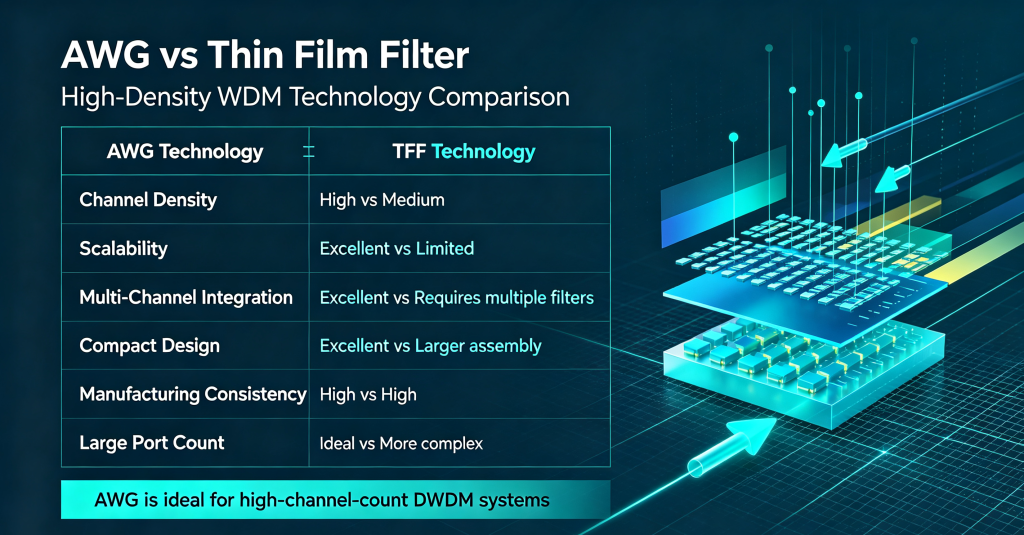
Traditional WDM solutions often rely on thin-film filter (TFF) technology.
Both AWG and TFF have advantages depending on application requirements.
| Feature | AWG Technology | Thin Film Filter (TFF) |
|---|---|---|
| Channel Density | High | Medium |
| Scalability | Excellent | Limited |
| Multi-Channel Integration | Excellent | Requires multiple filters |
| Compact Design | Excellent | Larger assembly |
| Manufacturing Consistency | High | High |
| Large Port Count Applications | Ideal | More complex |
For high-channel-count DWDM systems, AWG provides significant advantages due to its integrated design and scalability.
Feiyi AWG Manufacturing Capability
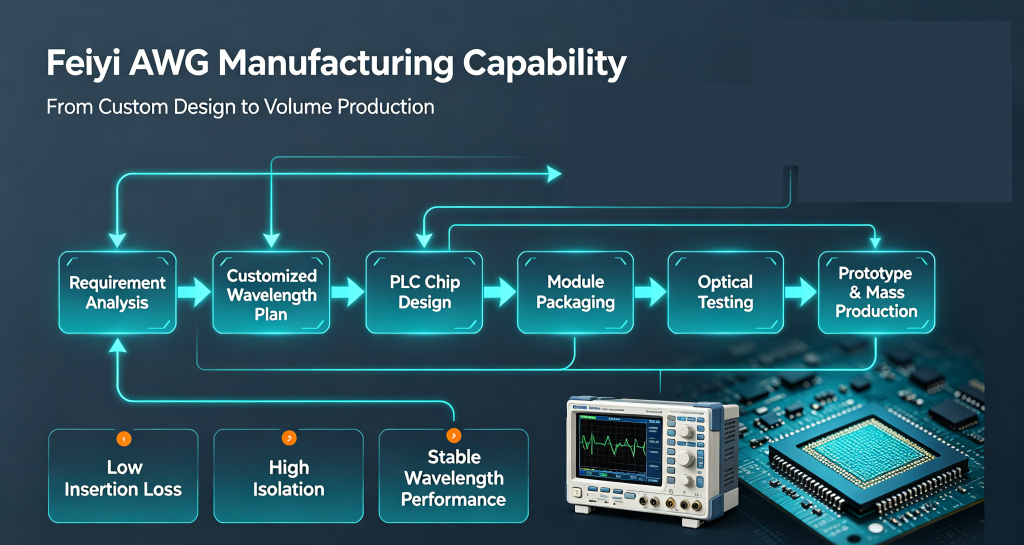
Feiyi Optoelectronic specializes in the development and manufacturing of passive optical components for global telecom and photonics industries.
Our AWG solutions are designed for:
- DWDM transmission systems
- Optical transport networks
- Data center interconnect (DCI)
- Telecom infrastructure
- Optical networking equipment
Our capabilities include:
Customized AWG Solutions
Supporting:
- Different channel configurations
- Customized wavelength plans
- Various fiber and connector options
- OEM/ODM requirements
Strict Quality Control
Each optical component undergoes professional testing to ensure:
- Low insertion loss
- High isolation
- Stable wavelength performance
- Long-term reliability
Flexible Manufacturing Support
Feiyi provides:
- Prototype samples
- Small-batch production
- Volume manufacturing
- Customized optical solutions
helping optical equipment manufacturers improve supply chain flexibility.
Conclusion
As optical networks continue to evolve toward higher capacity and greater flexibility, AWG modules will remain a key enabling technology for next-generation DWDM systems.
For optical equipment manufacturers, selecting a reliable AWG and passive optical component partner is essential to developing high-performance communication solutions.
With strong manufacturing capabilities, customization support, and extensive experience in passive optical components, Feiyi Optoelectronic is committed to supporting global partners in building advanced optical networks.
Request an AWG Solution
Tell us your AWG requirements and our team will recommend a suitable solution for your DWDM application.