
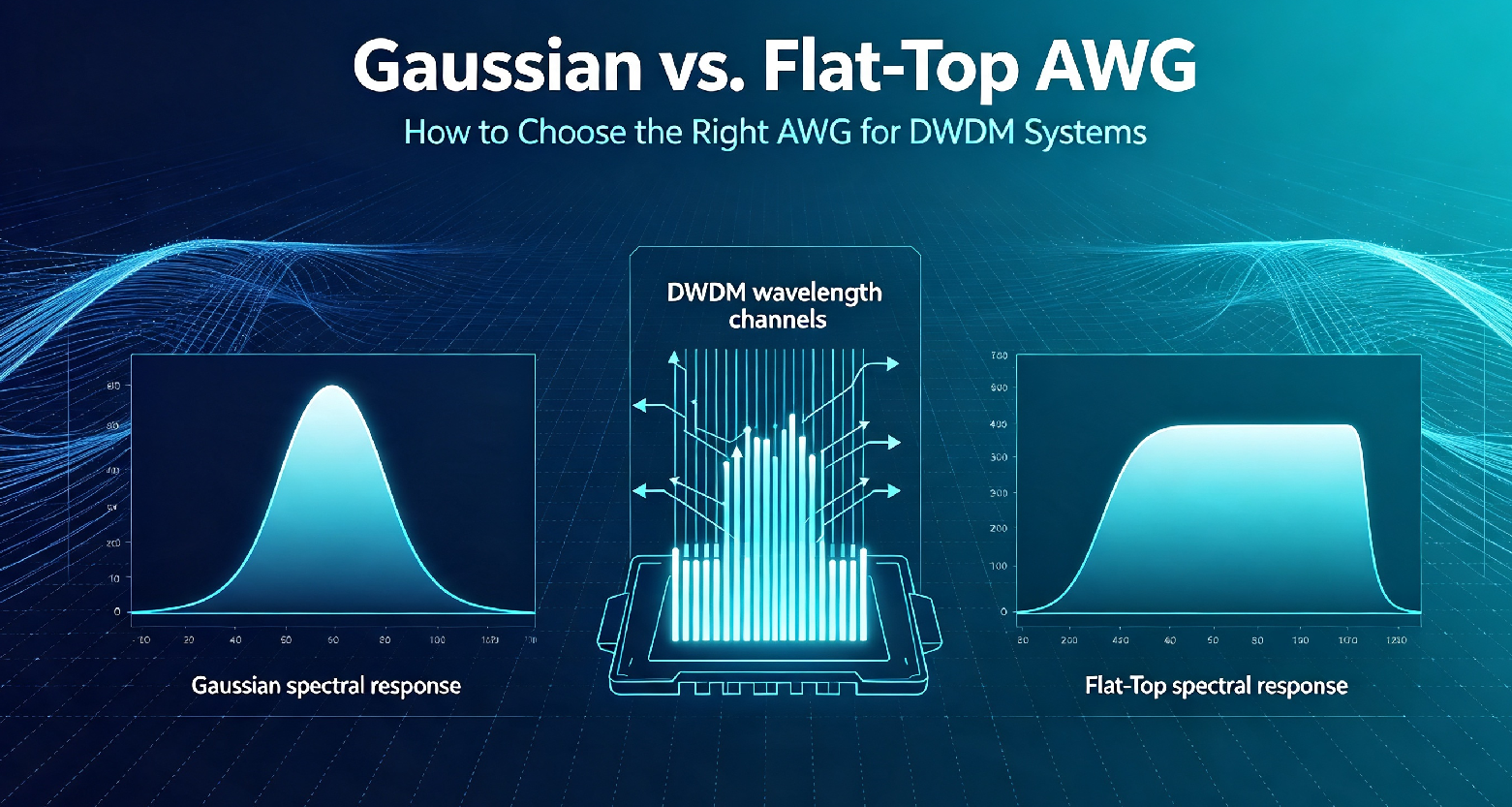
Gaussian vs. Flat-Top AWG: How to Choose the Right One for Your DWDM System
When designing a DWDM network, selecting an Arrayed Waveguide Grating (AWG) involves more than just channel count and channel spacing.
One of the most important considerations is the spectral response shape: Gaussian or Flat-Top.
Both designs have their advantages. The right choice depends on your system’s wavelength tolerance, transmission requirements, operating environment, and optical power budget.
Let’s look at the key differences and how to choose the right AWG for your application.
What’s the Difference Between Gaussian and Flat-Top AWGs?
The main difference is the shape and usable width of the optical passband through which each DWDM channel passes.
Gaussian AWG
A Gaussian AWG has a rounded, bell-shaped spectral response with a relatively narrower passband.
Depending on the specific design, it can provide favorable insertion-loss and isolation performance. It can be suitable for systems where the transmitter wavelength is well controlled and the available passband meets the application’s requirements.
However, a narrower passband may provide less tolerance to wavelength deviation.
Flat-Top AWG
A Flat-Top AWG is designed with a broader and flatter passband.
The wider usable passband can provide greater tolerance to wavelength deviation caused by factors such as temperature variation, transmitter characteristics, and component tolerances.
This can be particularly useful in higher-speed transmission systems or applications where maintaining consistent channel performance across the operating wavelength range is important.
The actual insertion loss, isolation, and passband performance depend on the specific AWG design and configuration.
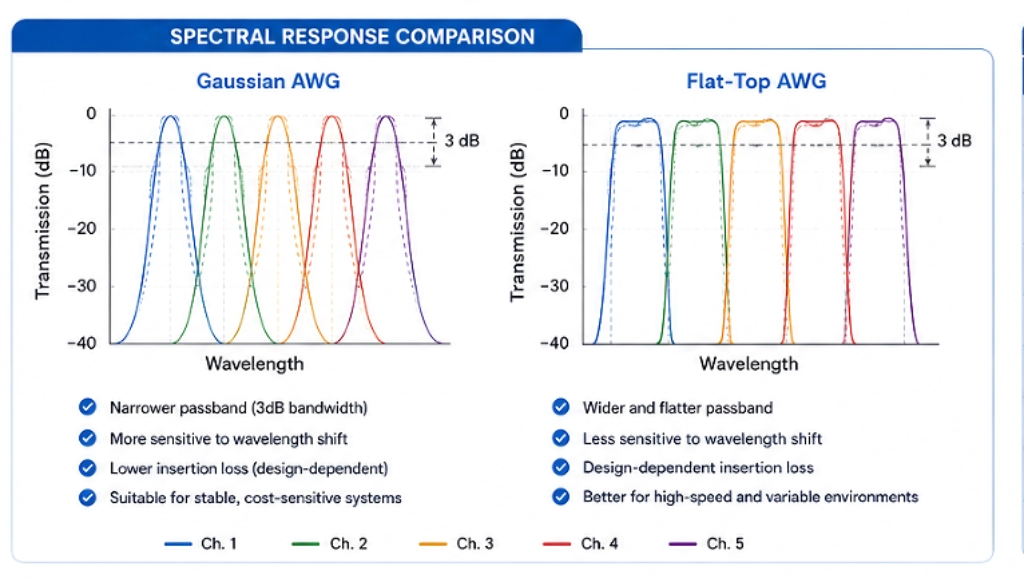
Gaussian vs. Flat-Top AWG: Quick Comparison
| Parameter | Gaussian AWG | Flat-Top AWG |
|---|---|---|
| Passband shape | Rounded | Broad and flattened |
| Usable passband | Relatively narrow | Relatively wide |
| Wavelength tolerance | More limited | Generally higher |
| Insertion loss | Design-dependent | Design-dependent |
| Channel isolation | Design-dependent | Design-dependent |
| Main advantage | Efficient spectral response for suitable applications | Greater passband tolerance |
Neither design is universally better. The actual performance should always be evaluated against the requirements of the complete DWDM system.
Why Does Passband Width Matter?
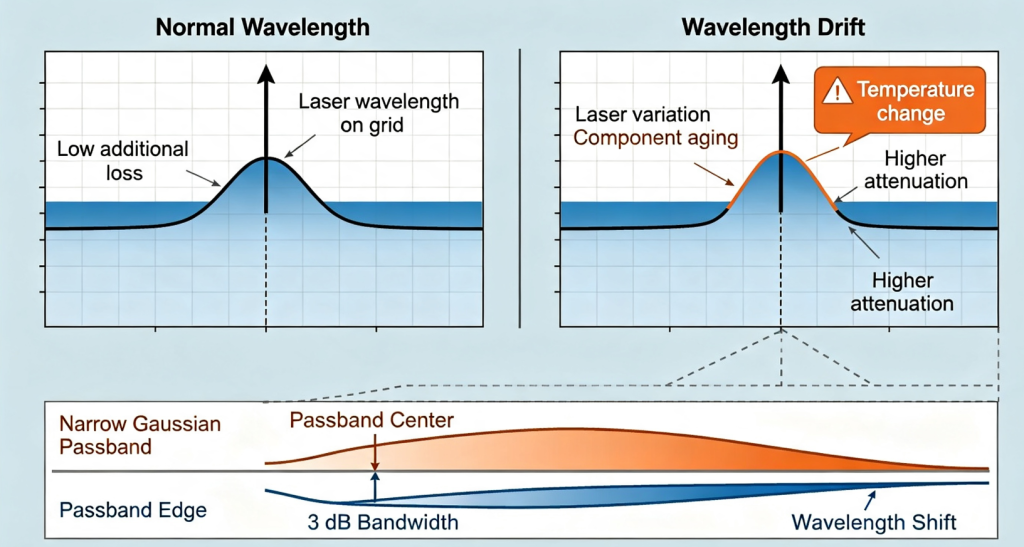
In an ideal DWDM system, each laser operates precisely on its assigned wavelength grid.
In real-world applications, however, wavelength deviation can occur due to:
- Temperature changes
- Laser wavelength variation
- Transmitter characteristics
- Component tolerances
- Long-term aging
If the operating wavelength moves away from the center of the AWG passband, additional insertion loss may occur.
A wider Flat-Top passband can provide a larger operating window, helping maintain more consistent transmission when the wavelength shifts within the specified range.
For this reason, passband width and ripple should be considered together with transmitter characteristics and system power budget when selecting an AWG.
Key Selection Criteria
Before choosing an AWG, evaluate the following parameters together:
- Channel spacing – 50 GHz, 100 GHz, 200 GHz, or other requirements
- Channel count – 40, 48, 64, 80, 96, or customized configurations
- Wavelength band – C-band, L-band, or C+L-band
- Insertion loss – Must fit within the system optical power budget
- Isolation / crosstalk – Should meet the required adjacent-channel performance
- Passband width and ripple – Important for wavelength tolerance and transmission performance
- Operating temperature – Consider the actual environmental conditions
- Thermal design – Athermal or temperature-controlled
- Package and connectors – Module, ABS box, rack-mount, LC, SC, FC, or customized
The best AWG is the one that provides the required performance while fitting the overall system architecture and power budget.
When Should You Choose a Gaussian AWG?
A Gaussian AWG may be a suitable option when:
- The transmitter wavelength is well controlled
- The system operates under relatively stable conditions
- A narrower passband meets the transmission requirements
- Insertion-loss performance is an important consideration
- The system is designed around a Gaussian spectral response
For these applications, a Gaussian AWG can provide an effective and economical wavelength management solution.
When Should You Choose a Flat-Top AWG?
A Flat-Top AWG may be a better fit when:
- Greater wavelength tolerance is required
- A wider usable passband is beneficial
- The system needs greater tolerance to wavelength deviation
- Passband characteristics are important for higher-speed transmission
- The operating environment involves greater temperature variation
The final selection should be based on the actual transmitter, modulation, channel spacing, temperature range, and system power budget.
When Does an Athermal AWG Make Sense?
For systems that operate across changing temperatures without active temperature control, an athermal AWG can be an attractive option.
An athermal design is engineered to maintain stable wavelength performance over its specified operating temperature range without requiring an active heater or TEC.
Athermal designs can therefore help:
- Reduce the need for active thermal control
- Simplify system design
- Reduce power consumption associated with temperature control
- Improve suitability for compact or remote optical equipment
Athermal AWGs can be implemented with different spectral response designs, including Gaussian and Flat-Top configurations, depending on the application requirements.
Feiyi AWG Solutions
Feiyi provides both Gaussian and Flat-Top AWG solutions for DWDM system integration.
Available configurations can be customized according to project requirements, including:
- Channel counts: 40 / 48 / 64 / 80 / 96 and customized
- Channel spacing: 50 GHz / 100 GHz / 200 GHz
- Wavelength bands: C-band / L-band / C+L
- Spectral response: Gaussian or Flat-Top
- Thermal options: Athermal or temperature-controlled
- Package: Module / ABS box / rack-mount
- Fiber and connectors: LC / SC / FC and customized options
- MUX / DEMUX configurations
Whether you need a Gaussian AWG for a specific passband requirement or a Flat-Top AWG for greater wavelength tolerance, Feiyi can provide a configuration based on your system requirements.
Final Thoughts
There is no universally better AWG.
Gaussian and Flat-Top AWGs are designed for different spectral response requirements, and the right choice depends on the application.
When selecting an AWG, consider the complete system rather than a single specification. Channel spacing, wavelength tolerance, passband, insertion loss, isolation, operating temperature, and optical power budget should all be evaluated together.
Need help selecting the right AWG for your DWDM system?
Share your channel count, spacing, wavelength band, operating temperature, and package requirements with our team. Feiyi can recommend a suitable Gaussian or Flat-Top AWG configuration for your application.
Have questions or need a sample? Contact Feiyi today.
#DWDM #AWG #FlatTopAWG #GaussianAWG #AthermalAWG #OpticalNetworking #FiberOptics #WDM #Photonics