
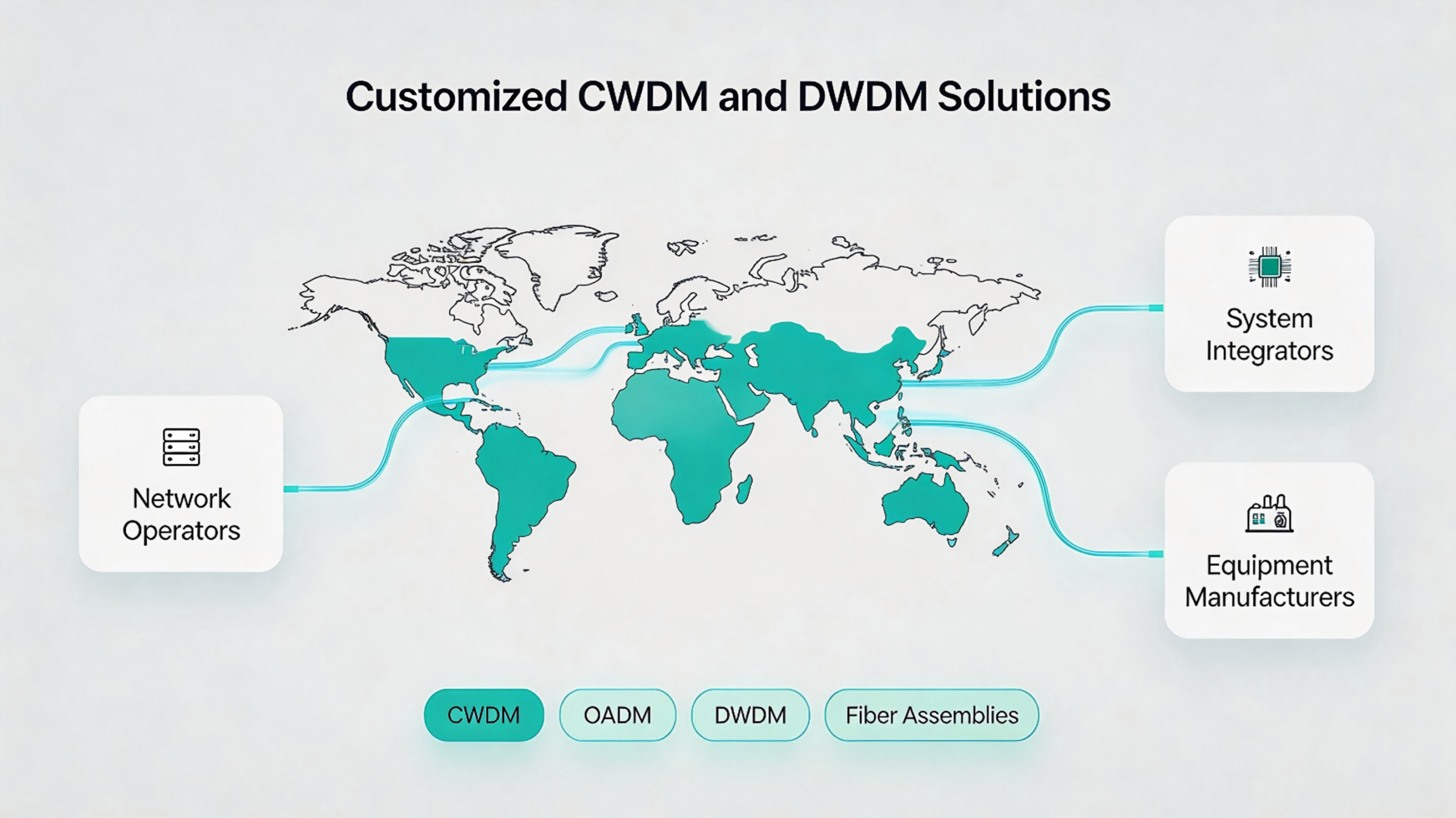
Customized CWDM and DWDM Solutions for Flexible Optical Network Deployment
As optical networks continue to evolve, network operators, system integrators, and equipment manufacturers increasingly require solutions that can adapt to different transmission capacities, distances, wavelength plans, and network architectures.
A standard optical module may be suitable for a specific application, but real-world network projects often require more flexibility. Channel counts may vary, different wavelengths may need to be added or dropped at different locations, and fiber infrastructure may need to be expanded without significant changes to the existing network.
At Feiyi Optoelectronic, we provide customized CWDM and DWDM passive optical solutions designed around the actual requirements of each application.
From a compact CWDM OADM link to a high-density DWDM transmission system, our engineering team can help configure the appropriate passive optical solution for your network.
1. Customized CWDM Solutions for Different Network Requirements
CWDM is widely used in metro networks, access networks, enterprise connectivity, telecom backhaul, data center interconnect, and other applications where multiple wavelengths need to share the same fiber infrastructure.
Instead of limiting customers to a fixed configuration, Feiyi can provide multi-channel CWDM solutions according to project requirements.
Depending on the application, we can support different channel counts, wavelength combinations, package formats, and connector configurations.
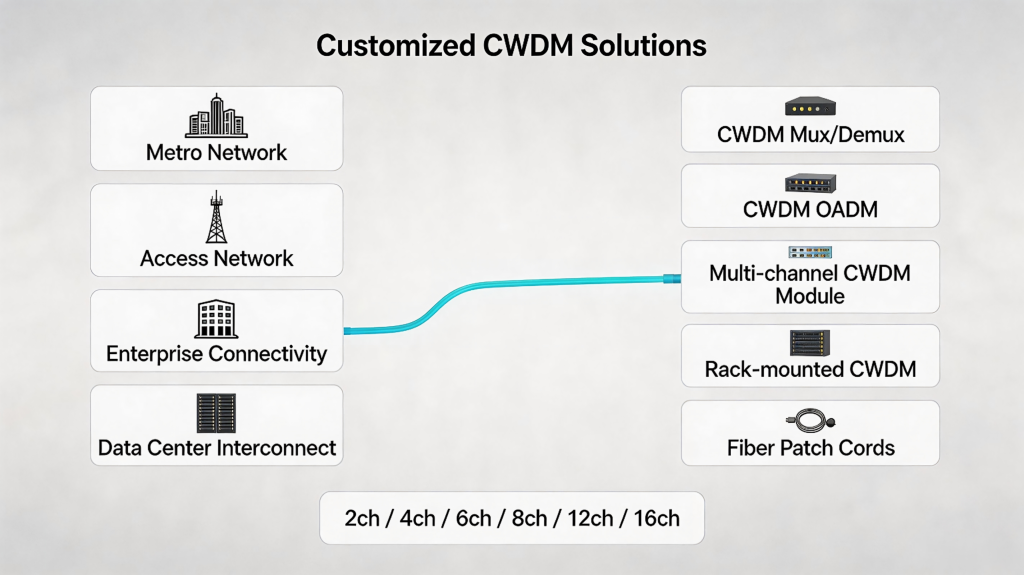
Typical CWDM solutions may include:
- CWDM Mux/Demux
- CWDM OADM
- Multi-channel CWDM modules
- Compact CWDM modules and cassettes
- Rack-mounted CWDM solutions
- Fiber patch cords and pigtails
- Customized fiber-optic assemblies
Flexible Channel Configuration
Different projects may require different numbers of wavelengths. A network may start with only a few active channels and gradually expand as traffic increases.
Feiyi can therefore support customized channel configurations rather than limiting customers to a single standard channel option.
Depending on the application, customers may select configurations such as:
2-channel, 4-channel, 6-channel, 8-channel, 12-channel, 16-channel or other customized configurations.
The exact configuration can be optimized according to the required wavelengths, available fiber infrastructure, network topology, and future expansion plans.
2. CWDM OADM for Multi-Node Network Expansion
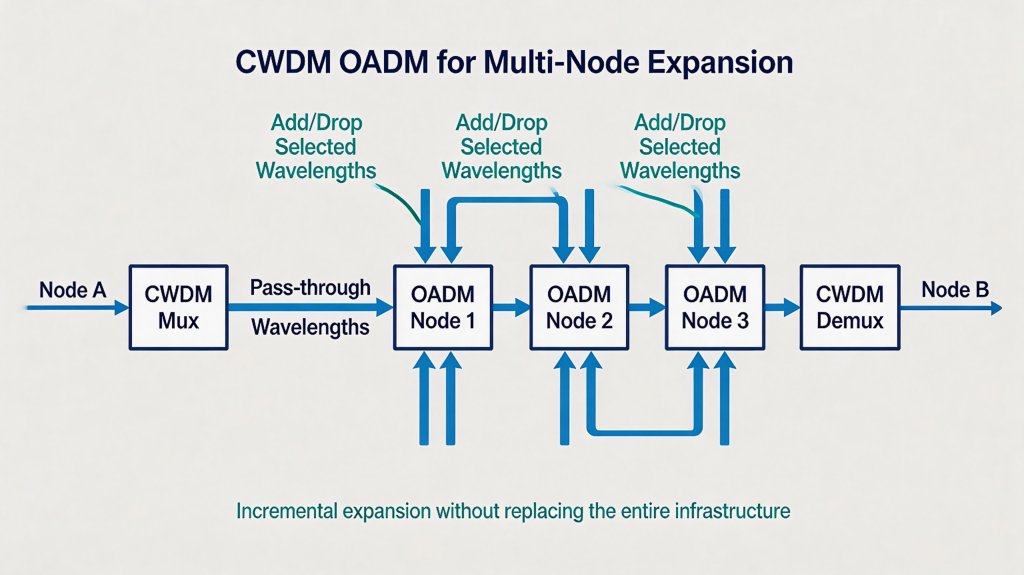
For networks with multiple transmission nodes, a simple point-to-point Mux/Demux architecture may not provide sufficient flexibility.
A CWDM OADM (Optical Add-Drop Multiplexer) allows selected wavelengths to be added or dropped at specific network nodes while other wavelengths continue through the network.
A typical architecture can be represented as:
Node A → CWDM Mux → Fiber Link → OADM Node → OADM Node → CWDM Demux → Node B
This architecture can help operators make better use of existing fiber infrastructure and support incremental network expansion.
For example, a customer may initially deploy several wavelengths and reserve additional channels for future services. As bandwidth requirements increase, additional wavelengths can be introduced without replacing the entire optical infrastructure.
Feiyi can customize CWDM OADM configurations according to:
- Number of add/drop channels
- Wavelength plan
- Node architecture
- Connector type
- Fiber type
- Packaging
- Transmission requirements
3. Customized DWDM Solutions for Higher Capacity
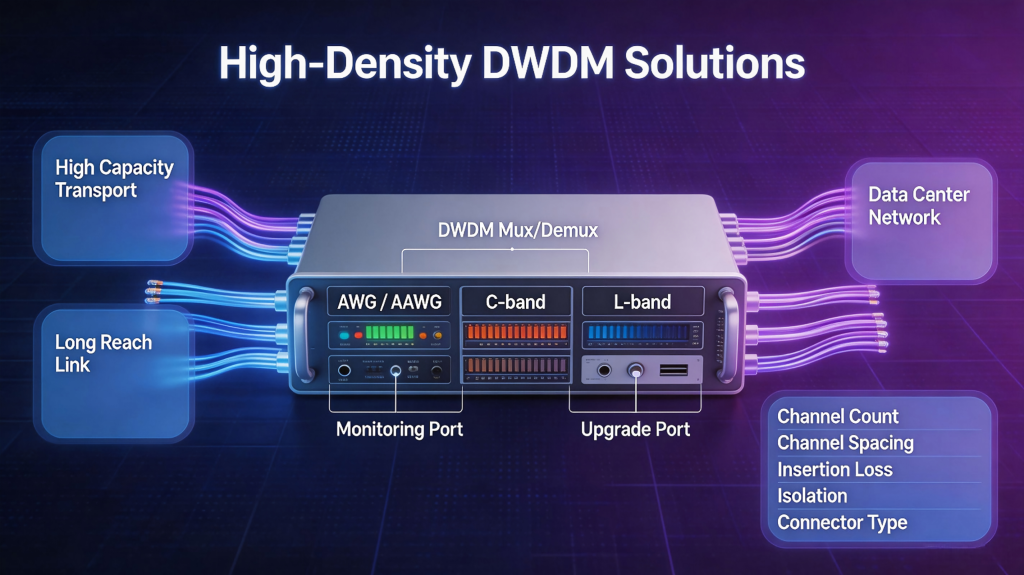
When the network requires more wavelengths, higher capacity, longer transmission distances, or more efficient use of the C-band or L-band spectrum, DWDM can provide a higher-density wavelength solution.
Feiyi supports customized DWDM Mux/Demux and AWG/AAWG solutions for optical transport and high-capacity networking applications.
Depending on the system design, customers can select different channel counts and wavelength configurations.
Typical solutions may include:
- DWDM Mux/Demux
- AWG / AAWG Modules
- C-band and L-band solutions
- DWDM OADM
- Passive monitoring ports
- Upgrade ports
- Customized optical configurations
High-Density Wavelength Management
For systems requiring high channel density, AWG/AAWG technology can provide a compact and scalable approach to wavelength multiplexing and demultiplexing.
Feiyi can configure AWG/AAWG solutions according to the required:
- Channel count
- Channel spacing
- Operating band
- Wavelength plan
- Insertion loss
- Isolation
- Package format
- Fiber and connector configuration
This allows the optical solution to be matched to the architecture of the target equipment or network.
4. From Standard Products to Fully Customized Solutions
Every optical network has different requirements.
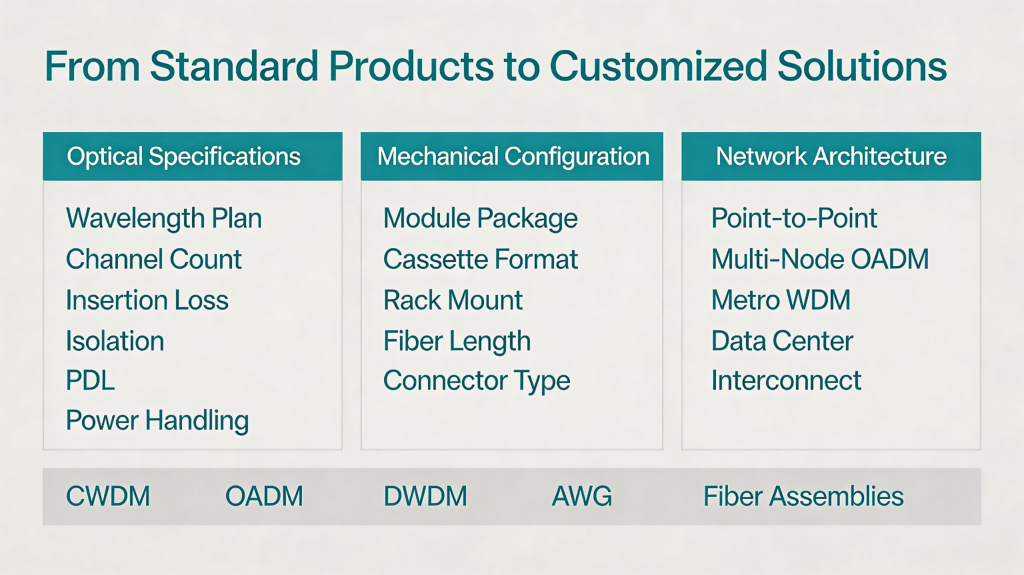
For some projects, a standard CWDM Mux/Demux may be sufficient. For other applications, customers may require a combination of CWDM, OADM, DWDM, AWG, fiber assemblies, monitoring ports, and upgrade ports in a customized configuration.
Feiyi supports customization at multiple levels.
Optical Specifications
Customization may include:
- Operating wavelengths
- Channel count
- Channel spacing
- Insertion loss
- Isolation
- Return loss
- PDL
- Power handling
Mechanical Configuration
We can also support different:
- Module packages
- Cassette formats
- Rack-mount configurations
- Fiber lengths
- Connector types
- Connector combinations
- Fiber types
Network Architecture
For project-based applications, the solution can also be designed around the actual topology, such as:
Point-to-Point
Multi-Node OADM
Metro WDM
Data Center Interconnect
Optical Transport
Backbone Network
5. CWDM or DWDM: Which Solution Is More Suitable?
The choice between CWDM and DWDM depends on the actual network requirements rather than simply the number of wavelengths.
CWDM
CWDM can be suitable for applications that require:
- Moderate channel capacity
- Cost-effective wavelength multiplexing
- Metro and access networks
- Shorter or medium transmission distances
- Simple network expansion
DWDM
DWDM can be considered when the application requires:
- Higher channel density
- Greater transmission capacity
- Longer-distance transmission
- More efficient spectrum utilization
- High-capacity optical transport
- Future network scalability
For some projects, a CWDM-to-DWDM upgrade path can also be considered, allowing the network to expand as traffic requirements increase.
6. Complete Passive Optical Connectivity
A successful WDM deployment involves more than Mux/Demux modules alone.
To simplify integration, Feiyi can also provide complementary passive optical products, including:
- Fiber Patch Cords
- Fiber Pigtails
- Fiber Couplers
- Optical Circulators
- Optical Isolators
- Optical VOAs
- Optical Monitoring Components
- Customized Fiber-Optic Assemblies
This allows customers to source multiple passive optical components from one manufacturing partner.
For equipment manufacturers and system integrators, this can simplify project coordination and component integration.
7. Solutions for OEMs and System Integrators
Optical equipment manufacturers often need components that fit specific product architectures rather than standard catalog items.
Feiyi supports OEM and ODM requirements with:
- Customized optical specifications
- Customized packaging
- Customer-defined connector configurations
- Project-specific wavelength plans
- Prototype and sample support
- Engineering communication
- Test reports and product documentation
Whether the requirement is a 6-channel CWDM OADM, an 8/16-channel CWDM system, a high-density DWDM/AWG solution, or a customized optical assembly, the solution can be designed around the actual project.
8. Designing for Future Network Expansion
A well-designed optical network should not only meet today’s bandwidth requirements but also allow for future growth.
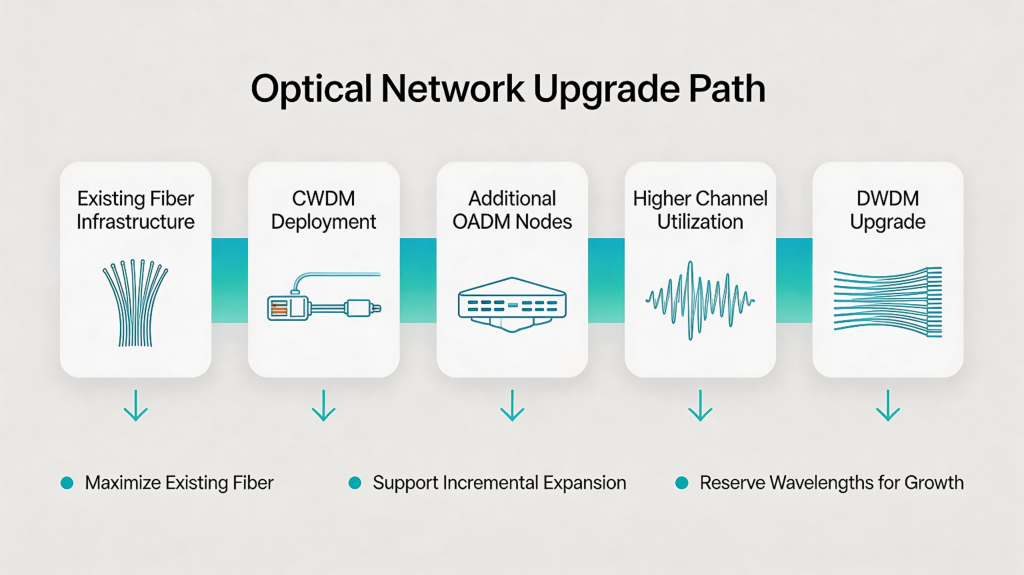
A customized WDM solution can reserve additional wavelengths, support network nodes for future add/drop requirements, and provide a practical migration path from lower-density to higher-density wavelength systems.
For example:
Existing Fiber Infrastructure
↓
CWDM Deployment
↓
Additional OADM Nodes
↓
Higher Channel Utilization
↓
DWDM Upgrade
This approach can help operators and system integrators maximize the value of existing fiber infrastructure while preparing for future capacity growth.
9. Why Work with a Customized Passive Optical Component Manufacturer?
For project-based optical networking, the ability to customize the component can be just as important as the standard product itself.
A flexible manufacturer can help customers address:
- Non-standard channel requirements
- Special wavelength combinations
- Space limitations
- Custom connector configurations
- Specific optical performance targets
- Project-specific packaging
- Integration requirements
At Feiyi Optoelectronic, our goal is not simply to provide a standard catalog item. We aim to provide a passive optical configuration that fits the customer’s actual network or equipment design.
Conclusion
CWDM and DWDM technologies provide flexible ways to increase the capacity and scalability of optical fiber networks. However, the ideal solution depends on the specific requirements of each project.
From multi-channel CWDM and OADM solutions to high-density DWDM and AWG/AAWG systems, Feiyi Optoelectronic supports customized passive optical configurations for network operators, system integrators, OEMs, and optical equipment manufacturers.
Our capabilities cover not only the WDM modules themselves, but also the supporting passive optical components and fiber assemblies required for system integration.
Whether you are planning a new WDM deployment, expanding an existing fiber network, adding new wavelengths, or upgrading from CWDM to DWDM, a customized optical solution can provide a more flexible path for network growth.
Feiyi Optoelectronic — Customized Passive Optical Solutions for Your Network.