
Polarization Maintaining Optical Components Manufacturer: How to Qualify a PM Supply Program
A buyer looking for a polarization maintaining optical components manufacturer is rarely sourcing one isolated part. The usual project contains several polarization-sensitive interfaces鈥攑atch cords, isolators, circulators, WDM devices, couplers, collimators, switches or attenuators鈥攁nd the difficult part is making those interfaces behave as one optical chain. The first questions should therefore be practical: what wavelength band is required, which axis is used, what extinction ratio must be preserved after connectorization, what insertion-loss budget is available, and which functions belong in the same supplier qualification.
Feiyi Optoelectronic’s published portfolio gives engineering teams a useful starting point because it covers PM products across common bands from the visible and near-infrared region through 1550 nm and into 1950-2000 nm product families. The company profile states that Shenzhen Feiyi Optoelectronic Communication Co., Ltd. was established in May 2014, operates production bases in Shenzhen and Shaoguan totaling about 6,000 m2, is ISO9001:2015 certified, and develops both single-mode and polarization-maintaining passive optical components. Those are useful company-level facts, but the final supplier decision should still be made against the actual optical specification of each project.
What a polarization maintaining optical components manufacturer should resolve before quotation
PM purchasing becomes unreliable when the request stops at a generic name such as “PM isolator” or “PM circulator.” The device name says what the component does; it does not define the optical operating point. For a real quotation, the working wavelength, fiber type, connector, axis orientation, optical power and environmental conditions need to be aligned with the product family.
For example, Feiyi’s PM 1550 nm circulator lists a center wavelength of 1550 +/-30 nm, typical insertion loss of 0.7 dB, minimum extinction ratio of 20 dB, crosstalk of at least 50 dB, return loss of at least 50 dB and maximum power handling of 300 mW. Its ordering information allows bare fiber or connectorized configurations and different fiber lengths. A 1550 nm sensing assembly that sends and receives light on the same fiber can therefore begin with a circulation requirement, but the buyer must still state whether the intended launch is on the slow or fast axis and how the ports will be terminated.
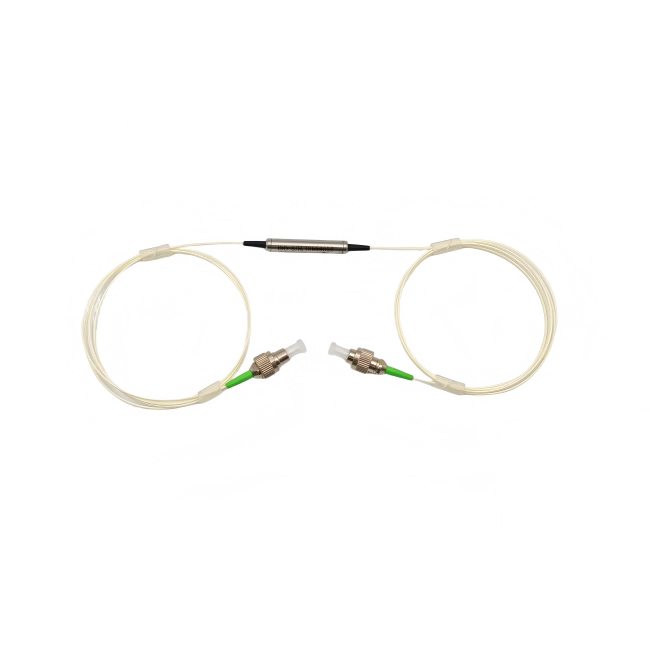
PM circulators for bidirectional routing and sensing loops
A circulator is selected when the system must route light sequentially between ports rather than merely suppress a reflection. Feiyi publishes PM circulators at 780, 850, 980, 1064, 1310, 1480, 1550, 1950 and 2000 nm. That wavelength coverage matters to a manufacturer qualification because a buyer may have a 1064 nm laser platform today and a 1550 nm sensing platform in another program. Using a supplier that can discuss both bands makes it easier to keep connector conventions, fiber-length documentation and inspection expectations consistent.
The 1550 nm specification also shows why a buyer should compare grade and architecture rather than only the catalog title. The published page distinguishes single and double configurations, with the double configuration providing higher isolation. If the return signal is weak but the source is sensitive to back-propagating light, the isolation requirement may drive the choice. If optical power budget is tighter, insertion loss may receive more weight. The manufacturer should be able to explain that trade-off from the actual device table, not from a generic statement that one grade is “better.” Engineers working specifically on reflected-signal routing can also compare the project logic in this 1550 nm PM circulator sensor example.
PM isolators when source protection matters more than port routing
Feiyi’s PM 1310/1550 nm fiber isolator family provides single-stage and dual-stage versions. The published single-stage P grade lists 1310 or 1550 nm +/-10 nm operation, typical isolation of 40 dB, typical insertion loss no greater than 0.55 dB, return loss of at least 55 dB, PDL no greater than 0.05 dB and extinction ratio of at least 19 dB. The standard dual-stage version raises typical isolation to 55 dB while retaining a low-loss PM path.
This is a different procurement decision from a circulator. A laser or amplifier chain that needs reverse-light suppression may need an isolator even if it has no bidirectional routing requirement. Conversely, a reflection sensor that must separate transmitted and returned signals needs port directionality that an isolator alone cannot provide. A capable PM manufacturer should help the buyer keep those functions separate in the bill of materials.
PM optical components supplier depth matters at the interfaces between devices
Many PM system failures appear at interfaces rather than inside a single component. A patch cord may meet its insertion-loss requirement but lose system extinction ratio because its connector key is not aligned with the intended PM axis. A WDM may separate wavelengths correctly but the total link can still be unstable if the wrong fiber type is spliced into the next module. Supplier depth matters because these issues cross product-family boundaries.
Patch cords establish the axis convention for the rest of the assembly
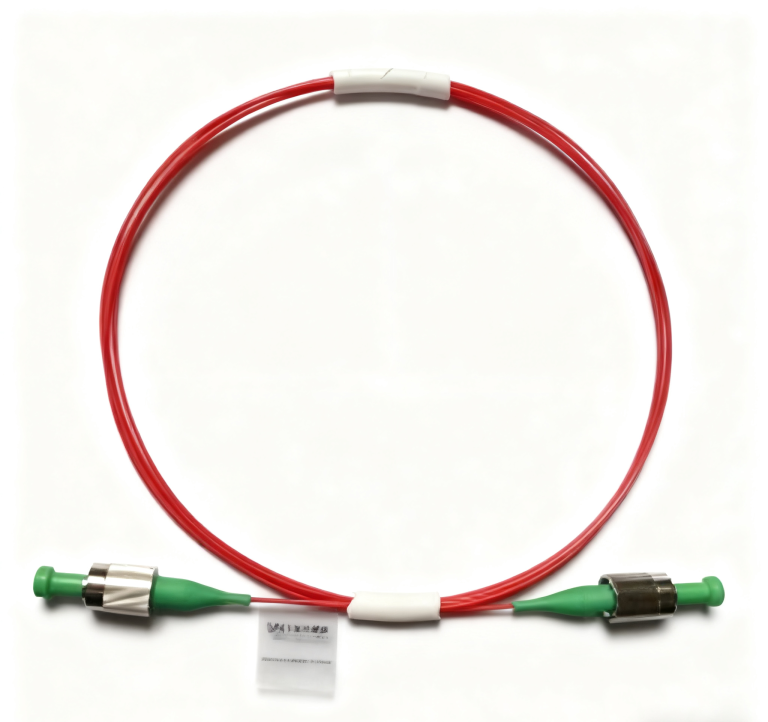
Feiyi’s custom PM fiber patch cord page publishes operating wavelength options at 780, 850, 980, 1064, 1310 and 1550 nm. It lists extinction ratio of at least 20 dB, repeatability no greater than 0.1 dB, interchangeability no greater than 0.2 dB and at least 1,000 mating cycles. The page also states that, for connectorized devices, the connector key is aligned to the slow axis.
That single detail should be transferred into the drawing or purchase description. A project engineer should not assume that every PM connector in every supply chain uses the same key convention. When a patch cord mates to an isolator, circulator, modulator or collimator, the axis convention must be deliberate. In practical incoming inspection, record the wavelength, connector polish, key alignment requirement and cable length together; separating those fields makes it easier to identify whether a problem is optical, mechanical or documentation-related. The axis issue is explored in more detail in the PM patch cord axis-alignment guide.
PM WDM and polarization combiners should be specified by optical function
Feiyi’s PM WDM family includes filter WDM and three-port DWDM products, while its polarization beam combiner/splitter family includes 1×2 and 2×2 devices across multiple wavelengths. They are not substitutes. The PM 1550 nm DWDM three-port product is a wavelength-selective device with published pass and reflection insertion-loss figures, isolation, extinction ratio and PM Panda fiber options. A polarization beam combiner/splitter, by contrast, combines or separates orthogonal polarization states.
A coherent receiver, fiber sensor or laser subsystem may contain both wavelength routing and polarization routing. The purchase specification should therefore state which variable each device is supposed to separate: wavelength, polarization state or physical path. This prevents a parts list from being driven by similar-looking housings or similar numbers of fiber leads.
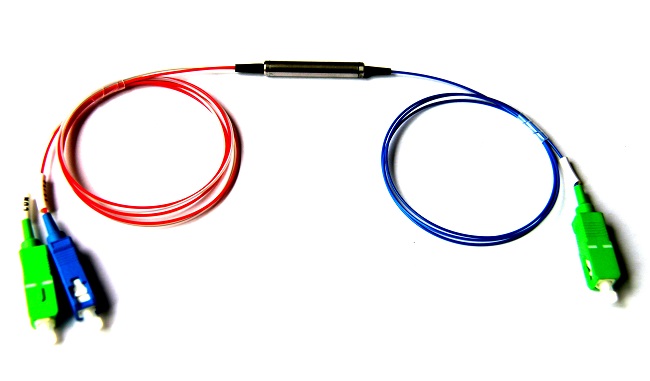
How to audit a polarization maintaining optical components manufacturer without overgeneralizing one datasheet
A useful supplier audit separates company capability from product capability. Company-level items include quality-system certification, manufacturing location, engineering support and the breadth of product families. Product-level items include wavelength, insertion loss, isolation, return loss, PDL, extinction ratio, axis orientation, connector type, fiber length, package size and temperature range. One should not be used as a shortcut for the other.
Feiyi’s company page states ISO9001:2015 certification and identifies a production base in Shenzhen and Shaoguan. Its product pages then publish detailed performance tables for individual devices. A buyer can use the company information to establish whether the supplier belongs on the approved-vendor path, then use the device tables to determine whether a specific item belongs in the optical design.
For a 1550 nm sensing platform, qualify the chain rather than a single component
Consider a fiber sensor that launches polarized 1550 nm light, routes it toward the sensing fiber, receives a reflected signal and then attenuates the return before a detector. The sourcing discussion can involve a PM 1550 nm circulator, a PM patch cord, a PM 1550 nm VOA and, where needed, a PM 1550 nm in-line polarizer. The right qualification question is not “does the supplier make PM parts?” It is “can the defined axis, connector and optical-loss budget survive all four interfaces?”
The in-line polarizer page, for example, publishes 1550 nm operation with +/-50 nm range, typical insertion loss of 0.3 dB, maximum insertion loss of 0.5 dB, typical extinction ratio of 30 dB and a minimum of 28 dB at 23 deg C for the PM fiber type. That gives the engineer a concrete polarization-cleanup option, but it also adds another insertion-loss contribution. This is why a component-by-component design review is more useful than chasing the highest number in any single table.
For laser platforms, separate isolation, polarization cleanup and collimation
A laser subsystem may use a PM isolator to protect the source, a PM in-line polarizer to improve polarization purity and a PM collimator to launch into free space or another optical element. Feiyi lists PM collimators from 630 to 1550 nm as well as dual-, four-, five-, nine- and sixteen-fiber versions. Those multi-fiber configurations belong in a different mechanical conversation from a single-fiber laser output, even if both are described as “PM collimators.”
For an engineering team handing a design to purchasing, the drawing should therefore identify the optical role of every part. “Collimator” should be accompanied by working wavelength, fiber count and beam-interface requirements. “Isolator” should be accompanied by stage, isolation and insertion-loss targets. “Polarizer” should include working axis and power level. A manufacturer that receives those details can answer a technical RFQ more accurately than one receiving a list of generic nouns.
Documentation and incoming checks for repeat PM orders
Repeatability matters when an optical system moves from prototype to recurring production. The buyer should preserve the ordering code, drawing revision, fiber type, connector polish, axis convention and accepted optical limits from the approved sample. If the supplier’s product page offers several grades or connector choices, the purchase order should name the selected configuration instead of pointing only to the family page.
At incoming inspection, the most useful checks depend on the product. For PM patch cords, verify connector type, axis key convention, insertion loss and extinction ratio against the agreed method. For circulators and isolators, verify port direction, wavelength and insertion loss before deeper isolation tests. For WDM devices, check the channel map and port labeling before measuring isolation. For multi-port switches, verify route state and electrical control definition before running optical repeatability tests. These steps are tied to the actual function of each component and prevent a generic inspection form from missing the failure mode that matters.
Packaging should also be treated as an agreed order detail rather than an assumption. The public product pages define optical and mechanical configurations but do not publish one universal packing method for every PM family. Buyers shipping pre-production or repeat lots should therefore confirm how connector end faces, bare-fiber sections and labeled port groups will be protected and identified for their specific order.
Where to start in Feiyi’s PM product range
For a first technical review, start with the device that controls the most critical system variable. If the problem is reverse reflection, review the PM isolator range. If the problem is sequential port routing, review PM circulators. If the challenge is maintaining a defined polarization state through a removable interface, begin with PM fiber patch cords. If the system needs controlled power reduction, compare the PM VOA family. Wavelength-selective designs can move into the PM WDM range.
A strong PM sourcing decision is therefore less about finding the longest catalog and more about finding a manufacturer whose real product families match the interfaces in the optical schematic. Define wavelength, axis, loss budget, polarization requirement and connector convention first; then compare the actual published device tables. That produces a specification a production team can build and an incoming-inspection team can verify.