WDM Manufacturer: Match the Wavelength Plan to the Right Product Family
An engineer asking a WDM manufacturer for “a multiplexer” has not yet described enough of the optical job to release an order. The first decision is whether the system is separating widely spaced wavelength bands, carrying closely spaced DWDM channels, adding or dropping selected channels, or preserving polarization while wavelengths share one fiber. Those choices lead to different Feiyi product families: CWDM Mux/Demux, DWDM modules, AWG modules, filter WDM devices and polarization-maintaining WDM components.
For an OEM, system integrator or distributor, the practical starting point is a wavelength plan. Record every optical source, its nominal wavelength or channel, the port where it enters, the port where it must leave and the maximum loss or unwanted-light leakage the system can tolerate. A WDM manufacturer can then map that requirement to a buildable device instead of forcing the project into a familiar housing.
A WDM manufacturer should see the wavelength map before the enclosure drawing
Wavelength division multiplexing is a routing function. Two products can both be called WDM modules yet solve very different problems. A three-port filter device may combine or separate two spectral regions. A CWDM module may place several channels on a coarse grid. A DWDM or AWG module may work with many channels on a much tighter grid. The number of fiber leads therefore does not tell purchasing what the component actually does.
Separate broad-band pairing from dense channel routing
Feiyi lists three-port CWDM and DWDM devices, CWDM Mux/Demux products in 4-, 8- and 16-channel forms, rack-mounted CWDM, DWDM modules, DWDM OADM modules, 40/48-channel AWG modules and PM filter/DWDM devices. A buyer should not treat these as interchangeable versions of one product.
For a pump-and-signal assembly, a three-port filter WDM may be the natural starting point because only two wavelength regions need to share a common fiber. For a telecom shelf carrying multiple coarse channels, a CWDM Mux/Demux provides a clearer architecture. For a dense channel plan, the DWDM or AWG route allows the purchase specification to be tied to a defined frequency grid and channel isolation requirement.
Channel spacing should describe the optical grid, not a marketing data rate
ITU-T G.694.2 defines the CWDM wavelength grid with 20 nm channel spacing, while ITU-T G.694.1 defines the DWDM frequency-grid framework around 193.1 THz and supports much tighter spacing. Those standards are useful when the engineering drawing needs an unambiguous channel plan. They do not replace the selected Feiyi product specification.
This matters because terms such as “100G” can be misunderstood. In an AWG or PM DWDM ordering context, a page may use 100 GHz or 200 GHz spacing. That is an optical channel-spacing description, not by itself a promise about the bit rate carried by the link. The occupied signal spectrum, center-frequency tolerance and passband all have to fit the selected optical filter.
Choosing a WDM manufacturer means matching the product family to the network job
A useful supplier evaluation is not based on how many WDM names appear in a catalog. It is based on whether the manufacturer can keep the wavelength plan, physical packaging and acceptance data consistent from sample approval to repeat production. Feiyi’s product range lets a buyer compare several routing architectures without changing the basic procurement conversation.
CWDM Mux/Demux fits projects that need 4, 8 or 16 coarse wavelength channels
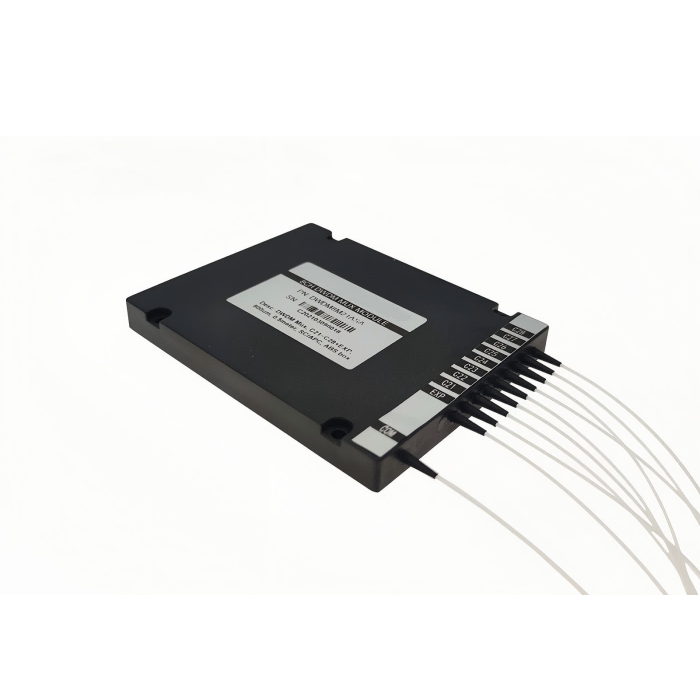
Feiyi publishes 4CH, 8CH and 16CH CWDM Mux/Demux products as well as a 1U rackmount version. These are appropriate when a project needs multiple coarse wavelength channels and values a relatively straightforward channel plan. A distributor stocking CWDM should record channel count and connector format as separate inventory fields; “CWDM module” is too broad for repeat fulfillment.
A metropolitan access link, enterprise fiber expansion or line-monitoring arrangement may need a different number of active channels today than the final system will use later. That does not automatically mean ordering the highest channel count. Unused ports, enclosure size, connector density and the existing wavelength plan still affect the correct choice.
DWDM modules and AWG modules serve denser channel plans
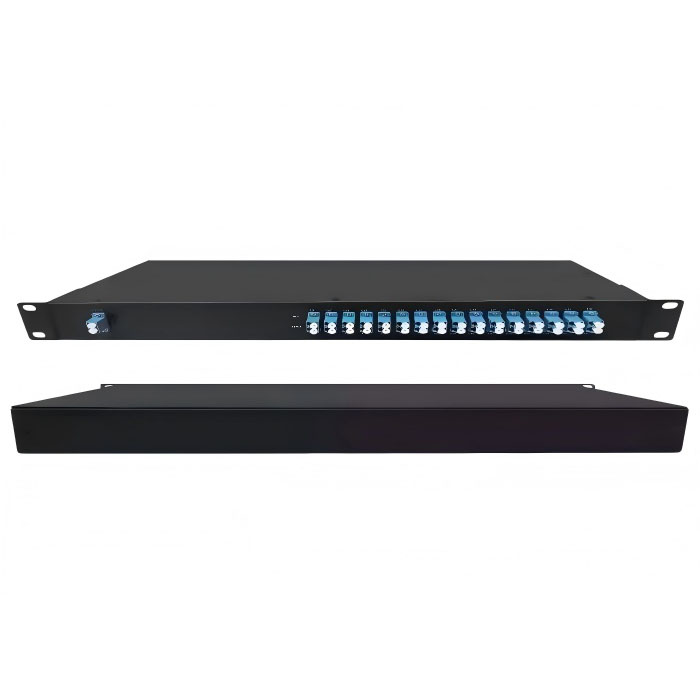
Feiyi’s passive-device range includes a standard DWDM Module, a DWDM Module in an LGX box, a DWDM Module in a 1U rackmount and a DWDM OADM Module. These options separate the optical filtering decision from the mechanical integration decision. A lab build may accept a compact module with fiber leads, while a deployed rack may require protected front-panel interfaces and a defined channel labeling scheme.
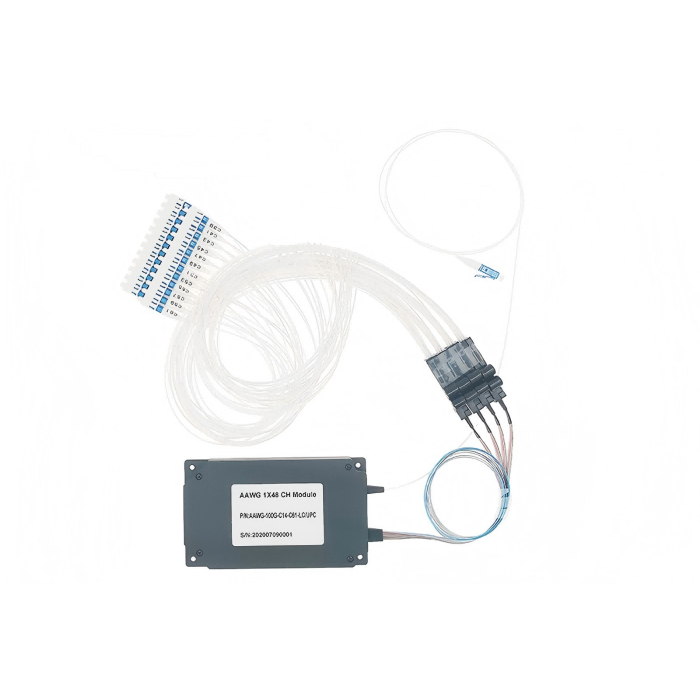
Feiyi also lists a 40CH/48CH AWG Module. Its published 48-channel specification uses 100 GHz spacing in the C-band and allows C13-C60 or customized channel plans. The page distinguishes flat-top and Gaussian spectral profiles. For the published values, the 1 dB bandwidth is 0.38 nm for the flat-top specification and 0.20 nm for the Gaussian specification; the 3 dB bandwidth is 0.58 nm and 0.38 nm respectively. That difference is an engineering decision, not a cosmetic product variant.
A WDM manufacturer quotation should preserve the specifications that can break the finished link
The purchasing file should contain more than a part name. At minimum, capture the wavelength or frequency plan, channel count, input/output port definition, insertion-loss limits, isolation requirements, connector polish, fiber type, enclosure and environmental range where those parameters are published for the selected family.
Insertion loss must be assigned to the actual optical path
A three-port device can have different requirements on its pass and reflection paths. Feiyi’s PM 1064 nm three-port WDM, for example, publishes a maximum pass-channel insertion loss of 0.8 dB and a maximum reflection-channel insertion loss of 0.6 dB. If incoming inspection records only one loss number, it may miss a problem on the second path.
For a multi-channel module, the issue changes from two path losses to channel uniformity. The 40/48-channel AWG module publishes insertion-loss uniformity up to 1.5 dB in the listed specifications. A system whose power budget is tight across many receivers should therefore review both absolute loss and channel-to-channel variation.
Isolation should be tied to the receiver that needs protection
In a dense channel plan, adjacent-channel leakage and non-adjacent leakage are not the same test. Feiyi’s 40/48-channel AWG module lists adjacent-channel isolation of at least 25 dB and non-adjacent isolation of at least 30 dB, with higher typical values in its published flat-top/Gaussian table. The engineer should identify which interfering channels can reach each receiver and set acceptance around the real risk.
For PM DWDM, Feiyi’s published 100/200 GHz three-port device lists adjacent-channel isolation of at least 30 dB and non-adjacent isolation of at least 40 dB. These numbers belong to that PM product family and should not be copied into a CWDM RFQ or treated as a universal Feiyi WDM guarantee.
Connector and enclosure decisions belong in the same approved configuration
A DWDM filter can be supplied as a compact module, LGX-style assembly or rackmount product. A CWDM system can likewise move from a component-level device to a 1U rack. The optical function may be similar, but field handling is not. Front-panel labels, adapter type, patch-cord routing and service access become part of the installed product.
For a distributor, this is a common inventory trap. Two units can share the same wavelength plan but not the same deployment interface. Stock records should therefore separate optical channel plan from package and connector format. That prevents a technically correct filter from becoming an unusable field replacement.
Polarization-sensitive projects need a WDM manufacturer to define the PM axis as well as the wavelength
Standard CWDM and DWDM networking normally focuses on wavelength routing. A polarization-maintaining instrument adds a second interface: the fast/slow axis reference. Feiyi’s PM WDM family includes filter WDM and 100/200 GHz DWDM three-port devices, so the RFQ must state both spectral routing and polarization routing.
A PM filter WDM should be ordered from a port map, not from a two-wavelength nickname
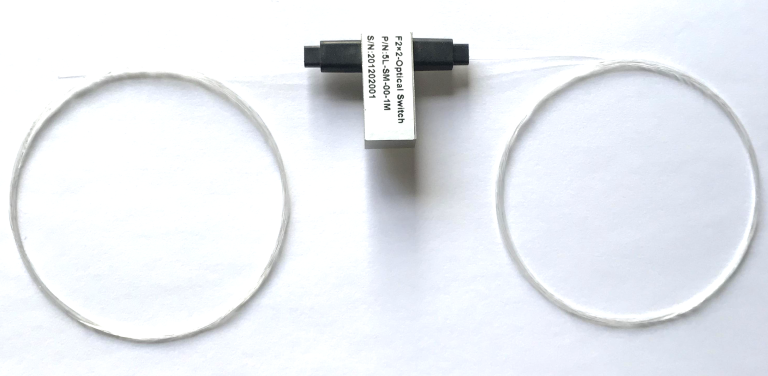
Feiyi’s PM 1064 nm three-port WDM pairs a 1064 nm channel with a 980 nm reflection route. In a pump/signal assembly, the order drawing should label common, pass and reflection leads, identify which fiber type applies to each connection and state the axis convention at the interfaces. “980/1064 WDM” is useful shorthand only after those details are controlled elsewhere.
A laser integrator may reuse the same wavelength pair across several products but change connector polish, lead length or axis orientation between instrument generations. The manufacturer needs the current approved configuration, not only the legacy nickname.
A PM DWDM passband must fit the source spectrum, not just the nominal center
Feiyi’s PM 100/200 GHz DWDM three-port device lists passband values greater than 0.3 nm for the 100 GHz option and greater than 0.5 nm for the 200 GHz option at the published -0.5 dB condition. A buyer should compare that window with the transmitter’s occupied spectrum and center drift. A center-wavelength measurement made at room temperature is not enough if the source can move toward the filter edge in service.
Incoming inspection should reproduce the wavelength route the WDM manufacturer was asked to build
For a two-band or three-port device, check the common-to-pass and common-to-reflection paths separately at the agreed wavelengths. For a multi-channel module, sample or measure the required channels using the same channel identifiers used on the purchase drawing. Inspect connector end faces before optical testing so contamination is not mistaken for component loss.
An OEM replacing an older WDM should be especially careful with undocumented port colors. Lead color can help assembly, but it is not a substitute for an optical route diagram. If the legacy part is identified only by photographs, reconstruct the wavelength map from the system schematic and bench measurements before approving the replacement.
For repeat orders, freeze the accepted channel plan and physical interface together
After the first build is accepted, retain the exact product family, channel list, connector type, lead length, enclosure and any PM axis requirement in the controlled purchase description. If a later order changes from a compact DWDM module to a rackmount format, treat that as a configuration change even when the channels remain the same.
For Feiyi’s published ranges, useful starting points are the CWDM Mux/Demux in 1U Rackmount, the DWDM Module, the 40CH/48CH AWG Module, the Polarization Maintaining Filter WDM and the broader passive WDM range.
What to send the WDM manufacturer before approving a production order
A strong RFQ can be short if it is specific. Provide the optical channel table or wavelength pairs, identify every port, state the required package and connector interfaces, and attach the loss/isolation limits that matter to the system. For dense-channel products, include the grid and spacing. For PM products, include the axis reference. For repeat orders, identify the previously accepted configuration and call out every intended change.
A network designer planning a new fiber route may begin with channel count and future expansion. A laser-equipment buyer may begin with two wavelengths and a shared fiber. A distributor may begin with which package types can be stocked without creating ambiguous substitutes. Those are different buying situations, but the same rule holds: the wavelength map comes first. Once that map is controlled, the manufacturer can match it to a specific CWDM, DWDM, AWG or PM WDM product instead of asking purchasing to choose from names alone.