Optical Circulator Manufacturer: Specify the Return Path, Not Just Three Ports
A buyer searching for an optical circulator manufacturer should start with the signal direction that has to be separated. A three-port circulator is not selected because it has three fibers; it is selected because light must travel from port 1 to port 2 and a returning signal must be routed from port 2 to port 3. The wavelength, insertion loss, isolation, return loss, power and fiber type then define which circulator fits that directional job.
Feiyi publishes standard optical circulators alongside polarization-maintaining circulators. Its passive-device catalog includes three-port and four-port circulator configurations, with standard three-port products around 1310 and 1550 nm and additional wavelength options in the broader range. A non-PM circulator is appropriate when the system needs directional routing but does not require preservation of a defined polarization axis.
An optical circulator manufacturer should receive the reflected-signal path before the part number
The most common sourcing mistake is to describe only wavelength and port count. That leaves the manufacturer without the system reason for the device. A useful RFQ includes a small route diagram showing the launched signal, the shared fiber or optical element, and the returned signal that must reach the receiver.
The standard three-port circulator is a natural fit for reflected-signal systems
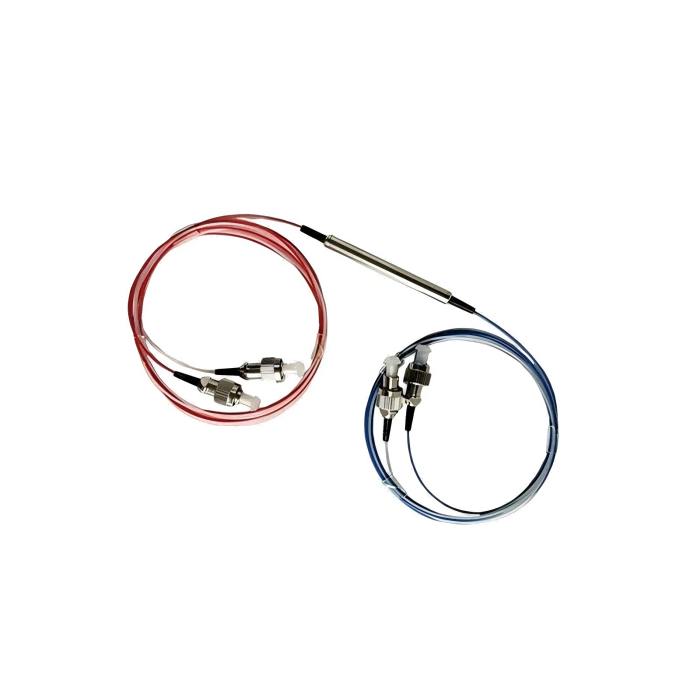
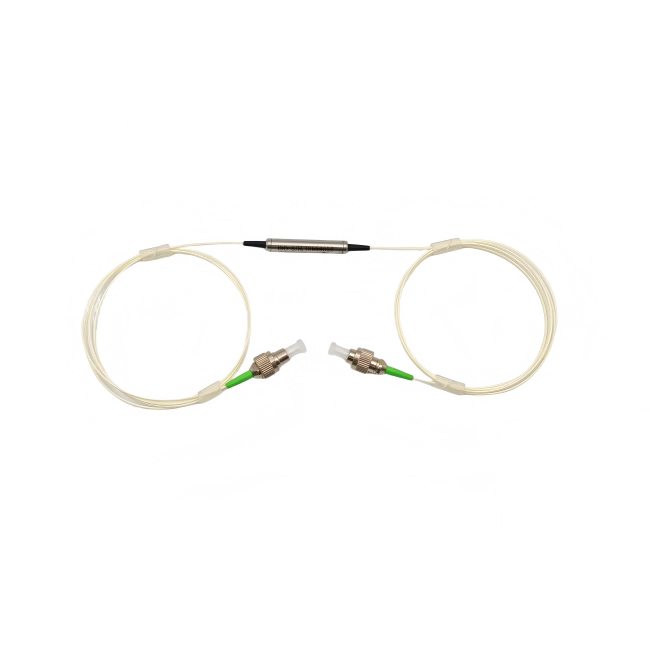
Feiyi’s 3 Port Optical Circulator is published for 1310 +/-30 nm or 1550 +/-30 nm. The product page lists typical insertion loss around 0.6 dB and maximum insertion loss of 0.8 dB, typical isolation of at least 50 dB and minimum isolation of at least 40 dB. PDL is listed at no greater than 0.15 dB and directivity above 50 dB.
The page also publishes maximum power handling of 300 mW and an operating-temperature range from -20 to +75 deg C, with storage from -40 to +85 deg C. Package options include cylindrical 5.5 mm-diameter bodies and a 90 x 20 x 10 mm ABS box. Those figures create a concrete starting point for a sensing or bidirectional link review.
A four-port circulator belongs in systems that need another sequential route
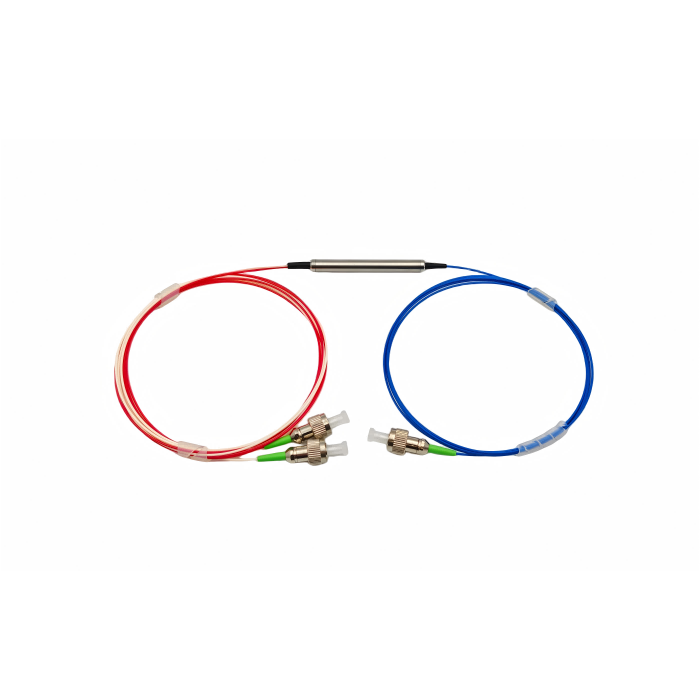
Feiyi’s catalog also lists four-port circulator products. A fourth port can extend the sequential routing path, but it also changes how the system is tested and labeled. A buyer should move to a four-port configuration only when the optical architecture genuinely uses the additional route.
For a replacement project, compare the old route diagram rather than the number of fiber leads visible in a photograph. Some components can have multiple pigtails without providing circulator behavior. The functional drawing is the safest way to identify the correct family.
Optical circulator manufacturer selection should keep isolation and directivity distinct
Isolation describes suppression between specific undesired port directions, while directivity describes leakage between non-sequential ports. Both matter in a circulator because a receiver may sit next to a much stronger launched signal. The buyer should identify which unwanted path is most critical in the system rather than requesting “high isolation” without a measurement direction.
A weak return signal can make leakage more important than a small loss difference
In distributed or reflective sensing, the returned signal can be much weaker than the outgoing pulse. Leakage from the source path can then contaminate the receiver. A circulator with appropriate isolation and directivity is essential even if its insertion loss consumes part of the link budget.
In a short laboratory setup with a strong reflection, the balance can change. The engineer may place more emphasis on forward insertion loss because receiver dynamic range is less demanding. Neither project proves that one circulator specification is universally better; it shows why system context must be included in the RFQ.
Return loss and connector polish belong in the same reflection discussion
Feiyi’s ordering information lists FC/PC, FC/APC, SC/PC and SC/APC among connector options. A system sensitive to reflections may use APC interfaces where mating hardware supports them, while another instrument may require UPC/PC compatibility. The connector choice should be made with the full link in mind.
A high-performing circulator cannot compensate for dirty or damaged connectors. Incoming optical measurements should therefore follow end-face inspection and cleaning. If a device is tested with temporary adapters, record that setup so later measurements can be compared.
Standard and PM optical circulators serve different polarization requirements
Feiyi publishes both standard and PM circulator families. The PM versions add extinction-ratio and working-axis requirements because the system must preserve a defined polarization state. The standard product can be the better fit when only directional routing matters.
Do not pay for PM complexity when the receiver is polarization-insensitive
A conventional telecom or sensing path may use single-mode fiber and a receiver that does not depend on polarization orientation. In that case, specifying a PM circulator adds fiber-axis requirements that the system does not need. A standard circulator keeps the BOM simpler.
Conversely, a fiber gyroscope, polarization-sensitive interferometer or coherent laboratory setup may require the PM family. Feiyi’s PM circulator manufacturer guide covers the extra axis and extinction-ratio decisions for those systems.
Wavelength-specific circulator approval should not be copied between 1310 and 1550 nm
The Feiyi standard three-port page publishes both 1310 and 1550 nm variants, but an OEM should still preserve the exact wavelength in the approved part record. Sources, detectors, filters and test equipment around the circulator are wavelength dependent. A 1310 nm sample does not automatically validate a 1550 nm build.
A field-replacement program should label wavelength on the product record and package
Two cylindrical circulators can look nearly identical. If a maintenance organization stocks both 1310 and 1550 nm parts, the package label and ERP description should include the wavelength. That reduces the chance that the technician installs the correct physical form with the wrong optical band.
For bare-fiber variants, labeling becomes even more important because there may be no connector color or boot style to distinguish them. Port labels and wavelength should survive repacking and field transport.
Three-port packaging can hide three very different passive functions
A circulator, a three-port WDM and a fiber isolator with pigtails can all appear as small cylindrical components. That visual similarity is why replacement sourcing should begin with the optical function. A circulator routes sequentially by propagation direction. A WDM sends different wavelengths to different ports. An isolator suppresses reverse propagation rather than preserving it for another receiver.
Use a circulator when the return signal is valuable and must reach another receiver
In a reflective sensor, the returning light contains the measurement, so the system cannot simply block it. The circulator sends the launch toward the sensing path and directs the return to the detector. That is fundamentally different from an isolator placed in front of a laser, where the unwanted return is suppressed to protect the source.
If the returned signal is at a different wavelength from the launch, a WDM may also appear in the same system. The engineer should then draw wavelength routing and directional routing separately. One device does not automatically replace the other.
Power and environmental limits should be checked at the circulator location
The Feiyi three-port page publishes 300 mW maximum power handling, -20 to +75 deg C operating temperature and -40 to +85 deg C storage. Those limits are properties of the published device family, not universal values for every circulator. A buyer should compare them with the optical power and environment at the actual component location.
If an amplifier is added upstream, the circulator power may increase even though the wavelength and route stay unchanged. If an instrument moves from a laboratory into an outdoor enclosure, temperature qualification may also need review. Treating these system revisions as optical-component changes helps keep an approved circulator from being used outside the conditions that supported its original selection.
Incoming inspection should reproduce both sequential routes
For a three-port product, verify the intended port 1-to-2 transmission and port 2-to-3 transmission. Then measure isolation in the unwanted directions according to the approved test. Recording only the lowest insertion-loss path does not confirm that the circulator routes a returning signal correctly.
Port identity comes before insertion-loss numbers
Start with physical labels and a low-power source. Confirm that each lead corresponds to the route drawing. Then perform insertion-loss, isolation and return-loss measurements at the specified wavelength. This sequence catches a labeling or fixture error before the team interprets an impossible optical result.
If the device is connectorized, the receiving procedure should include connector inspection. If it is bare fiber, document the temporary splice or launch. The goal is to make repeat measurements comparable from the engineering sample to later production lots.
Packaging should preserve the route labels that make the circulator usable
Feiyi’s public product page does not state one universal packaging method for every circulator configuration. Buyers should therefore agree how ports, wavelength and connector type will be identified on the actual order. This is particularly important when several circulator variants arrive in the same shipment.
For OEM assembly, a short port label near each pigtail can reduce wiring errors. For a distributor, a sealed inner package with the exact wavelength and configuration helps prevent visually similar products from being mixed after receipt.
Choose a standard optical circulator when direction matters but polarization does not
Feiyi’s 3 Port Optical Circulator is a direct starting point for 1310/1550 nm directional routing. Buyers can also review the broader circulator range. If the project requires a defined polarization axis, move to the PM circulator family rather than trying to add a polarization requirement to a standard device.
The passive-component BOM guide helps distinguish a circulator from an isolator, WDM or splitter when several small fiber devices appear in the same assembly. The final circulator order should still remain simple and measurable: wavelength, sequential route, insertion loss, isolation/directivity, power, fiber, connector and package.