Specify the Useful Ring at the Target Plane With a Tapered Lensed Fiber Manufacturer
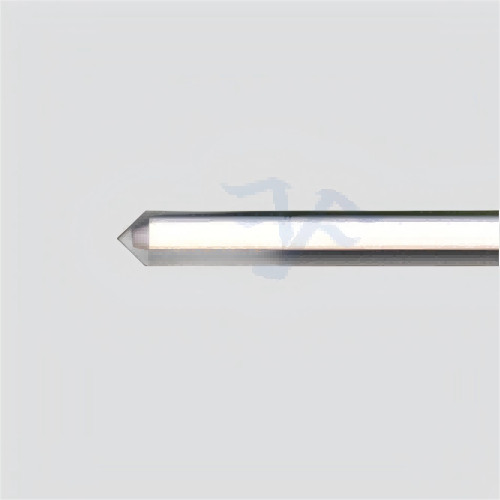
A bright ring in a supplier image is not an illumination specification. The useful question is where that ring lands in your assembly and how much of its light reaches the intended region. A tapered lensed fiber manufacturer needs the target plane, fiber choice and mounting conditions before a sample can be evaluated meaningfully. Feiyi’s tapered lensed fiber lists a ring-shaped far-field spot and an apex-angle range of 60–120 degrees. Start with that stated optical job, then define the ring required by your receiving geometry.
This is relevant to an illumination designer using light around a central obstruction or within an annular receiving region. It is a different selection from a laser-package engineer seeking a concentrated coupling spot. Both may ask for a tapered fiber, but accepting one from the name alone can lead to a sample that produces the wrong useful pattern.
A tapered lensed fiber manufacturer needs the ring’s receiving plane
Consider a compact illumination assembly with a shaped fiber end held behind an opening. The receiving region sits a defined distance away and accepts light over a limited radial area. The taper’s listed ring-shaped far field is a relevant starting point, but the engineer still needs the ring position, width and accepted power at that actual plane. A photograph taken at another distance cannot establish those requirements.
Give the manufacturer a drawing showing the optical tip, the receiving plane and any aperture between them. Mark the useful inner and outer radii or equivalent dimensions. Distinguish desired light in the annular region from light outside it. The Feiyi product does not publish a universal ring diameter or uniformity number, so those become sample requirements to discuss rather than figures to infer from the apex-angle range.
The taper’s 60–120 degree apex range is not an optical divergence guarantee
The apex angle describes the shaped end geometry. The useful light distribution also depends on fiber properties, wavelength, launch and the full optical arrangement. Do not equate a 60-degree geometric apex with a 60-degree outgoing cone. Ask for the proposed geometry and a measurement definition at the target plane so the supplier and buyer are evaluating the same optical result.
A target radius can help express the requirement, but it does not uniquely select the taper. Even a simple geometric relationship between output angle and distance assumes a defined ray or beam description. The supplier should evaluate the actual proposed fiber and tip configuration. Use the receiving dimensions as the engineering target instead of choosing an apex angle by a calculation that omits the fiber and wavelength.
The tapered fiber’s SM, MM or PM choice changes the sample question
Feiyi offers single-mode, multimode, polarization-maintaining or customized fiber choices for this tapered product. The order should identify which is appropriate for the source and optical assembly. A multimode illumination request and a PM laser-interface request need different launch and state definitions. The availability of several fiber classes does not mean their emitted distributions are interchangeable at the same shaped end.
For a multimode illumination designer, preserve the intended launch condition during sample evaluation. A changed launch can make comparisons difficult to interpret. For a PM-based system, retain the axis reference where polarization matters to another element. A ring-shaped intensity distribution alone does not prove that the required polarization interface is correct.
Custom stripped length determines where the tapered end can be supported
The Feiyi tapered-fiber description offers customization of fiber length and stripped coating length. Specify the support position, the exposed optical end and the clearance to the receiving assembly. The stripped length should let the fixture retain the fiber without placing an assembly load on the shaped tip. A mechanically unusable sample is not rescued by a promising far-field pattern.
The product describes processing directly on the bare fiber without auxiliary adhesives, and direct coating on its endface. These are stated features of the supplied fiber end. They do not establish the bonding method used by your complete illumination package. If the finished assembly adds adhesive, a sleeve or a seal, evaluate that interface separately rather than describing the whole device as adhesive-free.
A ring-forming taper should not be substituted for a concentrated coupling tip
A laser-package engineer may need a small receiving mode or an asymmetric coupling interface rather than an annular illumination pattern. Feiyi’s wedge lensed fiber identifies DFB laser coupling, with a radius range of 8–12 µm and a 60–120 degree wedge-angle range. That is a different discussion from acceptance of the tapered product’s ring-shaped far field.
The important contrast is the optical job, not which shape sounds more advanced. For the coupling request, describe the source mode, receiving mode and rotational reference. For the illumination request, describe the useful region at its plane. A ring-forming taper should not be approved using a coupling-efficiency result for another shaped fiber, and a wedge should not be promised to reproduce an annular distribution from its name.
Flat-top and rectangular fiber outputs belong to different target regions
Feiyi’s two-faceted lensed fiber lists a flat-top far-field pattern. Its four-faceted or pyramidal fiber lists a rectangular spot. These are alternatives when the intended receiving area calls for those distributions. They do not represent upgrades to a taper whose task is specifically to illuminate a ring.
An OEM comparing samples should define one useful target per proposed shape. Measuring only total emitted power can overlook whether the light reaches the intended region. A flatter distribution across a filled area may suit one receiver while wasting power outside an annular target. Explain the useful receiving geometry to the manufacturer before asking which end shape should be developed.

The illumination sample should be measured where the installed fiber will work
Define the source wavelength, fiber launch, tip position and receiving-plane distance before comparing taper samples. Use the same fixture and observation method when the purpose is to compare apex geometry. If the source launch and tip spacing change at the same time, the observed difference cannot confidently be assigned to the taper. A controlled comparison is more useful than several unrelated attractive spot images.
Specify how the ring is evaluated: useful radial region, allowable variation around the circumference and light falling outside the intended region, where relevant to the project. These are requested acceptance definitions, not published Feiyi numerical guarantees. Agree which are mandatory and which can be refined during sample development. That gives the manufacturer a concrete optical target without pretending that a single catalog shape defines the final result.
Ring eccentricity should be separated from fiber-tip mounting error
If the ring appears displaced from the mechanical target, examine tip position and tilt as well as the proposed optical geometry. A correctly shaped fiber mounted off-center can fail the illumination task. Preserve a mount reference in the sample record so a new fixture position is not mistaken for a manufacturing change. The acceptance should identify the condition under which the useful ring is expected.
OZ Optics’ tapered and lensed-fiber guidance explains why shaped-fiber requirements depend on the application. Its focusing examples are not ring-size specifications for Feiyi’s taper. Edmund Optics’ beam-propagation discussion is useful background for defining a measurement plane, but a ring-forming output should be characterized as its own distribution rather than assumed to be a Gaussian spot.
An angled fiber solves a turning route, not an annular acceptance requirement
Feiyi’s angled lensed fiber lists 8-, 30-, 45- and 60-degree angle options and applications involving path deflection. It is relevant if the assembly must redirect light toward another region or around a mechanical obstruction. A taper’s ring-shaped output and an angled fiber’s turning task should not be merged into one unconfirmed requirement.
For an illumination designer with a central obstruction, first determine whether the useful path needs a ring around it or a redirected side path. Those are different receiving geometries. If the project needs both, provide the complete arrangement as a custom feasibility question. Do not claim that a standard tapered tip automatically supplies a side-deflected pattern simply because another lensed-fiber family does.
The tapered entry lists an operating-temperature interval of −40 to +85 °C and a humidity interval of 0–85% RH. Define the actual environmental conditions for the selected sample, including whether the assembly adds another interface that changes the requirement. The listed endoscope-illumination application does not establish finished medical-device approval, sterilization suitability or a patient-contact material claim.
Protect the exposed taper during shipment so the shaped end cannot touch the container or carry a pulling load. Agree the exposed-length support and end identification for the requested sample. If a connector is selected from the listed FC, LC, SC or SMA options, keep its protection separate from the shaped end’s protection. A cap on the connector does not protect the optical tip at the other end.
A ring-pattern sample needs an accepted radial region, not a camera exposure preference
If sample approval uses an image, preserve the observation plane and measurement settings that make the comparison meaningful. A bright exposure can conceal low-light portions of a ring or saturate its stronger region. Describe the useful annular dimensions and the selected source condition alongside the image. That way a camera picture supports the optical requirement rather than becoming the requirement itself. Feiyi’s ring-shape description does not establish a particular camera-dependent brightness.
For a target with a central opening, specify whether light entering the opening is useful or wasted. For a target with an outer aperture, identify where clipping begins. Those dimensions determine whether the proposed taper sends enough of its pattern into the receiver. A large ring may look impressive while missing the usable area; a small one may illuminate the center instead of the intended annulus. Return that geometry to the sample request.
Compare the tapered sample with the two-faceted alternative only when the target definition actually allows both. A filled-area receiver might favor the listed flat-top pattern, while an annular receiver may favor the taper. Keeping the receiver unchanged makes the difference informative. Comparing each tip with a different target would not establish which one serves the intended assembly, even if both samples show attractive patterns in their respective setups.
For a repeat order, preserve the approved fiber, apex geometry, stripped length, connector selection and measurement-plane definition together. If the mount spacing changes, review the useful ring at the new plane before calling the previous sample approval transferable. This is a change to the taper’s optical job, not merely a mechanical drawing update. The manufacturer should see the changed target rather than being asked to reproduce an obsolete appearance.
Feiyi’s lensed-fiber discussion provides additional context for shaped ends. For your ring-illumination project, make the sample decision at the receiving plane with the intended source and mount. Accept the taper when the useful annular region is demonstrated under those agreed conditions, rather than when the end shape merely resembles the drawing.