
Optical Passive Components Supplier: A Distributor Stocking Strategy That Avoids Duplicate Inventory
An optical passive components supplier is often evaluated by a distributor very differently from an engineering team buying one fixed assembly. The distributor has to decide which products deserve shelf space, which variants should remain build-to-order, and how to avoid stocking several parts that look different but serve the same customer need. The useful starting point is therefore not a long product list. It is a stocking map organized by optical function, common wavelength, connector preference and installation format.
Feiyi’s passive portfolio spans WDM products, circulators, optical isolators, mechanical switches, variable optical attenuators, PLC splitters, couplers, pigtails and collimators. The range also includes polarization-maintaining versions for projects that cannot use ordinary single-mode components. For a distributor, this makes it possible to build a layered inventory: common single-mode items for routine network and test jobs, then more specialized PM or dense-WDM products against defined customer demand.
An optical passive components supplier should help distributors separate stock items from configuration items
Some passive components have a manageable number of common variants. Others explode into many combinations of wavelength, connector, port count, fiber length and package. A distributor that tries to stock every combination ties up cash without improving service. The better approach is to identify the parameters customers decide early and the parameters that can remain configurable until an order arrives.
Mechanical optical switches are stocked by route pattern before connector detail
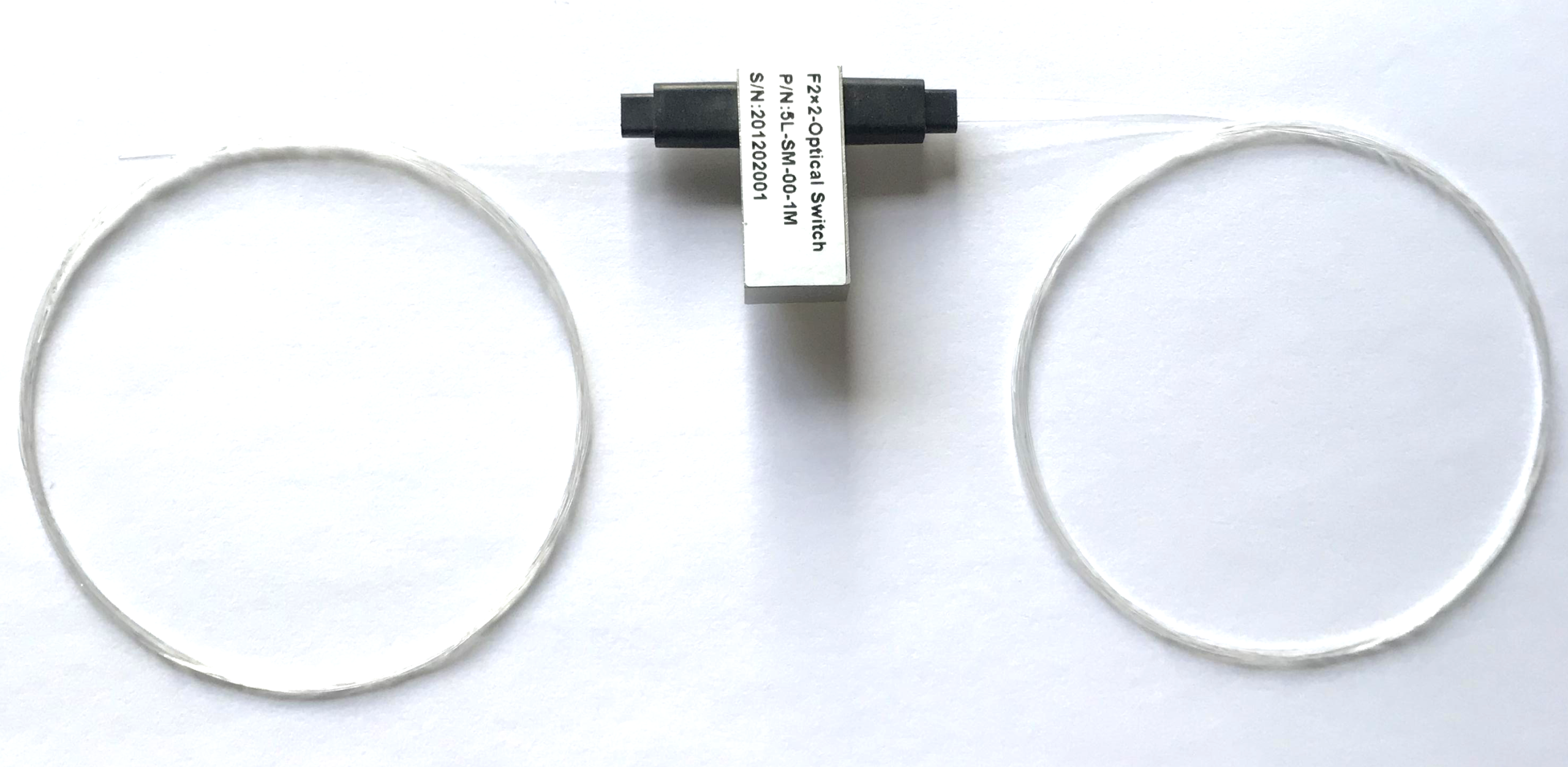
Feiyi’s mechanical switch family includes 1×1, 1×2, 1×4, 1×8, 1×10, 2×2 and rack-mounted configurations. The F2x2 mechanical switch operates at 850 +/-40 nm or across 1260-1650 nm depending version. Its single-mode specification lists typical insertion loss of 0.6 dB, maximum 0.8 dB, return loss of at least 50 dB, crosstalk of at least 70 dB and switching time no greater than 8 ms. It supports 3 V or 5 V drive and latching or non-latching behavior.
For stocking, route topology and control mode should be decided before a long connector matrix. A test-equipment reseller may see steady demand for 1×2 and 2×2 paths, while a protection-system integrator may ask for a specific latching state. Those patterns justify stocking the core switch or standard assembly. Connector and fiber-length variations can be handled against demand when the customer’s installation practice differs.
Circulators and isolators should not share one inventory label
Distributors sometimes group both devices under “directional components,” but their customer problems are different. Feiyi’s three-port circulator routes light from one port to the next and is published for 1310 +/-30 nm or 1550 +/-30 nm operation. An optical isolator, by contrast, is selected to suppress reverse light before it reaches a laser or amplifier.
If inventory is organized only by wavelength and package size, a salesperson can easily offer the wrong function. A more useful internal code distinguishes routing from source protection. Common 1310 nm and 1550 nm directional products may both deserve stock, but they should remain separate families in the ERP and on shelf labels. A buyer who needs reflected-signal routing should be directed toward a circulator; a buyer protecting a source should be directed toward an isolator.
Optical passive components supplier inventory for WDM should follow channel density and package format
Wavelength-management products are especially poor candidates for one-size-fits-all stocking. Feiyi offers CWDM, DWDM, FWDM, OADM and AWG products. A distributor should first separate coarse-grid access products from dense-grid transport products, then decide which channel counts and package forms appear repeatedly in its customer base.
4CH, 8CH and 16CH CWDM create three distinct inventory tiers
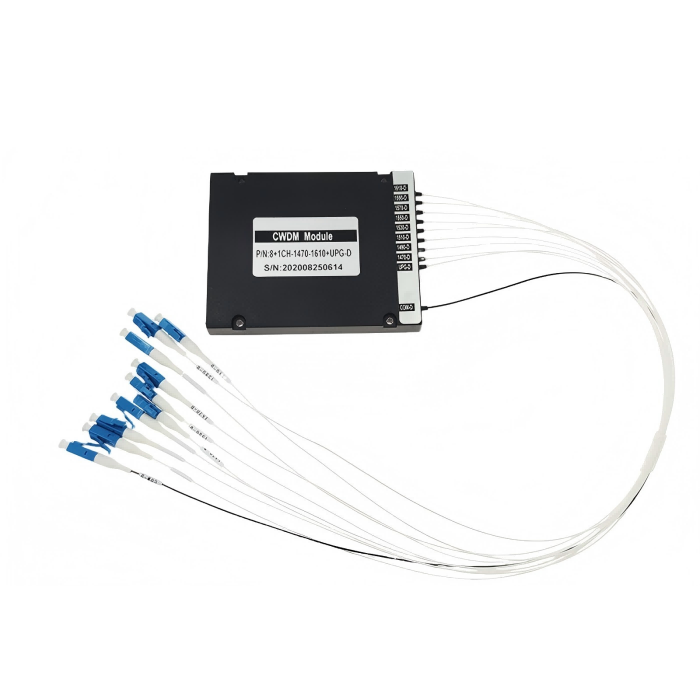
Feiyi’s CWDM Mux/Demux family uses 20 nm channel spacing across 1270-1610 nm or 1271-1611 nm. The published table gives insertion-loss limits of 1.5 dB for 4 channels, 2.5 dB for 8 channels and 3.5 dB low-loss or 4.5 dB standard for 16 channels. Adjacent isolation is at least 30 dB and non-adjacent isolation at least 40 dB.
Those products can be delivered in ABS-box, LGX and 19-inch rack forms, with LC, SC or FC connectors and UPC/APC polish options. A distributor serving small access links may stock compact 4CH or 8CH modules while leaving 16CH rack assemblies configured to order. A systems house doing repeated cabinet deployments may do the opposite and standardize one rack format. The useful inventory decision is driven by how customers install the product, not just by which channel count is largest.
Dense DWDM and AWG modules are better controlled by project frequency plans
Feiyi publishes DWDM modules, 1U rackmount DWDM products, LGX modules, OADM devices and athermal AWG products. These are better suited to project-controlled inventory because channel spacing and frequency plans can be much more specific. The 48-channel 100G athermal AWG, for example, is published on a 100 GHz ITU grid covering 191.7-196.4 THz, with center-wavelength accuracy within +/-0.05 nm.
A distributor should avoid buying a dense module simply because a customer said “48 channels.” The requested start channel, spacing, mux/demux direction, connector and package still have to match. Holding a small demonstration or engineering quantity may make sense, while full project quantities should follow a confirmed channel plan.
PLC splitters should be stocked by installation format as well as split count
Feiyi lists PLC Splitter – Mini, PLC Splitter – Insert Type and PLC Splitter – ABS Box products. Those names describe a physical difference that matters in the field. A mini unit fits compact internal installations, an insert type supports modular handling, and an ABS box provides a protected module format.
Distributors can reduce duplicate PLC stock by starting from enclosure use
An installer working inside a crowded splice tray has a different requirement from a contractor replacing a plug-in module in a cabinet. If a distributor stocks split ratios without recording where the product will be installed, it can end up with the right optical function in the wrong mechanical format. Internal sales questions should therefore begin with “where does the splitter mount?” before moving to connector and pigtail detail.
This also helps with replenishment. Fast-moving mini splitters can be replenished as one family, while insert and ABS-box versions can be forecast from project history. Feiyi’s PLC splitter category gives buyers a direct view of the available formats instead of forcing them to compare unrelated passive devices.
Collimators and pigtails require a different distributor stocking logic
Feiyi’s collimator family includes single-fiber, dual-fiber, four-fiber, nine-fiber, sixteen-fiber, 25-fiber, 36-fiber and 64-fiber products, along with high-power and long-working-distance options. Its pigtail family also ranges from single fiber to high-count arrays. These products are often tied to an OEM assembly rather than a generic field replacement, so their stocking logic should reflect the application.
Single-fiber interfaces are easier to stock than high-count optical arrays
A single-fiber collimator or pigtail can serve a wider range of laboratory and equipment-building requests. High-count arrays usually have tighter mechanical and channel-specific requirements. For that reason, distributors can keep common single-fiber variants available while treating 16-, 25-, 36- or 64-fiber versions as engineering orders unless repeat demand is proven.
The same applies to polarization-maintaining variants. A PM pigtail or PM collimator must carry wavelength and axis information that ordinary single-mode stock does not require. Feiyi publishes separate PM families, including single-, dual-, four-, five-, nine- and sixteen-fiber pigtails and multiple PM collimator formats. Those should not be merged with standard single-mode inventory simply because the mechanical shape is similar.
VOA inventory should reflect how customers control optical power
Feiyi’s passive range includes single-mode fiber variable optical attenuators, an online adjustable VOA and a MEMS VOA. A repair shop replacing a fixed instrument part may need one package style, while a laboratory reseller may need an adjustable device for test benches. The distributor should understand whether the customer wants manual adjustment, system control or a specific optical package before choosing what to hold in stock.
Power-control components also need to be kept separate from loss specifications elsewhere. A VOA deliberately creates attenuation. High insertion loss in a switch, WDM or circulator is an unwanted penalty. Stock descriptions and sales training should make that difference obvious, especially when customers are trying to diagnose low received power.
Supplier documentation can make distributor inventory much easier to control
For each stock family, the distributor should preserve the manufacturer’s product name, wavelength range, port topology, connector/polish, package and any electrical requirement. For configurable products, a short option code sheet prevents sales staff from promising a variant that has not actually been defined. For repeat OEM orders, keep the approved drawing or ordering string together with the original sample record.
Incoming checks should follow the family. Switches need route-state and drive checks; WDM modules need channel and port-label checks; PLC splitters need enclosure and output-count checks; circulators need port-direction checks; collimators need the agreed optical/mechanical interface. One generic incoming form may be convenient administratively, but it should point to family-specific acceptance items.
Feiyi states on its About page that the company was established in 2014, has production bases in Shenzhen and Shaoguan totaling about 6,000 m2, and is ISO9001:2015 certified. A distributor can use those company facts for supplier qualification, then use product-level documents for item qualification. The two records should remain distinct.
Packaging instructions should follow what the distributor will reship
A stocking distributor often receives a component, stores it, and ships it again without opening the optical package. That makes identification and protection part of the inventory design. Connectorized CWDM modules need clear port and connector labels; bare-fiber or pigtail products need protection against sharp bends and contamination; multi-fiber products need channel identification that remains readable after storage. Feiyi’s public product pages describe product configurations but do not publish one universal packing method for every family, so distributors should agree the required labeling and protection for the actual stocked item.
It is also useful to separate shelf-life administration from optical acceptance. When a repeat batch arrives, compare the product code, wavelength, connector and package with the approved stock record before the cartons are distributed to branch warehouses. If the supplier has changed a pigtail length or connector polish by request, that change should travel with the inventory record. This avoids a situation where two visually similar units are combined under one SKU even though an installer would treat them differently.
Build the passive component shelf around recurring customer decisions
A practical distributor range does not need every option on day one. Start with the route topologies, wavelength families and installation formats that customers repeatedly request. Keep common CWDM modules, standard directional components or common splitters where demand supports stock. Leave dense DWDM grids, high-count collimator arrays and unusual connector combinations tied to project orders.
Useful Feiyi starting points include the passive-device range, WDM products, optical switches and collimators. For a deeper look at how a mixed passive BOM should separate functions, the passive-component manufacturer BOM guide provides the engineering view that complements this distributor stocking approach.
The result should be an inventory that answers real customer choices quickly without pretending that every passive component is a commodity. Function first, then wavelength, topology, package and connector: that sequence keeps the shelf useful and the special configurations under control.