
PM 1064nm Circulator Supplier: Lock the Laser Band and Return Path Before Production
A PM 1064nm circulator supplier should receive the optical route before the connector list. At 1064 nm, the buyer is often integrating a polarization-sensitive fiber laser, amplifier, sensing head or test instrument in which the launched axis and the returned signal both matter. Feiyi’s PM 1064nm Circulator is presented for optical amplifiers, fiber sensing, instruments, dispersion-compensation arrangements and bidirectional communication. Its ordering information identifies 1064 nm, PM1060 or PM980 fiber choices, common FC/SC connector finishes and several fiber-length options.
The first procurement decision is therefore not “FC/APC or FC/PC?” It is whether the source band, polarization axis and Port 1 → Port 2 → Port 3 route are defined clearly enough for the supplier to build the same optical function that the engineering bench used. Only after that should the buyer freeze connector polish, pigtail protection and finished length. Feiyi’s nearby PM 1064nm Fiber Optic Isolator, PM 1064nm Collimator and PM 1064nm Optical Patch Cord solve different jobs, so the bill of materials should identify the circulator’s directional routing role explicitly.
A PM 1064nm circulator supplier needs the laser wavelength and return path on the same drawing
“1064 nm” is a useful product-family label, but a production drawing should still show the source wavelength range expected in use. The Feiyi ordering block identifies 1064 nm as the wavelength selection. Industry documentation for other 1064 nm PM circulators also treats wavelength range as a controlled parameter rather than assuming every 1 µm source is equivalent. For example, Comcore’s 1064 nm PM circulator documentation specifies a dedicated 1064 nm product and separates optical performance from connector and pigtail choices.
A buyer moving from a narrow-line laboratory source to a different laser module should recheck the band rather than carrying over the old item name. The same applies to a supplier change. “PM circulator, 1064 nm” is not a complete interchangeability statement; the optical route, working axis, fiber and acceptance conditions need to travel with the item.
Port 1 → Port 2 → Port 3 should be shown with arrows, not inferred from a three-port symbol
Feiyi’s PM circulator family uses a Port 1 to Port 2 to Port 3 route. In a reflective sensor or fiber-Bragg-grating arrangement, launched light can travel from the source through Ports 1 and 2 while the returning light is directed toward Port 3. Draw those arrows in the controlled schematic. A technician reading only three connector labels cannot tell which port is expected to receive the return signal.
This matters when a project is handed from an optics engineer to a contract assembler. A cable harness drawing often describes physical endpoints, while the optical block diagram describes signal direction. The purchase file should connect both views so the assembled unit cannot be wired in a physically neat but optically reversed way.
PM1060 and PM980 fiber options should be matched to the launch condition, not treated as interchangeable pigtails
The Feiyi ordering information lists PM1060 and PM980 fiber alternatives for the PM 1064nm circulator. That choice belongs in the optical design. Coherent’s PM1060-GDF information describes a polarization-maintaining fiber engineered around the 1060 nm region, while its broader PM1060 documentation shows why mode-field and polarization behavior are tied to the selected fiber construction. Those external values are not Feiyi product specifications, but they illustrate why the fiber code is more than a jacket label.
If the rest of the instrument uses PM980 fiber, the splice, mode-field transition and polarization axis should be reviewed as a system. If it uses PM1060, keep that choice consistent through the circulator and any adjoining PM assembly unless an engineered transition has been approved. A supplier should not be asked to choose between PM1060 and PM980 based only on which is available.
The working axis should be referenced at every connector or splice boundary
The Feiyi page identifies fast-axis and slow-axis working choices. The purchase order should state which axis carries the intended polarization and how the connector key or splice reference represents that axis. A PM component can be installed with the correct wavelength and still underperform if the assembly rotates the polarization reference between components.
For an OEM repeat order, keep an axis sketch with the approved sample record. That becomes especially useful when connector types change during a mechanical redesign. The optical axis requirement should remain stable even if the housing, boot or cable routing changes.
A 1064nm PM circulator supplier should keep stage choice separate from connector choice
Feiyi’s product description refers to single- and double-stage configurations. Stage count is an optical architecture decision normally associated with the required isolation and allowed insertion loss; it should not be bundled casually with mechanical options. If a prototype was accepted in one stage configuration, purchasing should not approve a different stage solely because the external package appears similar.
Before a buyer places a volume order, request the current 1064 nm specification revision for the exact stage being quoted. This is particularly important because different wavelength families and different stages can have materially different loss and isolation behavior. Do not copy a numerical acceptance limit from a 1310 nm, 1550 nm or another vendor’s 1064 nm device and attach it to the Feiyi order.
For a fiber-laser engineer, the stage decision should be connected to the amount of backward light the source can tolerate and the forward loss available in the power budget. If the source protection requirement becomes stricter after an amplifier redesign, revisit the circulator stage rather than assuming the earlier build still provides the necessary margin.
The listed 300 mW class should be checked against the final source, including future upgrades
The current Feiyi PM 1064nm product table lists a 300 mW maximum power-handling line. Use the rating documented for the exact quoted configuration and do not substitute a higher number from a market “high-power 1064 nm circulator.” High-power PM circulators are a separate design class; published industry examples span very different power levels and fiber constructions.
A laboratory team may initially run the source at modest power for alignment and then increase output after the optical chain is stable. Procurement should qualify the final operating point, not the temporary alignment level. For pulsed sources, provide pulse width, repetition rate and expected peak power because an average-power statement alone does not define pulse capability.
If the project genuinely requires a high-power device, treat that as an engineering variant and obtain a specification that states the allowed operating conditions. Do not assume that changing only the pigtail or connector converts a standard circulator into a high-power model.
FC/APC, FC/PC, SC/APC and SC/PC belong to the reflection plan for the whole instrument
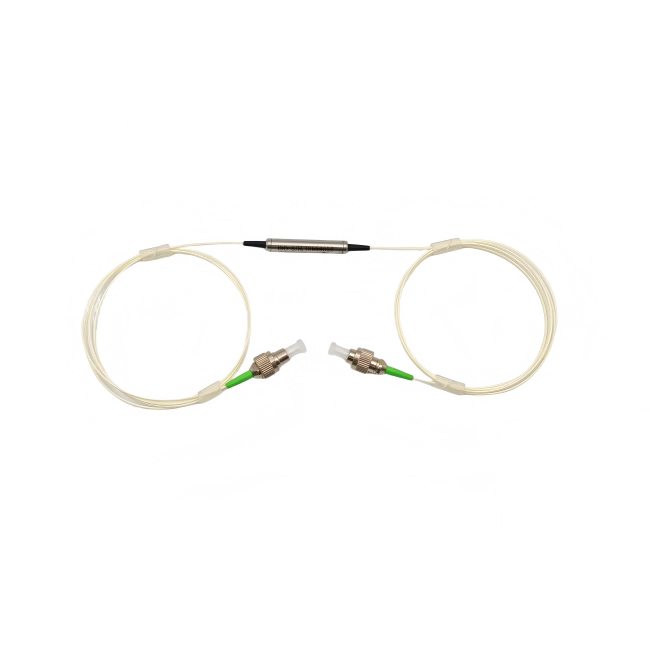
Feiyi lists FC/PC, FC/APC, SC/PC and SC/APC ordering options, plus bare-fiber and jacket choices. Connector selection should follow the adjoining equipment. APC and PC interfaces should not be mated as though the polish angle were merely a naming difference. A laser or interferometric sensor that is sensitive to reflected light should have the reflection strategy documented from source through each mated pair.
Fiber lengths of 0.5 m, 1 m and 2 m are also listed as ordering choices. An OEM should specify finished pigtail length based on the enclosure route and service loop. A distributor stocking several connector variants can reduce picking errors by treating connector polish, fiber type and fiber length as separate item attributes instead of relying on a shared “1064 PM circulator” description.
For a fiber-laser bench
Freeze source wavelength, working axis, stage, power condition and connector reflection strategy. Confirm the current optical acceptance values for the exact stage before release.
For a reflective sensor
Show Port 1 → 2 → 3 direction and detector location. Preserve the PM-axis reference through the return path rather than specifying only connector type.
For distributor stock
Separate PM1060/PM980, connector polish and fiber length in the SKU description. Do not substitute variants on appearance alone.
Companion 1064 nm components should be assigned by optical function before a buyer approves the BOM
Several Feiyi products share the 1064 nm region but should not be collapsed into one “PM device” line. The PM 980/1030/1064nm Coupler splits or combines optical power. The PM 1064nm 1×2 Polarization Beam Combiner/Splitter handles polarization channels. The PM 1064nm Collimator interfaces fiber with a free-space beam. None of those devices substitutes for the circulator’s directional port sequence.
This distinction helps when an engineer sends a supplier a block diagram containing only part numbers. Add the optical job next to each component: “route return light,” “split 90/10,” “combine orthogonal polarizations,” “collimate to free space.” The manufacturer then has a clearer basis for checking whether the requested component matches the intended function.
A PM 1064nm patch cord is the interface between components, not a replacement for a circulator
The PM 1064nm Optical Patch Cord can preserve a controlled PM connection between separate modules, but it does not create non-reciprocal routing. When a service technician sees similar FC/APC ends on a patch cord and circulator pigtail, the BOM should still make the functional difference unmistakable.
Mechanical package and temperature limits should be checked before the 1064 nm module leaves the lab
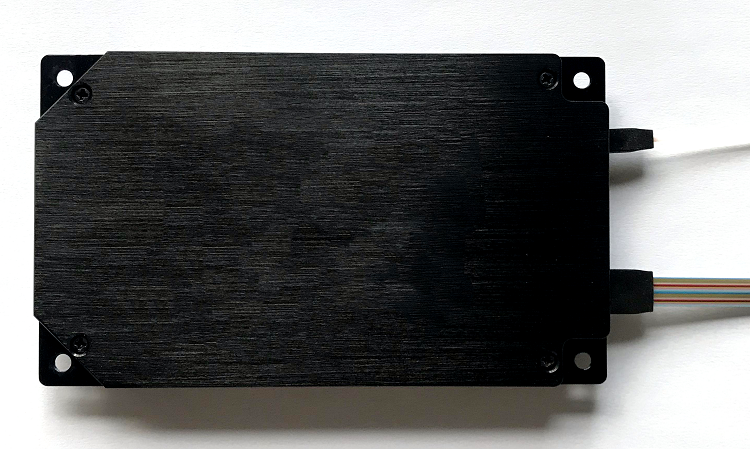
The current Feiyi page lists cylindrical package choices around 5.5 mm in diameter with L35 and L50 body lengths, plus a 90 x 20 x 10 mm ABS-box option. It also lists an operating range from -10 to +75 C and storage from -40 to +85 C. These are not background catalog numbers to ignore after optical testing. The final enclosure must provide enough room for the selected body, pigtail exit and allowed fiber routing, while the environmental requirement must stay inside the condition documented for the ordered build.
A prototype mounted on an open optical table may never reveal a clearance problem that appears inside a sealed instrument. If the production version moves the circulator behind a panel, next to a heat source or into a compact laser head, repeat the mechanical review before ordering the lot. Do not assume that the shorter cylindrical body, longer body and ABS box can be exchanged without affecting mounting and fiber routing.
Receiving inspection should compare the physical build before optical numbers are judged
When a batch arrives, first check the ordered fiber type, connector polish, pigtail length, body style and port labels against the controlled item record. Measuring a unit built with the wrong mechanical or fiber option wastes test time and can hide the real configuration error. Once the physical identity is confirmed, the optical team can apply the current 1064 nm acceptance method for the selected stage.
For shipping between a distributor and an OEM, protect the fiber exits and connector faces so the tested interface is not stressed in handling. The exact factory packing method should be confirmed for the order rather than assumed, but the buyer can still require that labeling keeps the stage, fiber and connector variant distinguishable from visually similar stock.
Repeat-order control should preserve the optical identity that engineering actually approved
After the first production lot passes, keep the approved stage, wavelength designation, fiber type, working axis, connector polish, pigtail length, package and current acceptance values together. A repeat order should not be defined by an old email saying “same 1064 circulator as last time.” The more complete record lets purchasing detect a silent change before a component enters a calibrated laser or sensor.
Feiyi’s broader PM circulator manufacturer guide can be used to compare wavelength and isolation decisions across the family, while the 1550 nm sensor article shows how a return path changes the selection logic in another band. For a 1064 nm project, keep the decision anchored to the actual 1064 nm source and PM interface rather than borrowing the assumptions from those neighboring designs.
The useful handoff is a short controlled package: optical route with arrows, source wavelength range, stage, PM fiber, working-axis reference, power condition, connector polish, fiber length and the supplier’s current acceptance table. Once those items are fixed, the PM 1064nm circulator supplier can quote and build against a configuration that the buyer can verify again at receiving.